
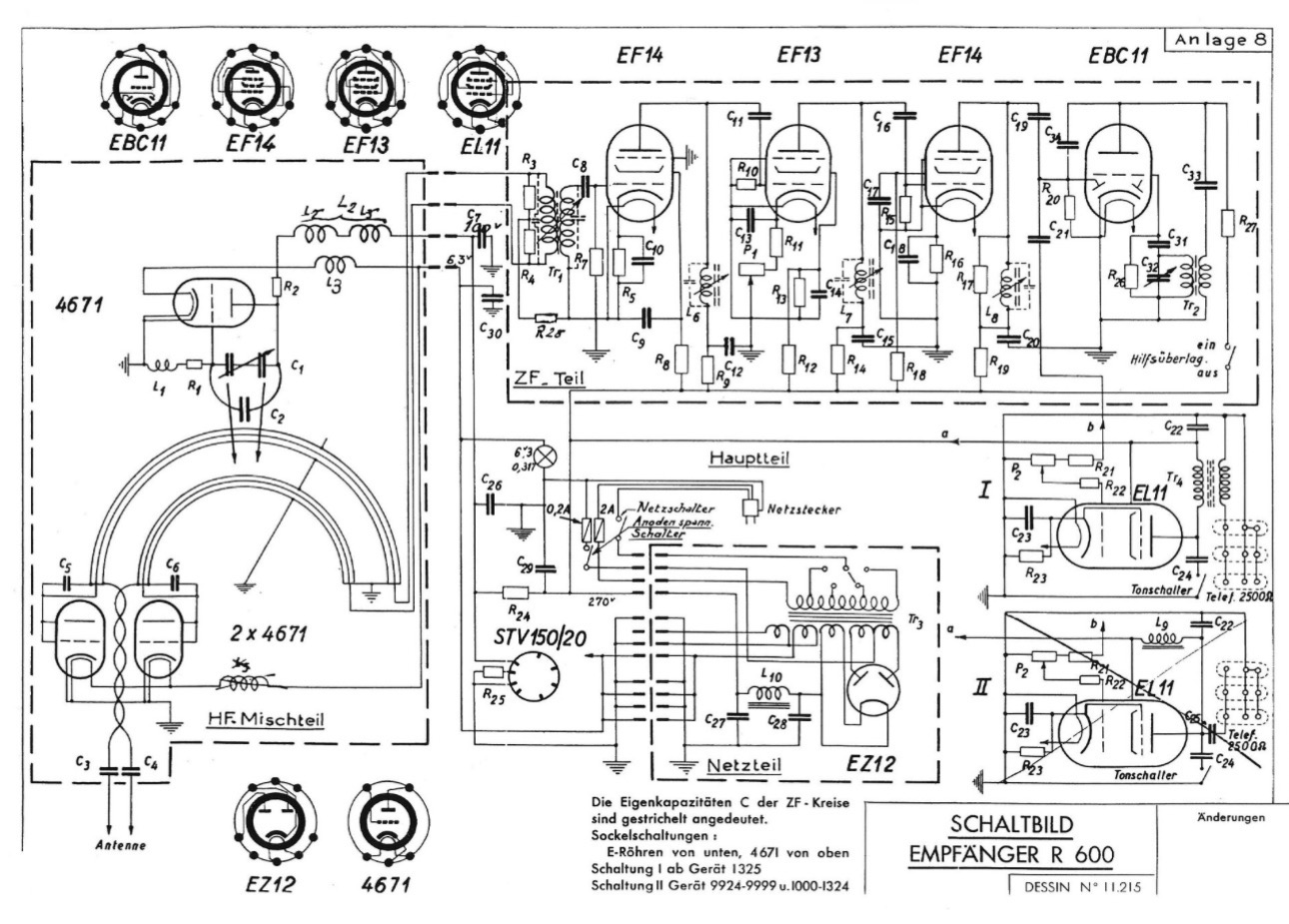
This essay is intended to correct misconceptions about the Metox receiver for German U-Boat detection of English 1.5 meter radar (about 200 MHz).
First, this is NOT a superheterodyne receiver. There is no RF amplifier between the antenna and the mixer stage. It is, therefore, best called a heterodyne receiver. Not super, because it is not very sensitive. The two 4671 tubes on the antenna are wired as diodes. The first detector, to use the language of the time. A non-linear stage is required to translate the incoming RF wave to the intermediate frequency, for amplification, by means of generating sum and difference frequencies with a local oscillator (L.O.). That L.O. is the third 4671 tube. Now, coupling the L.O. to the antenna, as done here through two diodes, will result in some L.O. power, as well as harmonic power, being broadcast out the antenna. This forms a nice non-directional beacon (NDB) transmission from the submarine. Which means the is is effectively a "come get me" signal.
It can be debated as to whether the Navy's understanding as of the latter part of the 1940s was sufficient to build an ADF (airborne direction finder) with sufficient sensitivity to be useful for the purpose of homing in on a submarine using its Metox apparatus while on the surface. Modern signals intelligence hardware would be. All that would be needed is a 200 MHz RF amplifier stage. A common circuit, but requiring a nuvistor (miniature) vacuum tube. Such would also be useful in the Metox to increase its sensitivity, as well as to eliminate the L.O. signal transmission.
The beat frequency is forwarded to the Trf, the intermediate frequency stage input. There is one fairly narrow bandpass Intermediate IF stage filter transformer Tr. There are three IF stage amplifiers, which provide the receiver gain. The amplified signal is then passed through C19. The diode in the EBC11 tube is the second detector. At the input to R21, one would hear a very faint quieting of audio noise when the transmitted RF pulse from the English radar transmitter appears at the Metox antenna. This is not useful for signal discernment. The triode of the EBC11 tube is an oscillator, probably operating near IF stage frequency. It is unlikely that this very low frequency signal would make it to the antenna, and the antenna would reject it for radiation if any did. No NDB action here. The EBC11 oscillator would be strong enough to drive EL11 into non-linear action, if P2 is tuned correctly. That oscillator signal is added through C34, and can be turned off with the switch on R27. Therefore, one would hear the difference frequency of the detected IF signal with post IF oscillator. One would hear through the headset a faint beeping tone, at the PRF frequency of the radar, amongst the static noise. Much improved discernment of a man made signal. As the aircraft grew closer, one might estimate range qualitatively by turning off the post IF stage oscillator, and estimating degree of noise quieting.
Mr. Peshak was an ETR Instructor circa 1975 in the Readiness Command at the Great Lakes Naval Base.
09 July 2026 - New Essay