
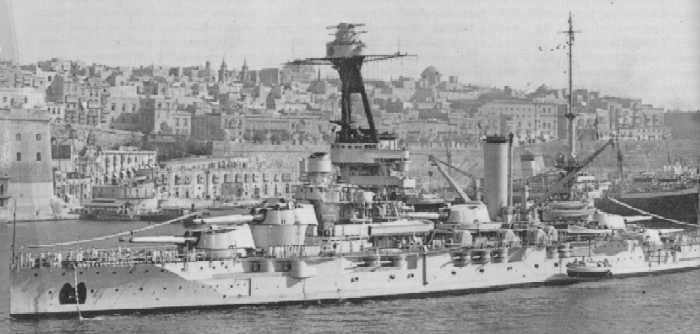
The building of Britain's "Super-Dreadnoughts" prompted France to increase the size of her battleship guns as well. This meant a reduction from twelve main guns to ten, but this was more than offset by the abandonment of wing turrets in favor of having all turrets on the centerline.
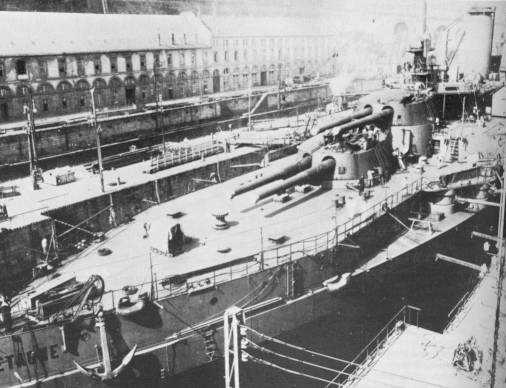
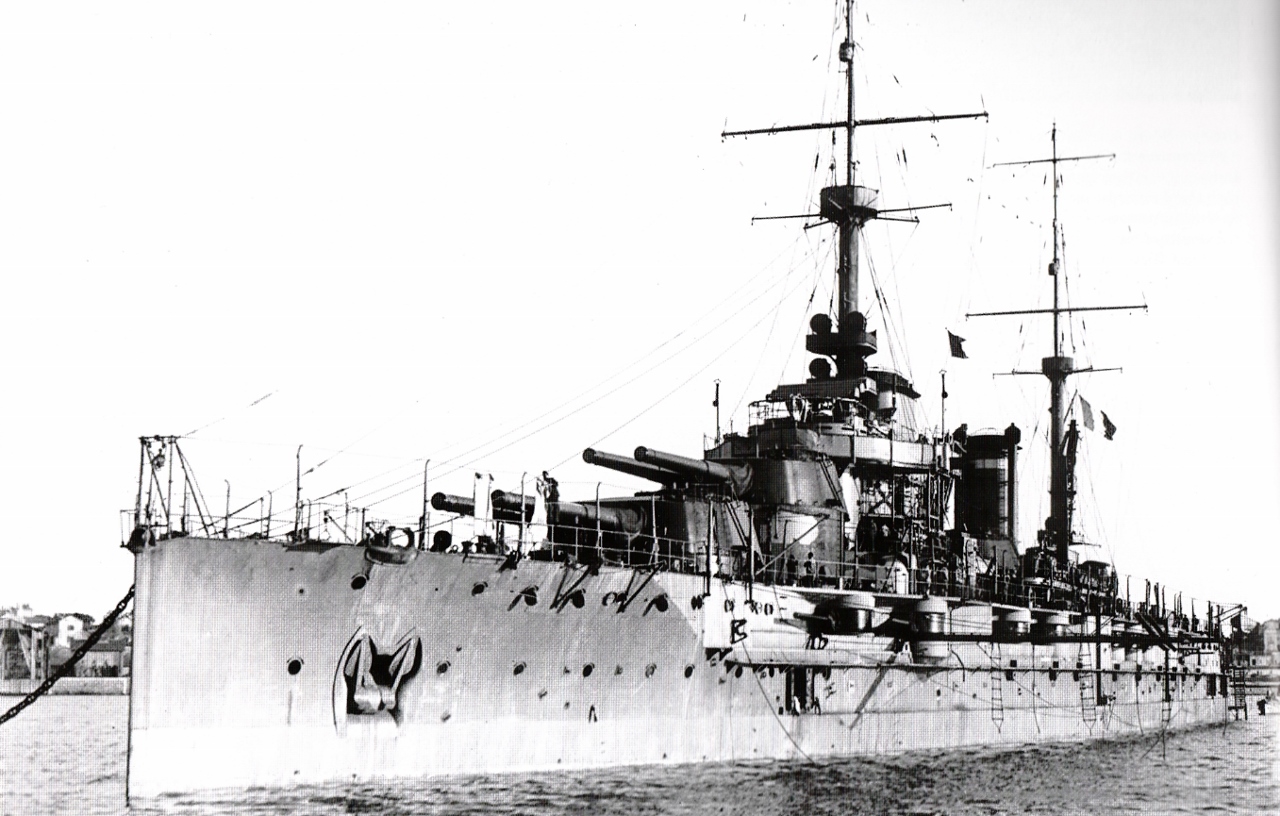
The Model 1912 was the original design and were used on the Bretagne class. These guns were considered to be an excellent weapon by the French, but the ships they were installed on were handicapped by poor fire control and low maximum gun elevations. These low elevations were the result of French thinking that battle ranges would be 10,000 m (10,940 yards) or less. Salvo dispersion at their maximum range of 15,860 yards (14,500 m) was 330 feet (100 m).
The Model 1912M was a slightly modified design intended to be used on the Normandie class which were never completed. Some of the unused guns intended for these ships were used as railway guns while others were later used to rearm the Bretagne class when they were reconstructed in the 1930s. Other spare guns were employed as coast artillery, with four guns in two twin turrets being mounted at Cap Cépet near Toulon. Four additional guns were used with a French version of the German BSG mounting and installed at Plouharnel near Quiberon. After Provence was scuttled at Toulon in November 1942, the Germans removed two guns from her after turrets and used them in Turret F at Cap Cépet to replace two guns that had been sabotaged by the French. These emplacements saw action in August 1944 during the Allied invasion where they were fired upon by the French battleship Lorraine and by USS Nevada (BB-36).
The Type C, an interim designation, was planned for the never-built Lyon class. This would have used the same barrel as the Model 1912M but designed to fire an improved and lengthened APC projectile. No guns were built and a Model Year designation was never assigned.In May 1943 the French proposed to the USA that the incomplete Jean Bart be finished in a US yard as a combination anti-aircraft / carrier platform. Jean Bart had already given up her four operational 380 mm (14.96") guns to re-arm sister-ship Richelieu, so this proposal saw refitting Jean Bart's single main turret with four 34 cm (13.4") guns taken from the old battleship Lorraine together with cradles from the Métline coastal defense battery in Tunisia. All smaller caliber guns were to be removed and replaced with fifteen twin 5"/38 (12.7 cm) mountings and sixteen 40 mm Bofors quad mountings. Six aircraft of either USA Avenger or British Barracuda torpedo bomber types along with US Hellcat or British Seafire fighters were to be carried. A second proposed reconstruction saw removal of all aircraft facilities and the secondary battery increased to seventeen twin 5"/38 (12.7 cm) mountings along with twenty 40 mm quads. This latter design also entailed using eight Mark 37 GFCS and twenty Mark 51 fire control systems. Nothing came of this plan as the USN decided that their resources would be much better spent turning out new ships rather than to use them to rearm an obsolescent foreign warship - the guns and directors were the equivalent of about six Gearing class destroyers. Following this decision, Jean Bart then languished until her postwar rebuild in France.
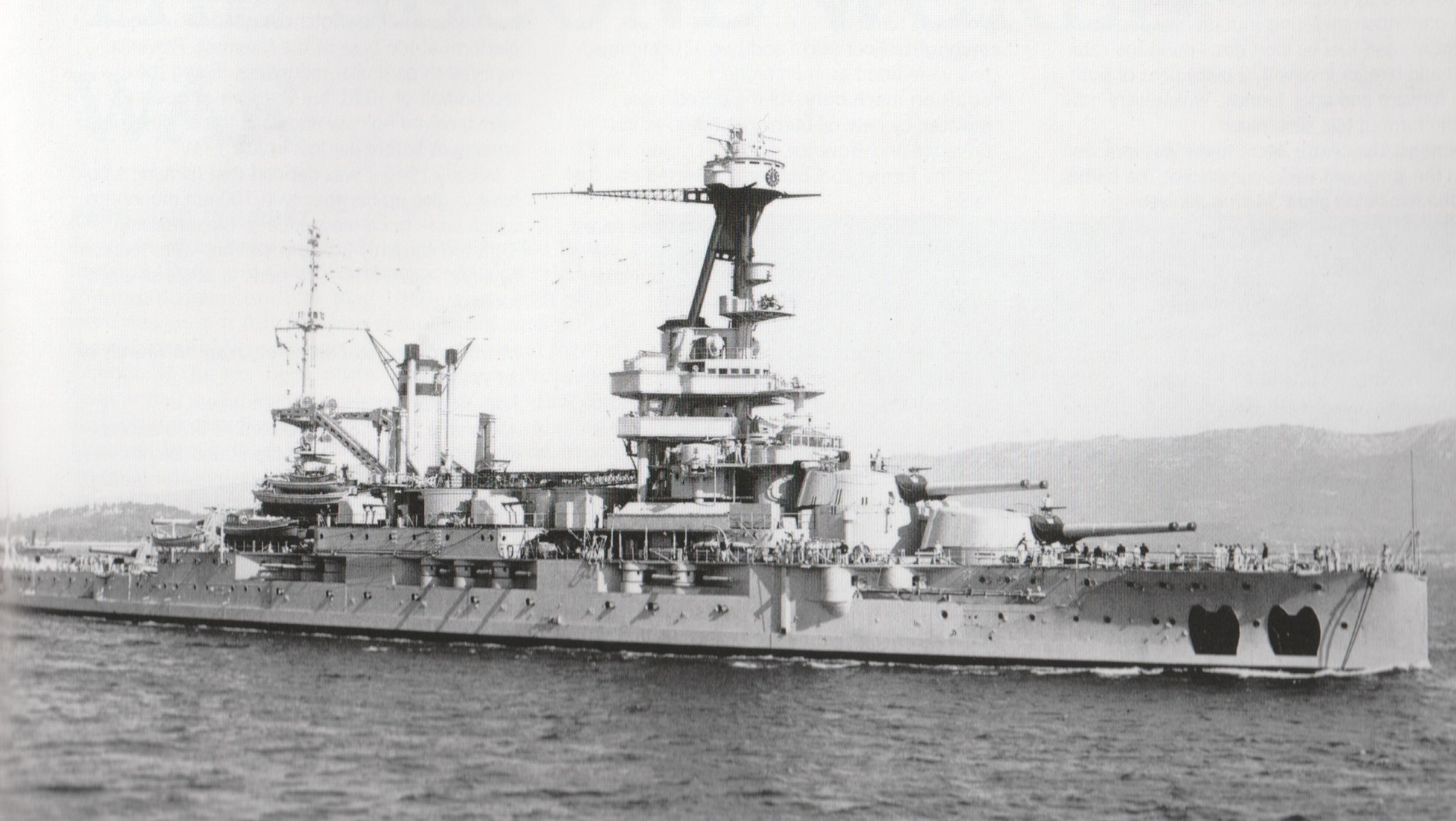
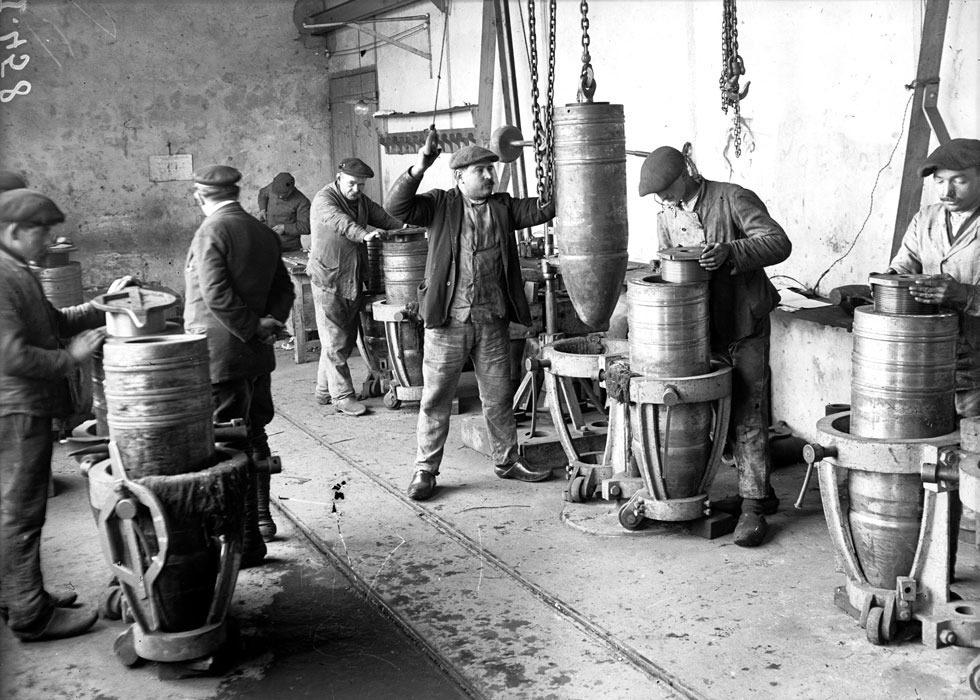
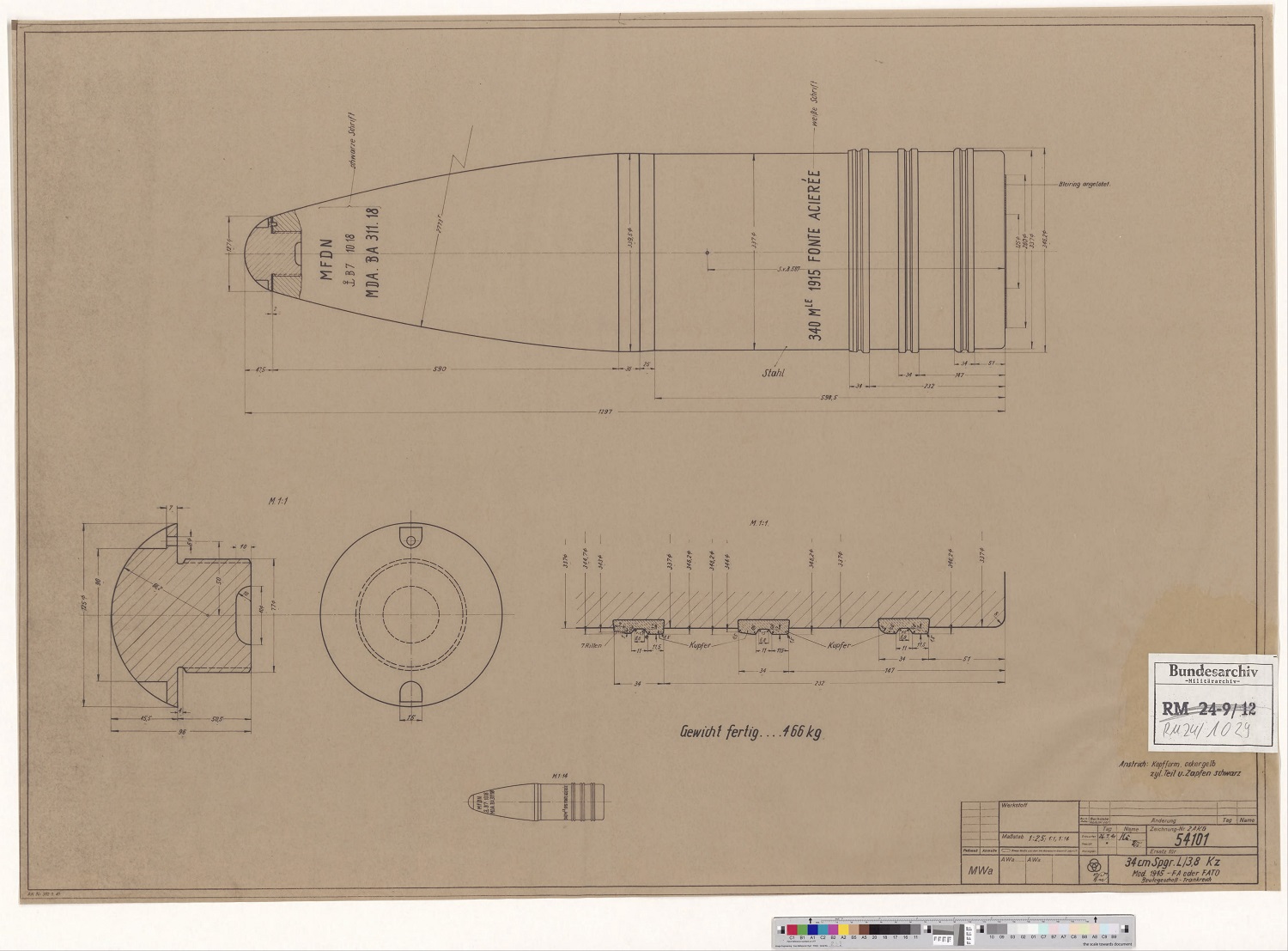
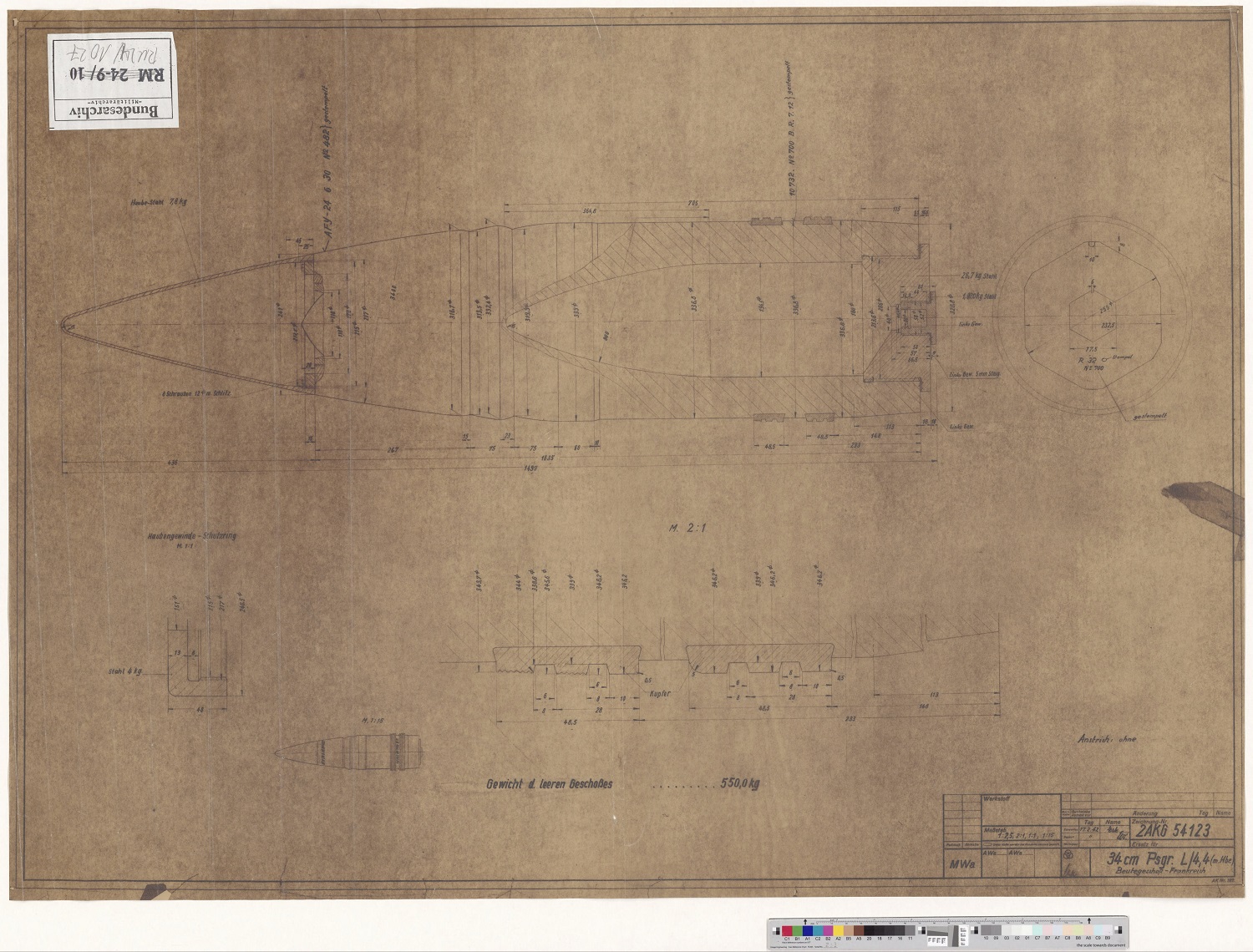
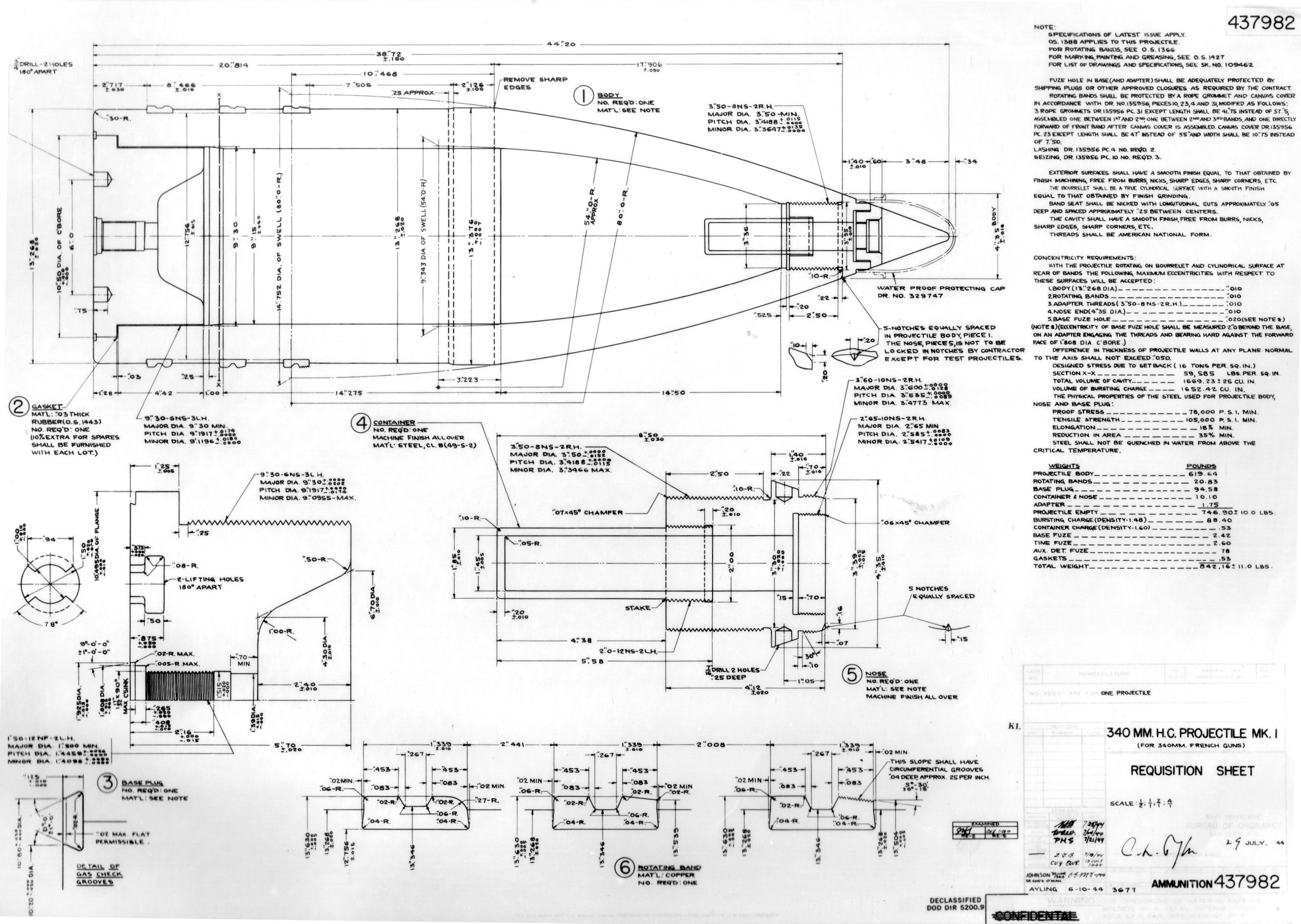
As for Lorraine, she saw action during "Operation Dragoon," the invasion of South France, where she bombarded the 34 cm guns at Cap Cépet. Later, the firm of Crucible Steel manufactured 340 mm HC shells and the USN probably also supplied SPD charges to be used by Lorraine. See sketch below.Gun construction was generally similar to that of the 380 mm (14.96") guns used on the later Richelieu class battleships, but there was an additional C tube and no loose liner. Used a Farçot breech mechanism with a three-motion interrupted thread (not a Welin) breech plug which was worked hydraulically or manually.
French guns designed between about 1902 and 1922 were designated in centimeters. Actual bore length was 45.82 calibers.
| Designation | 34 cm/45 (13.4") Model 1912
34 cm/45 (13.4") Model 1912M 34 cm/45 (13.4") Type C |
|---|---|
| Ship Class Used On | Model 1912: Bretagne class
Model 1912M: Normandie class 1 Type C: Lyon class |
| Date Of Design | 1912 |
| Date In Service | 1915 |
| Gun Weight | 65.89 tons (66.95 mt) |
| Gun Length oa | 634.5 in (16.115 m) |
| Bore Length | 609.6 in (15.485 m) |
| Rifling Length | 521.7 in (13.250 m) |
| Grooves | (102) 0.075 in deep x 0.295 in (1.9 mm x 7.5 mm) |
| Lands | 0.118 in (3.0 mm) |
| Twist | Uniform RH 1 in 29.89 |
| Chamber Volume | 15,646 in3 (256.4 dm3) |
| Rate Of Fire | about 2 rounds per minute 2 |
- ^During rebuilds in the 1930s, guns originally intended for the uncompleted Normandie class were used to regun the Bretagne class.
- ^The firing cycle was officially listed at 28 seconds but in practice the ships could fire one round every 35 seconds. In case of hoist failures, the auxiliary hoist could be manually worked by eight men to bring up one complete round every seven minutes. It then took a second crew of four men five minutes to hoist the round into the gunhouse.
| Type | Bag |
|---|---|
| Projectile Types and Weights 1a 2a | Ship Projectiles
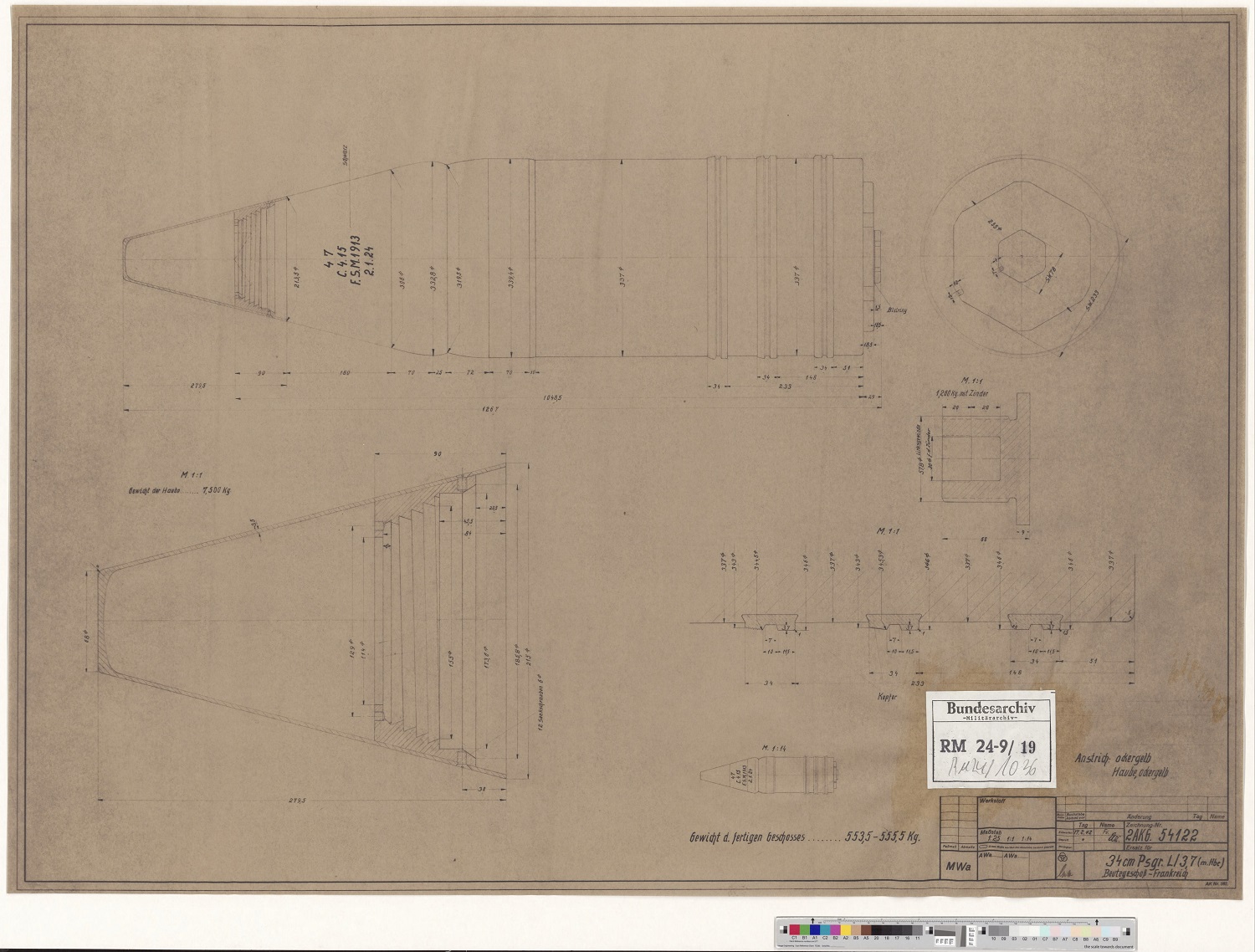
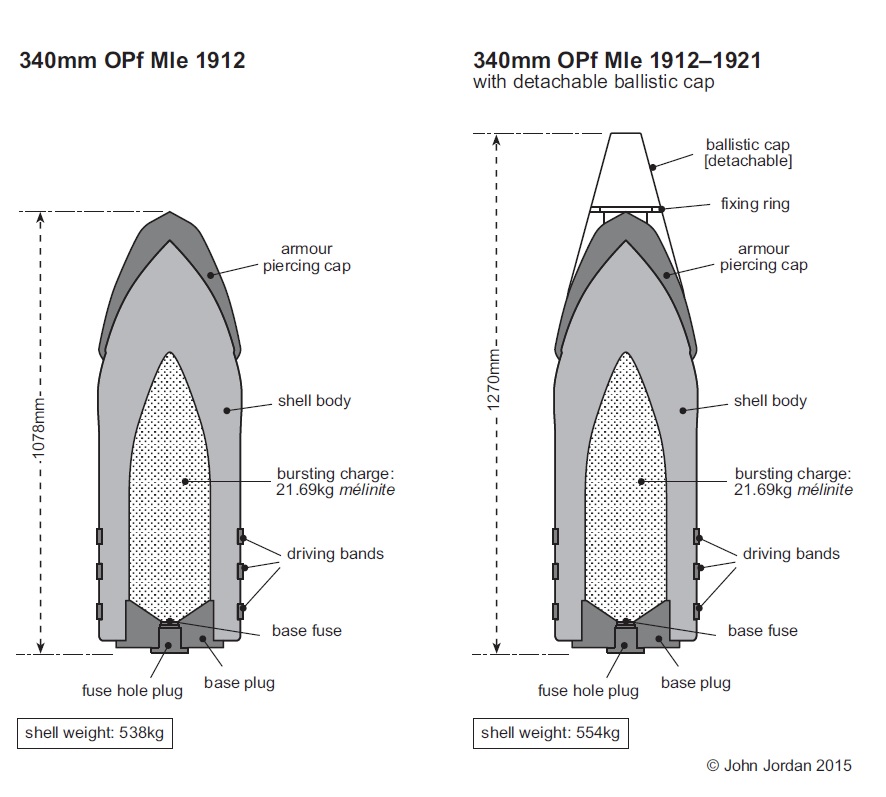
APC M1912 3a: 1,190 lbs. (540 kg) APC M1912-1921 4a 5a: 1,221 lbs. (554 kg) HE M1926: 842.2 lbs. (382.0 kg) Crucible Steel HC Mark 1: 842.2 lbs. (382.0 kg) 6a Projectiles for Railway Guns 7a Projectiles for Coast Defense Guns 7a |
| Bursting Charge | APC M1912-1921: 47.8 lbs. (21.7 kg) Mélinite
Crucible Steel HC Mark 1: 88.4 lbs. (40.1 kg) Explosive D Others: N/A |
| Projectile Length | APC M1912: 42.1 in (107.0 cm)
APC M1912-1921 4a: 49.9 in (126.7 cm) HE M1926: 41.5 in (105.4 cm) Crucible Steel HC Mark 1: 44.2 in (112.3 cm) APC M1924: 59.0 in (149.9 cm)
|
| Propellant Charge 8a | APC M1912: 341.7 lbs. (155.0 kg) BM 17
APC M1912-1921: 341.7 lbs. (155.0 kg) BM 1 HE M1926: 308.6 lbs. (140 kg) BM 15 Crucible Steel HC Mark 1: N/A APC M1924: 338.4 lbs. (153.5 kg) BM 16
|
| Muzzle Velocity | APC M1912: 2,605 fps (794 mps)
APC M1912-1921: 2,559 fps (780 mps) HE M1926: 2,904 fps (885 mps) Crucible Steel HC Mark 1: N/A APC M1924: N/A
|
| Working Pressure | 17.8 tons/in2 (2,800 kg/cm2) |
| Approximate Barrel Life | about 250 rounds |
| Ammunition stowage per gun | Bretagne: 100 rounds
Normandie: 100 rounds Lyon: N/A, but probably 100 rounds |
- ^A Note on Sources: The secondary sources listed below differ greatly on the details for the ammunition used for these guns. John Jordan kindly provided information taken from French official documents and these values are used throughout this section for shipboard projectiles.
- ^
Actual designations for Ship Projectiles APC M1912 340 mm OPf Mle l912 APC M1912-1921 340 mm OPf Mle 1912-1921 HE M1926 340 mm OEA Mle 1926 HC Mark 1 340 mm OEA Mle 1944 (?) - ^The APC M1912 did not have a ballistic cap. They were classified as obus alourdi (heavyweight shell). The base fuzes had a dual delay mechanism which in theory enabled them to engage both thin-skinned and heavily armored targets. They therefore replaced both the separate APC (obus de rupture) and SAPC (obus de semi-rupture) shells carried by earlier battleships. These dual delay base fuzes did not work particularly well but their performance was improved over the years.
- ^The APC M1912-1921 was modified to add dye bags around 1940 (K version). These projectiles weighed 1,230 lbs. (558 kg).
- ^Propellant was in four bags.
- The new APC intended for the Type C guns would have weighed 1,300 lbs. (590 kg) with a burster of 47.6 lbs. (21.6 kg) and a length of 51.2 in (130 cm). It was designed to have an underwater trajectory up to (100 m). This preliminary design eventually became the post-war APC M1912-1921.
| Elevation | Range |
|---|---|
| 12 degrees
Max elevation for Bretagne class as built |
15,860 yards (14,500 m) |
| 18 degrees
Max elevation for Bretagne class as modified early 1920s |
19,690 yards (18,000 m) |
| 23 degrees
Max elevation for Bretagne class as modified late 1920s |
25,920 yards (23,700 m) |
| 15 degrees
Max elevation for Normandie and Lyon classes as planned |
18,040 yards (16,500 m) |
| Elevation | Range |
|---|---|
| 18 degrees | 22,970 yards (21,000 m) |
| 23 degrees | 29,090 yards (26,600 m) |
| Elevation | Range |
|---|---|
| 47.5 degrees
Max Range for Coastal Defense Guns |
38,750 yards (35,430 m) |
| Elevation | Range |
|---|---|
| 47.5 degrees
Max Range for Coastal Defense Guns |
47,680 yards (43,600 m) |
- The "Warship Volume X" articles listed below give contradictory ranges for 18 degrees of elevation. The above tables attempt to reconcile the data in those articles and also contain information provided by John Jordan.
- The APC Model 1912 had a residual velocity of 1,552 fps (473 mps) at the designed engagement range of 10,940 yards (10,000 m).
| Designation | Twin Turret: Bretagne (5) 1c 2c 3c 4c Quad Turret: Normandie (3) and Lyon (4) 5c |
|---|---|
| Weight | Twin Turrets: About 985 tons (1,000 mt)
Quad Turrets: About 1,476 tons (1,500 mt) |
| Elevation | Bretagne: -5 / +12 degrees 6c Normandie and Lyon: -5 / +15 degrees 7c Coastal Artillery: 0 / +50 degrees |
| Rate of Elevation | Twin Turret: 3.0 degrees per second 8c Quad Turret: 3.0 degrees per second |
| Train | Forward and aft turrets: about -150 / +150 degrees
Q turret: about 30 to 150 degrees on either side |
| Rate of Train | Twin Turret: 4.5 degrees per second 9c Quad Turret: 4.5 degrees per second 10c |
| Gun Recoil | N/A |
| Loading Angle | +2 degrees |
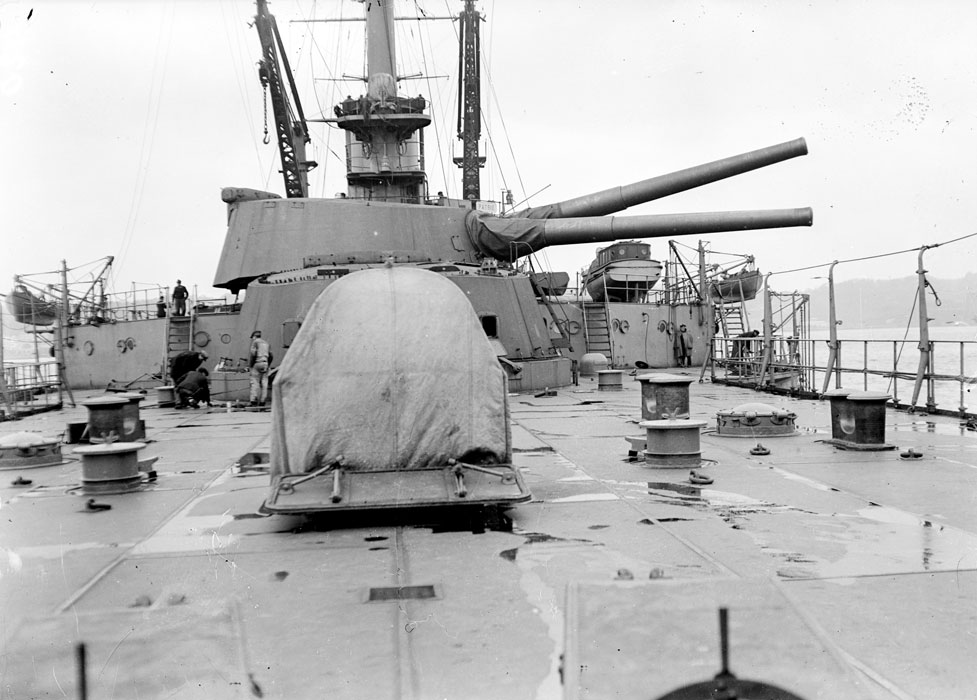
- ^The twin turrets were similar to the 30 cm turrets used on the Courbet class. They used British-style split hoists and ammunition transfers in the working chamber. The main hoist was divided into three sections by flash-tight automatic doors, but the magazine doors had to be left open during action as there was no flash-tight doors or scuttles through which charges could be passed. The upper cage hoist was also fitted with flame-proof shutters. Eight projectiles were stored in the working chamber and these could be lifted to the gunhouse by a small crane should the upper hoists fail. The upper hoist had a three-level loading cage which carried the projectile on the lower level and then two powder bags on each of the two upper levels. Charges were rammed two at a time.
- ^When the 340 mm OPf Mle 1912-1921 was introduced, only the upper hoists were modified to handle these longer projectiles. The lower hoists were not modified and the projectiles were stored in the shell rooms without the new ballistic caps. The ballistic caps were stored in the working chamber where they were attached by screwing them onto the projectiles before hoisting them up to the guns.
- ^The amidships turret was removed from Lorraine in 1934-35 in order to fit an aircraft catapult and additional AA guns.
- ^Turret No. 2 on the Bretagne class was fitted with an 8.20 m (26 ft) rangefinder during various rebuilds in the late 1920s and early 1930s.
- ^The quad turrets had four guns arranged in two pairs with a 1.6" (4 cm) longitudinal bulkhead separating the pairs. Turrets were trained electrically but elevated hydraulically by Williams-Janney motors for control. These turrets differed from previous ones by having a separate compartment at the base of the forward end of the turret which housed the turret commander, rangetaker and telephone operator. The mounting also differed from earlier ones by having the magazines and shell rooms concentric with the stalk with the magazines above the shell rooms. Two dredger hoists, one for each pair of guns, ran from here up to the working chamber. The hoists were linked such that one would be descending while the other was ascending. Cages had three levels, similar to earlier ships, with the projectile on the lowest level. When the cage arrived at the working chamber the projectiles and charges were slid onto waiting trays for the upper hoists. Eight ready rounds per gun were carried in racks behind the guns with the propellant charges stowed in lockers around the walls of the working chamber.
- ^As originally completed in 1915-16, all turrets had a maximum elevation of 12 degrees with the exception of Provence. As an experiment, it was decided during construction to increase the elevation of her No. 5 turret to 18 degrees. This required major changes to the turret design. As a result, the ship was completed without guns in this turret and they were not installed until July 1917, a year after she entered service. During reconstruction between 1919 and 1923, the elevation of all turrets on all ships was increased to 18 degrees and increased again during the late 1920s to 23 degrees.
- ^The maximum elevation of the Quad turrets would almost certainly have been increased had the Normandie and Lyon classes been completed.
- ^Elevation was by Janney motor with selectable speeds. Manual backup was available with a maximum speed of 0.25 degrees per second. Guns could be elevated independently or yoked together.
- ^Training of the twin turrets was by Janney motor with selectable speeds. Manual backup was available with a maximum speed of 1.0 degrees per second.
- ^Training of the quad turrets was by Janney motor with selectable speeds. Manual backup was available with a maximum speed of 0.4 degrees per second.
- Twin turret personnel consisted of a supervisor, four gunlayers and trainers (including one spare), two loaders, two breech operators and two assistant breech operators. The armored hood at the rear of the turret contained the turret commander, a range taker operating a Barr & Stroud 6 ft (2 m) rangefinder, an assistant fire control director, a telephone operator, and two manipulateur Routin operators, a device manufactured by Brequet that used synchronized electric motors that allowed the central fire control station to directly set the range on the gunsights. Turrets 2 and 5, which were auxiliary fire control stations, had two additional operators, a ladder ranging assistant and operator responsible for transmitting the order to fire.
- The Bretagne class were equipped with electric motors driving hydraulic training and elevation gear. Chain rammers were also electric powered. Each gun had its own hoist which ran from the working chamber under the turret and a second pair of hoists ran down to the magazines. Gun loading cages had three compartments, the lower one for the projectile and the upper two each carrying two charges.
- The Battleship Lorraine had her amidships turret removed during her 1934-1935 modernization in order to fit an aircraft catapult and aviation facilities.
- For the proposed Jean Bart reconstruction, the coastal battery gun cradles would have allowed a maximum elevation of +35 degrees.
- Armor thickness for the Bretagne Class as given in "French Battleships of World War One:"
Face: 8.9 in (22.5 cm) FH over two layers of 0.6 in (1.6 cm) plates
Sides: 7.4 in (18.8 cm) FH over two layers of 0.6 in (1.6 cm) plates
Rear: 7.4 in (18.8 cm) FH over two layers of 0.6 in (1.6 cm) plates
Roof: Three layers of 0.9 in (2.4 cm) plates
Floor: 2.4 in (6.0 cm) over two layers of 0.8 in (2.0 cm) plates
Barbette (parapet tronçonnique) above weather deck: 6.1 in (15.4 cm) over two layers of 0.5 (1.2 cm) plates - Armor thickness for the Normandie Class as given in "French Battleships of World War One:"
Face: 11.8 in (30.0 cm) FH over two layers of 0.8 in (2.0 cm) plates
Sides: N/A
Rear: 9.3 in (23.5 cm) FH over two layers of 0.8 in (2.0 cm) plates
Roof: 3.9 in (10.0 cm)
Floor: N/A
"Naval Weapons of World War Two" by John Campbell
"The French Dreadnoughts: The 23,500 ton Bretagne Class" articles by Robert Dumas in "Warship Volume X"
"Naval Weapons of World War One" by Norman Friedman
"The Big Gun: Battleship Main Armament 1860-1945" by Peter Hodges
"French Battleships of World War One" by John Jordan and Philippe Caresse
"French Battleships: 1922 - 1956" by John Jordan and Robert Dumas
"French Battleships 1933 - 1970: An Illustrated Technical Reference" by Wayne Scarpaci
"Battleships of World War Two" by M.J. Whitley
---
USS Nevada (BB-36) DANFS Entry from Warships1 files
---
Batterie de 340 de Cépet
---
Video of gunnery practice - The Fighting French Fleet Battleship Provence 1938 Documentary Part 2 48934
---
Special help from John Jordan,
Nathan Okun, Helen Peeters and Zhu Shipeng
12 August 2006 - Benchmark
22 December 2009 - Added information on proposed Jean Bart reconstruction
07 January 2012 - Added pictures of Lorraine and APC shells
25 February 2012 - Added information on guns used as Coastal Artillery
05 August 2018 - Converted to HTML 5 format, added details on guns, ammunition and mountings, added photograph of Lorraine
05 January 2023 - Added information about replacement of sabotaged guns at Cap Cépet, updated formatting to the latest template
28 September 2023 - Added sketch and data on Crucible Steel HC Mark 1
18 December 2023 - Added information on breech mechanism, data on FATO shells, German projectile sketches and link to Provence video
16 March 2024 - Corrected typographical error
12 April 2026 - Added photograph of Lorraine following her 1934-1935 modernization