
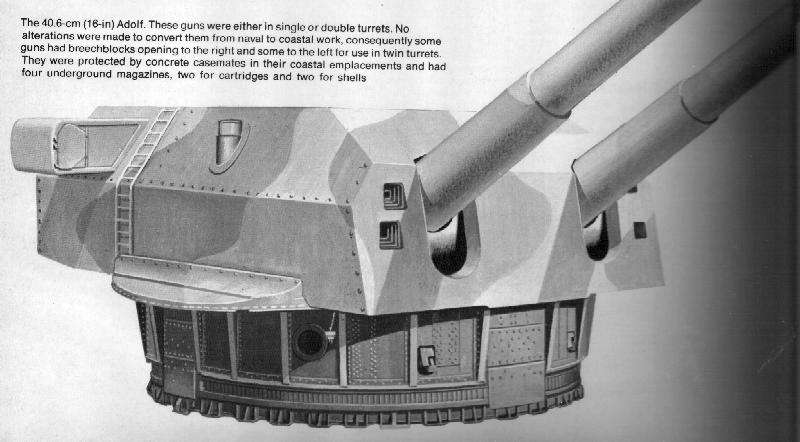
These guns were intended for the "H" class battleships which were laid down in 1939 but never completed. This weapon was a good design, but it could be said that it had an excessively high muzzle velocity, hence giving it minimal deck penetration even at long ranges.
Accounts differ as to the actual number of guns completed, but there appears to have been twelve. There were three versions of this weapon; the original prototype for proof and experimental testing; three guns built to the naval pattern and intended for the "H" battleships; and eight guns finished to a modified design for coastal artillery use and also known as Adolph. The coast artillery version had a similar construction to the naval version but had a larger chamber and shorter rifling length. The naval guns were completed as one left hand and two right hand. Only one of these had power ramming.
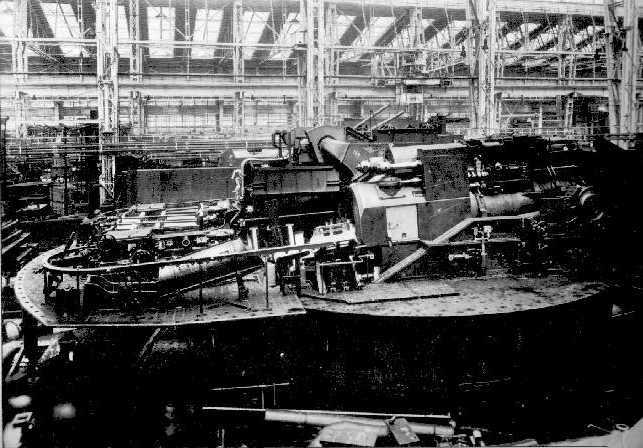
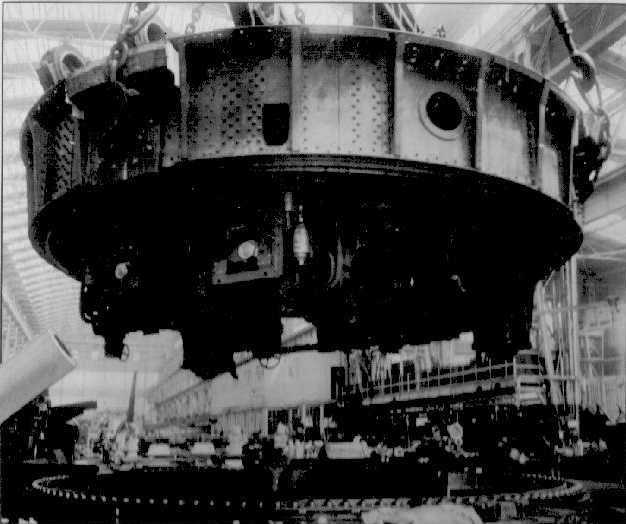
These naval guns were placed on BSG (Bettungschiess-Gerüst - "Platform firing framework") mountings and sent to the Hel Peninsula in Poland to become Battery Schleswig-Holstein. All three guns were emplaced and test fired, but shortly afterwards they were dismantled and were sent to France where they were made part of Battery Lindemann, named after the Captain of the battleship Bismarck. This battery was located near Sangatte in France where they often fired across the Channel at Dover.
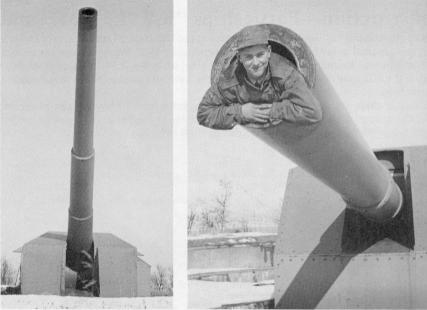
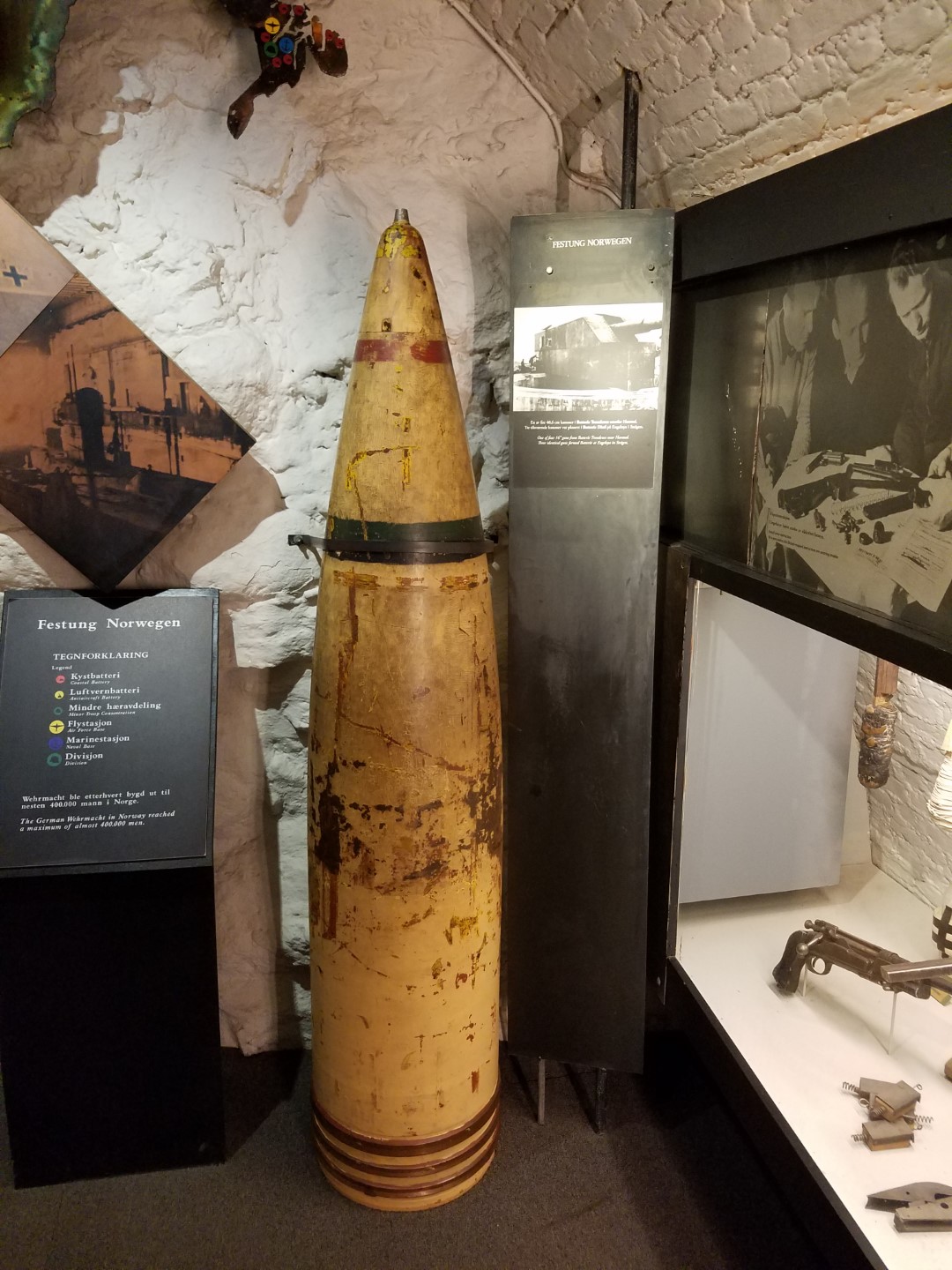
The eight coastal artillery guns were sent to Norway to be employed to protect Narvik and Tromsø, with one gun being lost in transit. Of the remaining seven guns, three were emplaced as Battery Dietl on the island of Engeløya and the other four were mounted as Battery Trondenes near Harstad. At the end of the war, the guns were taken over by the Norwegian Army along with 1,227 shells. A German gun crew trained the Norwegians in their use and the guns were actively used for about a decade. The three guns at Battery Dietl were decommissioned in the early 1950s and then scrapped in 1956. The battery at Trondenes was last fired in 1957 and formally taken out of commission in 1961. The guns then sat idle and were placed on sale for scrapping in 1968, but they still remain in place and one of them is currently open as a museum at Trondenes Fort.
As these guns had a rather thick barrel for their size, during the redesigns of the "H" class battleships in 1941 and 1942 (H-41 and H-42) it was proposed to bore them out and convert them into 42 cm/48 (16.54") weapons. One of the reasons behind this conversion was that this change would give these ships a larger caliber weapon than those planned for any known Allied battleship. None of the guns already built were ever converted and no new guns were started. The SK C/40 model year for this version is my estimate.
Constructed of a loose barrel, which was universally interchangeable between production guns, a loose liner which only fitted a particular gun, B tube, a jacket over the rear end of B tube, a breech end-piece thrust over the jacket and kept in place by a threaded ring, a breech block supporting piece inserted in the breech end-piece and secured by a threaded ring. A retaining ring with two fittings for transmitting rotation forces was screwed onto the rear of the barrel. Used a horizontal sliding breech block, similar to other large-caliber German naval guns.
The data that follows is specifically for the 40.6 cm (16") Naval version except where noted. Actual bore diameter of all versions was 40.64 cm (16.0").
| Designation | 40.6 cm/52 (16") SK C/34
42 cm/48 (16.54") SK C/40 |
|---|---|
| Ship Class Used On | "H" Class |
| Date Of Design | 1934 |
| Date In Service | 1942 as coastal defense guns |
| Gun Weight 1 | 352,516 lbs. (159,900 kg) including hornrings |
| Gun Length oa | 831.9 in. (21.130 m) |
| Bore Length | 777.6 in. (19.750 m) |
| Rifling Length | Naval Guns: 671.9 in. (17.066 m)
Adolf Coastal Guns: 664.2 in (16.871 m) |
| Grooves | Naval Guns: (110) 0.236 in deep x 0.323 in (5 mm x 8.2 mm)
Adolf Coastal Guns: (90) 0.189 in deep x 0.314 in (4.8 mm x 7.98 mm) |
| Lands | 0.277 in (7.03 mm ) |
| Twist | Increasing RH 1 in 35.9 to 1 in 29.9 |
| Chamber Volume | Naval Guns: 25,630 in3 (420 dm3)
Coastal Guns: 28,071 in3 (460 dm3) |
| Rate Of Fire | about 2 rounds per minute |
- ^The sliding breech block weighed 7,940 lbs. (3,600 kg), the barrel 91,710 lbs. (41,600 kg) and the liner 45,860 lbs. (20,800 kg). The prototype gun differed in that the barrel weighed 83,110 lbs. (37,700 kg) and the liner 38,360 lbs. (17,400 kg).
| Type | Cartridge - Bag | |
|---|---|---|
| Projectile Types and Weights 1a | Naval Projectiles
APC L/4,4: 2,271 lbs. (1,030 kg) HE L/4,6 base fuze: 2,271 lbs. (1,030 kg) 2a HE L/4,8 nose fuze 3a 4a: 2,271 lbs. (1,030 kg) Special Coastal Artillery Projectiles
|
|
| Bursting Charge 5a | APC L/4,4 | G: about 60.69 lbs. (27.527 kg)
S: about 57.61 lbs. (26.130 kg) TNT 6a |
| HE L/4,6 base fuze | G: about 102.74 lbs. (46.601 kg)
S: about 99.45 lbs. (45.109 kg) TNT 7a |
|
| HE L/4,8 nose fuze | G: about 187.90 lbs. (85.229 kg)
S: about 178.50 lbs. (80.964 kg) TNT 8a |
|
| Adolph HE L/4,2 | G: about N/A
S: about 179.64 lbs. (81.482 kg) TNT 9a |
|
| HE L/4,1 base and nose fuze | G: about N/A
S: about 182.63 lbs. (82.840 kg) TNT 10a |
|
| Projectile Length | Naval Projectiles
APC L/4,4: 70.3 in (178.6 cm) HE L/4,6 base fuze: 73.5 in (186.7 cm) HE L/4,8 nose fuze: 76.7 in (194.9 cm) Special Coastal Artillery Projectiles
|
|
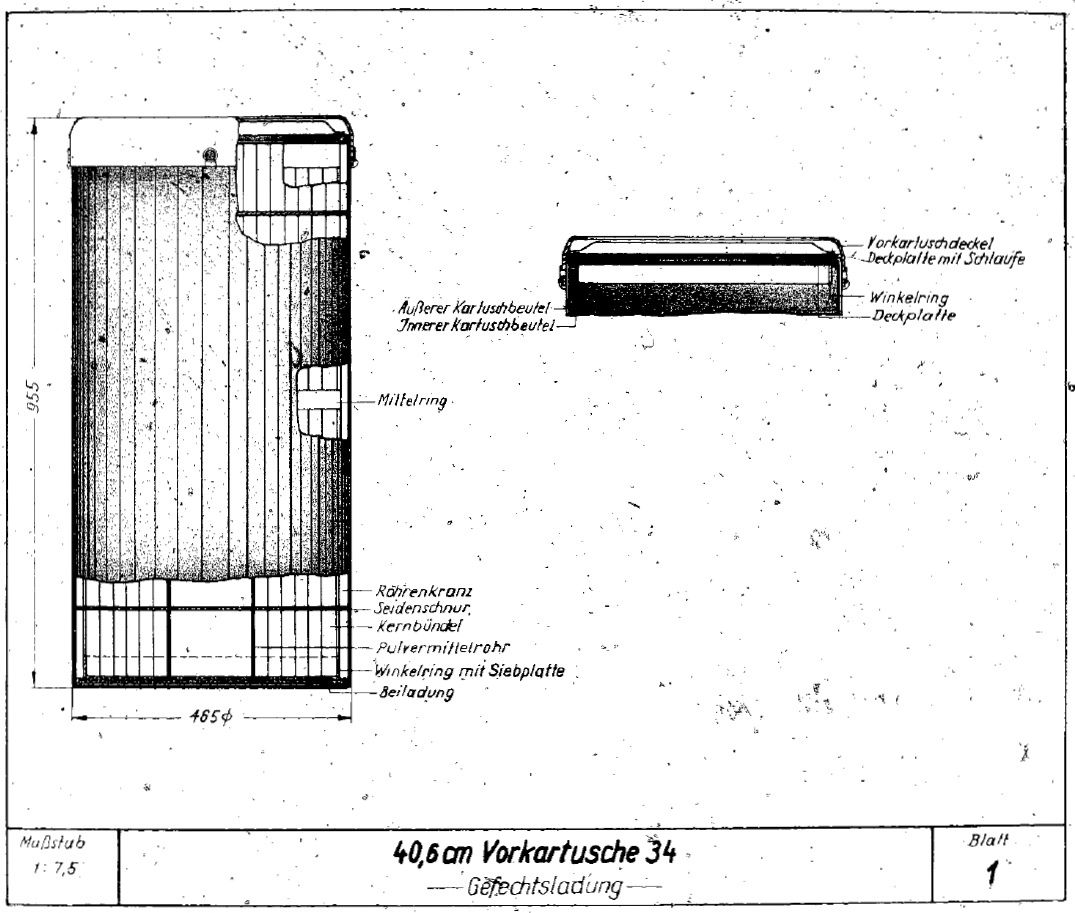
| Propellant Charge 11a 12a | Fore Charge: 295.4 lbs. (134 kg) RP C/38 (925/915 x 22/11) + (915 x 148/138 Pulvermittelrohr)
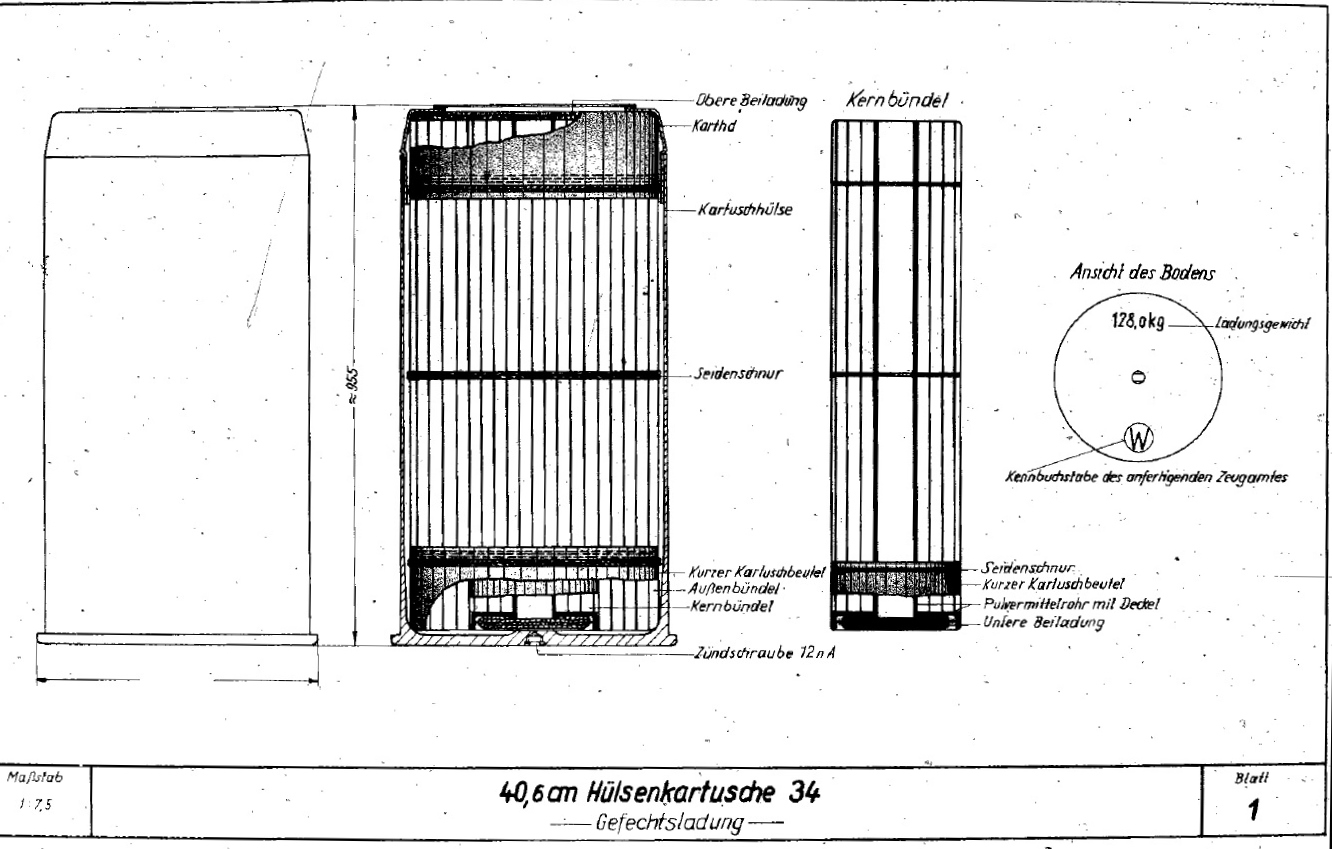
Rear Charge: 282.2 lbs. (128 kg) RP C/38 (905/875 x 22/11) + (881 x 75/65 Pulvermittelrohr) During the war, the Adolf coastal guns switched to the following:
|
|
| Cartridge Case Type, Size and Weight | Brass, 406 x 955 mm, 201 lbs. (91 kg) 13a 14a | |
| Muzzle Velocity | For naval shells: 2,657 fps (810 mps)
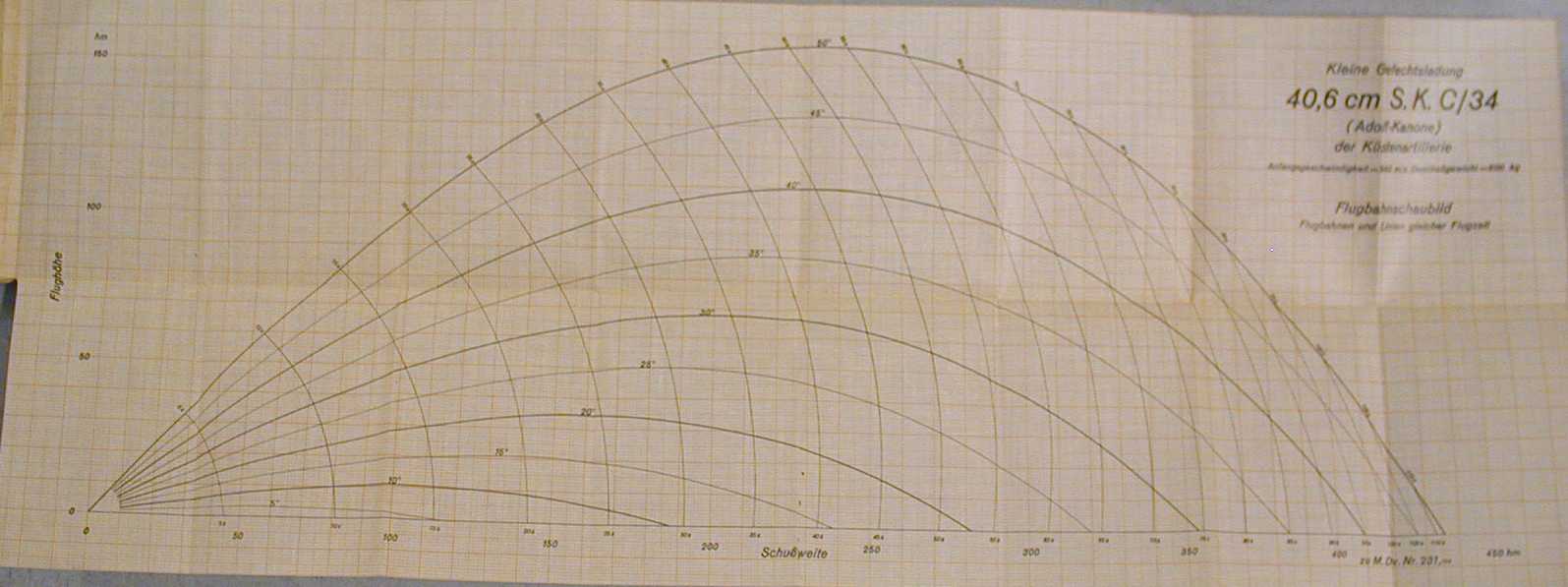
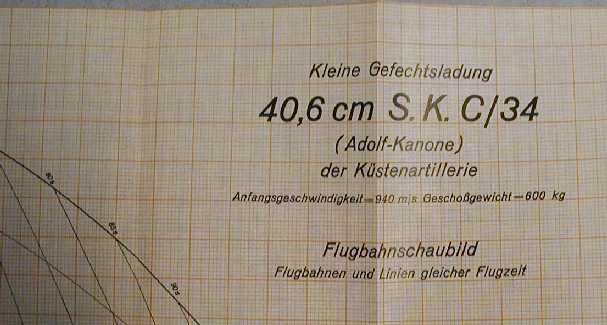
For light coastal artillery shells (new gun): 3,445 fps (1,050 mps) For light coastal artillery shells (average gun): 3,084 fps (940 mps) |
|
| Working Pressure | 20.3 tons/in2 (3,200 kg/cm2) | |
| Approximate Barrel Life | 180 - 210 rounds | |
| Ammunition stowage per gun | 120 rounds | |
- ^
Actual designations for Projectiles APC L/4,4 40,6 cm Psgr. L/4,4 (m.Hb) HE L/4,6 base fuze 40,6 cm Spgr. L/4,6 Bdz (m.Hb) HE L/4,8 nose fuze 40,6 cm Spgr. L/4,8 Kz (m.Hb) Adolph HE L/4,2 40,6 cm Ad.gr. L/4,2 Bdz u. Kz (m.Hb) HE L/4,1 base and nose fuze 40,6 cm Spgr. L/4,1 Bdz u. Kz (m.Hb) - ^The HE L/4,6 base fuze projectile (40,6 cm Spgr. L/4,6 Bdz) had an AP cap, making it more of a SAPC type of projectile.
- ^3.13.23.3German HE Nose Fuze and HE Base and Nose Fuze projectiles with ballistic caps had a rod between the nose of the shell and the fuze to improve performance when striking obliquely. See details on the 12.7 cm SK C/34 datapage.
- ^A Note on Sources: Most references say that the Spgr. Kz (HE nose fuze) was 4,4 calibers long, but M.Dv. Nr. 198 lists it as 4,8 calibers long. This agrees with the length given in "German Capital Ships of World War Two."
- ^Burster weights (G = Gesamtgewicht and S = reiner Sprengstoff) are my estimates based upon equivalent 38 cm projectiles. All weights shown above are therefore approximate values. Burster compositions from M.Dv. Nr. 198.
- ^The burster for the APC L/4,4 projectile was made from Fp 5, Fp 10, Fp 20 and Fp 25.
- ^The burster for the HE L/4,6 base fuze projectile was made from Fp 5, Fp 10, Fp 20 and Fp 25.
- ^The burster for the HE L/4,8 nose fuze projectile were made entirely with Fp 1.
- ^The burster for the Adolph projectile was made entirely with Fp 1.
- ^The burster for the HE L/4,1 base and nose fuze projectile was made entirely with Fp 1.
- ^These guns, like most large caliber German guns of this era, used a "fore charge" which was propellant in a double bag silk case and a "rear charge" which was propellant in a brass case. The brass case helped to seal the breech of the gun.
- ^Propellant weights and compositions from from M.Dv. Nr. 198.
- ^The case for the rear charge was changed to mild steel late in the war.
- ^The cartridge rim diameter was 465 mm.
| Elevation | Range |
|---|---|
| Range @ 30 degrees | 39,800 yards (36,400 m) |
| Range @ 33 degrees
(max elevation of naval turret) |
40,245 yards (36,800 m) |
| Range @ 52 degrees
(coastal artillery) |
47,025 yards (43,000 m) |
All of the 2,271 lbs. (1,030 kg) projectiles had similar maximum ranges.
| Elevation | Range |
|---|---|
| Range @ 52 degrees
Muzzle Velocity of 3,445 fps (1,050 mps) (coastal artillery) |
61,240 yards (56,000 m) |
| Range @ 50 degrees
Muzzle Velocity of 3,084 fps (940 mps) (coastal artillery) |
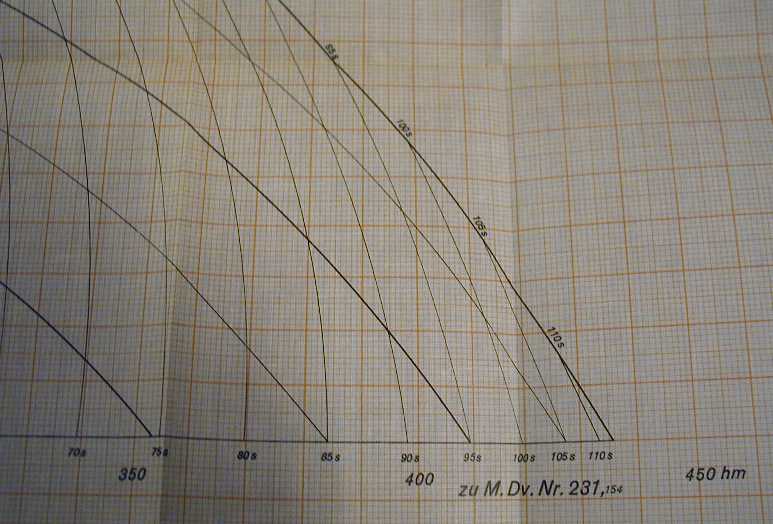
47,620 yards (43,550 m) |
| Range | Side Armor | Deck Armor |
|---|---|---|
| 0 yards (0 m) | 31.7" (805 mm) | --- |
| 10,000 yards (9,144 m) | 25.1" (638 mm) | 1.4" (36 mm) |
| 20,000 yards (18,288 m) | 18.8" (457 mm) | 3.2" (81 mm) |
| 30,000 yards (27,432 m) | 13.6" (345 mm) | 5.0" (127 mm) |
| 40,000 yards (36,576 m) | 10.2" (259 mm) | 8.5" (216 mm) |
This data is from "Battleships: Axis and Neutral Battleships in World War II" for a muzzle velocity of 2,657 fps (810 mps) and is based upon the USN Empirical Armor Penetration Formula.
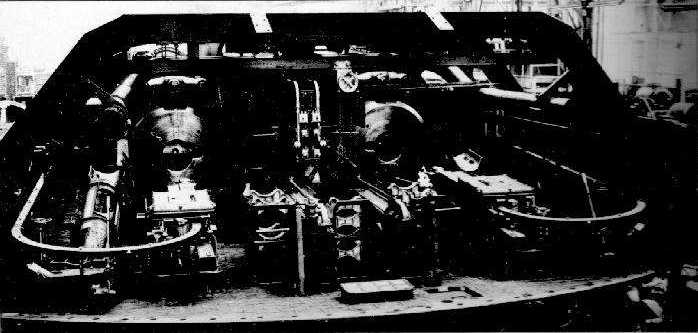
| Designation | Two-gun Turrets
"H" (4): Drh LC/34 Single BSG Coastal Artillery
|
|---|---|
| Weight | 1,452 tons (1,475 mt) |
| Elevation 1b | Drh LC/34: -5.5 / +30 degrees
Schiessgerät C/39: -5 (?) / +55 degrees |
| Elevation Rate | N/A |
| Train | +145 / -145 degrees |
| Train Rate | N/A |
| Gun recoil | N/A |
| Loading Angle | N/A |
- ^The sources listed below differ as to the actual elevation span of the ship turrets. I have chosen to use those figures given in "German Capital Ships of World War Two."
"Naval Weapons of World War Two" by John Campbell
"The Illustrated Encyclopedia of 20th Century Weapons and Warfare" by Bernard Fitzsimmons
"Battleships: Axis and Neutral Battleships in World War II" by W.H. Garzke, Jr. and R.O. Dulin, Jr.
"German Warships 1815-1945" by Erich Gröner
"German Artillery of World War Two" by Ian Hogg
"Naval Guns: 500 years of Ship and Coastal Artillery" by Hans Mehl
German Naval Guns: 1939 - 1945" by Miroslaw Skwiot
"German Capital Ships of World War Two" by M.J. Whitley
---
"Schlachschiff H" document by Dipl Ing Otto Riedel
"Munitionsvorschriften für die Kriegsmarine - Hülsenkartusche" M.Dv. Nr. 190,4A1 by Oberkommando der Kriegsmarine
"Munitionsvorschriften für die Kriegsmarine - Vorkartusche" M.Dv. Nr. 190,4A6 by Oberkommando der Kriegsmarine
"Übersicht über die für die Marinegeschütze und deren Abk K zu verwendende Munition und ihre Einzelteile einschließlich Salut-
und Manöverladungen" M.Dv. Nr. 198 by Oberkommando der Kriegsmarine
---
Special help from Cliff McMullen, Peter Lienau, Charles Schedel and Thorsten Wahl
The Adolf Guns. Existing 40.6 cm guns in Norway.
Polish Coastal Defense Museum. Includes Battery
Schleswig-Holstein fortifications where the German 40.6 cm guns were emplaced. Tourist Guidebooks in English are
available from the Museum.
10 September 2007 - Benchmark
02 April 2011 - Additional details about coast artillery guns, added link to Adolph Guns
19 May 2012 - Updated to latest template
18 September 2016 - Converted to HTML 5 format
26 February 2019 - Reorganized notes and added data and sketches from M.Dv. Nr. 190,4A1 and M.Dv. Nr. 190,4A6
30 July 2019 - Added link to the Polish Coastal Defense Museum - Battery Schleswig-Holstein, added comments
about use in Poland
14 February 2021 - Added photograph of 40,6 cm projectile on display in Norway
28 August 2024 - Added propellant information, notes about burster and designation of Spgr. L/4,8 Kz (m.Hb)
03 March 2025 - Added note regarding AP cap on 40,6 cm Spgr. L/4,6 Bdz (m.Hb) projectile
15 April 2025 - Corrected typographical errors and added propellant information
16 June 2025 - Redid Burster table