
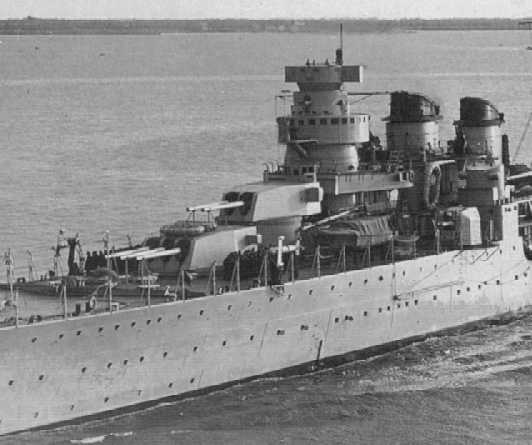
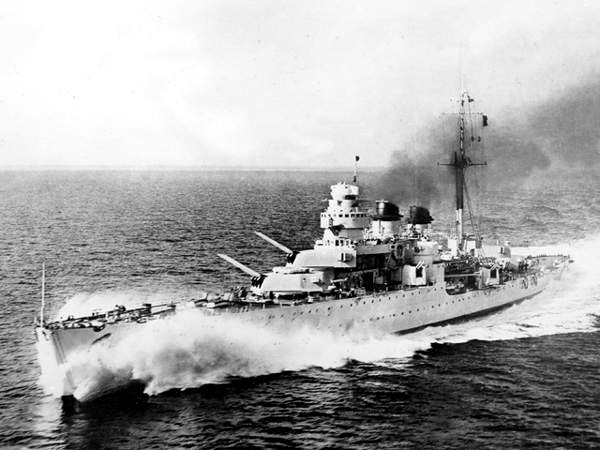
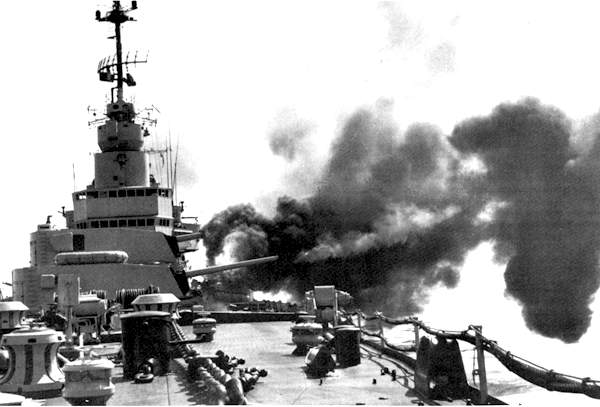
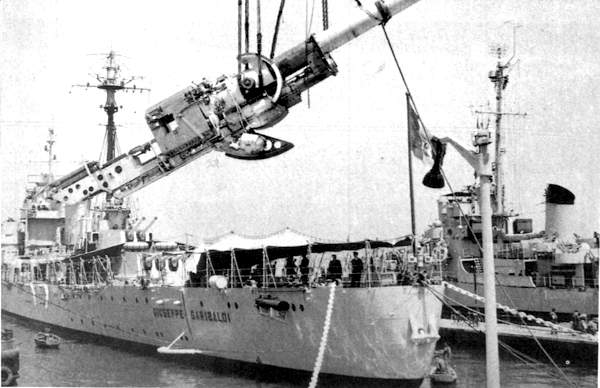
A good anti-destroyer weapon, this was the secondary gun on the Littorio class battleships and the main gun on the Garibaldi class (5th "Condottieri") light cruisers. The Model 1934 was made by Ansaldo and were of monobloc construction with a loose liner and a horizontal sliding breech block. The Model 1936 was made by OTO and was constructed of two tubes, loose liner and a horizontal sliding breech block.
These guns were a significant improvement from earlier 152 mm (6") guns in that they were more widely spaced in the turrets, were separately sleeved and had a lower and more reasonable muzzle velocity from the beginning. The increase in barrel length from the previous weapons was in attempt to obtain improved thermodynamic performance. Whatever the reasons, these new guns did prove to be the most accurate of all the Italian 152 mm (6") guns in service during World War II with dispersion patterns with APC being 260 to 300 feet (80 to 90 m) at a range of 19,140 yards (17,500 m). However, dispersion with HE rounds was much larger, 525 to 656 feet (160 to 200 m) at a range of 19,140 yards (17,500 m). This larger dispersion with HE was attributed to the shape of the nose and nose fuze used on these projectiles. Studies were underway in 1941 to alter the shape of the round and their internal weight distribution but a new design did not enter service.
Historical note: These cruisers were named after Italian military leaders.
| Designation | 152 mm/55 (6") Models 1934 and 1936 |
|---|---|
| Ship Class Used On | Littorio and Garibaldi classes |
| Date Of Design | 1934 / 1936 |
| Date In Service | 1940 |
| Gun Weight | 8.9 tons (9,689 kg) |
| Gun Length oa | about 348 in (8.840 m) |
| Bore Length | 330.0 in (8.382 m) |
| Rifling Length | 287.4 in (7.301 m) |
| Grooves | 40 |
| Lands | N/A |
| Twist | Uniform RH 1 in 30 |
| Chamber Volume | 1,537 in3 (25.19 dm3) |
| Rate Of Fire | 4 - 5 rounds per minute |
| Type | Separate |
|---|---|
| Projectile Types and Weights 1 2 | APC: 109.3 lbs. (49.60 kg)
HE: 98.3 lbs. (44.57 kg) 3 |
| Bursting Charge | APC: 1.85 lbs. (0.838 kg)
HE: 5.27 lbs. (2.390 kg) |
| Projectile Length | APC: 24.8 in (63.0 cm)
HE: N/A |
| Propellant Charge | 36.05 lbs. (16.35 kg) NAC |
| Muzzle Velocity | APC: 2,986 fps (910 mps)
HE: 3,100 fps (945 mps) 4 |
| Working Pressure | 20.8 tons/in2 (3,270 kg/cm2) |
| Approximate Barrel Life | N/A |
| Ammunition stowage per gun | Littorio: 210 rounds 5 Others: N/A |
- ^
Actual Italian designations APC Palla [Ball] da 152/55 HE Granata Dirompente (Disruptive Grenade) da 152/55 - ^The shell weights for these guns vary in secondary sources. I have chosen to use those weights given in Direttive e norme per l'impiego della Squadra Navale [Directives and regulations for the use of the Navy], a primary source.
- ^The HE shell with a time fuze was used for AA defense.
- ^New gun MV for HE was 3,133 fps (995 mps).
- ^Outfit for Littorio class was 840 AP, 1,428 HE and 252 AA.
| Elevation | APC | HE |
|---|---|---|
| 45 degrees | 28,150 yards (25,740 m) | 27,231 yards (24,900 m) |
| Range | Angle of Obliquity (Degrees) 2a | ||||
|---|---|---|---|---|---|
| 90 | 80 | 70 | 60 | 50 | |
| 20,000 m (21,870 yards) | 58 mm (2.28 in) | 56 mm (2.20 in) | 53 mm (2.09 in) | 47 mm (1.85 in) | <40 mm (<1.57 in) |
| 18,000 m (19,690 yards) | 65 mm (2.56 in) | 63 mm (2.48 in) | 60 mm (2.36 in) | 53 mm (2.09 in) | <40 mm (<1.57 in) |
| 16,000 m (17,500 yards) | 74 mm (2.91 in) | 72 mm (2.83 in) | 67 mm (2.64 in) | 60 mm (2.36 in) | 50 mm (1.97 in) |
| 14,000 m (15,310 yards) | 86 mm (3.39 in) | 84 mm (3.31 in) | 79 mm (3.11 in) | 70 mm (2.76 in) | 59 mm (2.32 in) |
Maximum Ranges at which given Thicknesses of Horizontal Armor (Homogeneous) can be Penetrated
X1 = Penetration @ maximum range of opening of fire under conditions of exceptional visibility.
X2 = Penetration @ maximum range of opening of fire under conditions of normal visibility.
X3 = Penetration @ typical combat range band, once engaged.
| X Number | Range | Armor Penetration |
|---|---|---|
| X1 | 20,000 m (21,870 yards) | 43 mm (1.69 in) |
| X2 | 18,000 m (19,690 yards) | 30 mm (1.18 in) |
| X3 | 14 - 16,000 m (15,310 - 17,500 yards) | 18 - 25 mm (0.71 - 0.98 in) |
Data in this table taken from a memorandum of 10 December 1939 by the Commissione Permanente per gli Esperimenti del Materiale di Guerra (Mariperman) [Permanent Commission for the Experiments of the Material of War (Mariperman)].
| Designation 1b 2b | Two-gun Turrets 3b Garibaldi (2): Model 1934 Three-gun Turrets 4b
|
|---|---|
| Weight | Twin: N/A
Triple: 133.3 tons (135.4 mt) [not including shield] |
| Elevation | -5 / +45 degrees |
| Elevation Rate | N/A |
| Train | about +120 / -120 degrees |
| Train Rate | N/A |
| Gun recoil | N/A |
| Loading Angle | -5 to +20 degrees |
- ^These mountings were electrically powered training and elevation. Rammers were pneumatically powered. Cartridge cases were ejected from tubes under the gun barrels.
- ^The gun axes were about 50 in (127 cm) apart for both the two-gun and three-gun mountings.
- ^In the twin mountings, each gun had separate shell and cartridge endless chain hoists. Projectiles and cartridge cases were transferred automatically to the loading trays at any elevation up to 20 degrees by swinging arms which pivoted about the trunnions. Loading was by telescoping hydraulic rammers.
- ^In the three-gun mountings there were lower endless chain hoists for each gun which ended in a handling room located below the gunhouse. Upper endless bucket hoists for each gun ran up to the gunhouse.
Armor thickness for the Littorio Class Face 11.0 in (28.0 cm) KC Front Sides 5.1 in (13.0 cm) KC Rear Sides 3.1 in (8.0 cm) Rear 3.1 in (8.0 cm) Front Roof 5.9 in (15.0 cm) Rear Roof 4.1 in (10.5 cm) These figures are from "The Littorio Class: Italy's Last and Largest Battleships 1937 - 1948".
"The Littorio Class: Italy's Last and Largest Battleships 1937 - 1948" by Erminio Bagnasco and Augusto de Toro
"Naval Weapons of World War Two" by John Campbell
"Questioni Di Tiro: E Altre le Artiglierie Navali Italiane Nella Guerra Nel Mediterraneo"
[Questions of Fire: And Others for the Italian Naval Artillery in the War in the Mediterranean] by Giuliano Colliva
"Italian Warships of World War II" by Aldo Fraccaroli
"Anatomy of the Ship: The Cruiser Bartolomeo Colleoni" by Franco Gay and Valerio Gay
"Cruisers of World War Two" by M.J. Whitley
---
Memorandum of the Commissione Permanente per gli Esperimenti del Materiale di Guerra (Mariperman)
[Permanent Commission for Experiments of War Material (Mariperman)], 111/RP of 10 December 1939, "Dati circa gli effetti dei proietti su
bersaglio navale", diretto a Maristat [Data on the Effects of Projectiles on Naval Targets, addressed to Maristat]. Archive of the
Historical Office of the Navy [AUSMM], Artillery and Munitions Inspectorate fund [IAM], box 2, file 3, pages 7 and 8.
"Direttive e norme per l'impiego della Squadra Navale" [Directives and regulations for the use of the Navy]
---
Marina Militare
---
Special help from Byron Angel
21 September 2008 - Benchmark
26 May 2012 - Updated to latest template
19 December 2012 - Added information on gun construction
12 January 2013 - Added ammunition information
10 January 2015 - Added armor penetration table, dispersion with HE, armor thickness, minor other additions to Ammunition and Mount / Turret sections
03 January 2022 - Converted to HTML 5 format, added loading details
12 April 2024 - Updated historical note
16 August 2025 - Added Armor Penetration section