
These guns were a Vickers design, manufactured in Britain and were probably similar to other Vickers 10" (25.4 cm) guns.
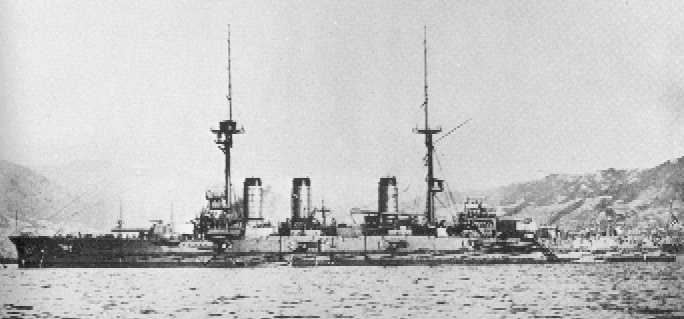
When the Japanese pre-dreadnoughts Satsuma and Aki were laid down in 1905, they were intended to be armed entirely with 12"/45 guns, which would have made them the first "all big-gun" battleships in the world. However, the cost of the Russo-Japanese War nearly ruined Japan so these ships were completed with twelve 25 cm (10") guns in the amidships turrets as a cost saving measure.
Redesignated as 41st Year Type on 25 December 1908. Redesignated in centimeters on 5 October 1917.
After these ships were scrapped in the 1920s some of their turrets were then used as coastal artillery. Four turrets were emplaced with two from Aki used to guard the Tokyo Bay area.
Actual bore diameter was 25.4 cm (10.0").
| Designation | 10"/45 (25.4 cm) Vickers 10"/45 (25.4 cm) 41st Year Type (Model 1908) 25 cm/45 (10") 41st Year Type (Model 1908) |
|---|---|
| Ship Class Used On | Satsuma and Katori Classes |
| Date Of Design | about 1905 |
| Date In Service | 1909 |
| Gun Weight | 22 tons (22.5 mt) |
| Gun Length oa | N/A |
| Bore Length | about 450.0 in (11.430 m) |
| Rifling Length | N/A |
| Grooves | (64) N/A |
| Lands | N/A |
| Twist | Uniform RH 1 in 28 |
| Chamber Volume | N/A |
| Rate Of Fire | about 1.5 rounds per minute 1 |
- ^The post-war US survey of Japanese Seacoast Artillery states that the coastal artillery turrets could fire 2 rounds per gun per minute for brief periods.
| Type | Bag |
|---|---|
| Projectile Types and Weights | AP: 518 lbs. (235 kg) AP Shell |
| Bursting Charge | N/A |
| Projectile Length | N/A |
| Propellant Charge | 152 lbs. (69 kg) |
| Muzzle Velocity | 2,657 fps (810 mps) |
| Working Pressure | N/A |
| Approximate Barrel Life | N/A |
| Ammunition stowage per gun | N/A |
| Designation | Twin Mount: Katori (2) and Satsuma (6) |
|---|---|
| Weight | N/A |
| Elevation | about -5 / +30 degrees 1a |
| Elevation Rate | N/A |
| Train | About +80 / -80 degrees |
| Train Rate | N/A |
| Gun recoil | N/A |
| Loading Angle | N/A |
- ^Mountings used for coastal artillery had their maximum elevation increased to +35 degrees. These coastal mountings were much simplified compared to the larger gun turrets used as coastal artillery and much of the ammunition supply and loading was manually operated.
Data from:
- "Battleships and Battlecruisers: 1905-1970" and "Battleships of the World: 1905-1970" both by Siegfried Breyer
- "Naval Weapons of World War Two" by John Campbell
Other:
- US Army Report "Survey of Japanese Seacoast Artillery, 1946"
- 05 September 2006
- Benchmark
- 05 January 2009
- Added the number of mountings on Katori
- 18 April 2010
- Corrected picture caption
- 20 January 2012
- Corrected typographical error
- 29 June 2012
- Added gun details and information about use as coastal artillery
- 24 December 2015
- Changed Vickers Photographic Archive links to point at Wayback Archive