
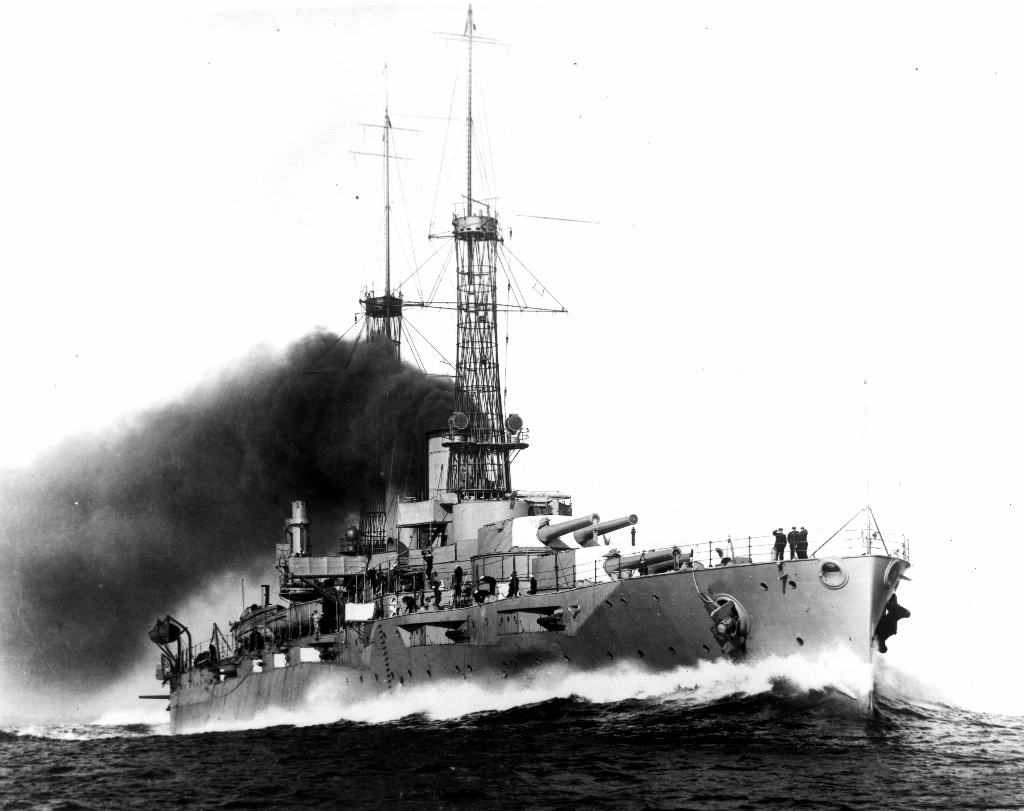
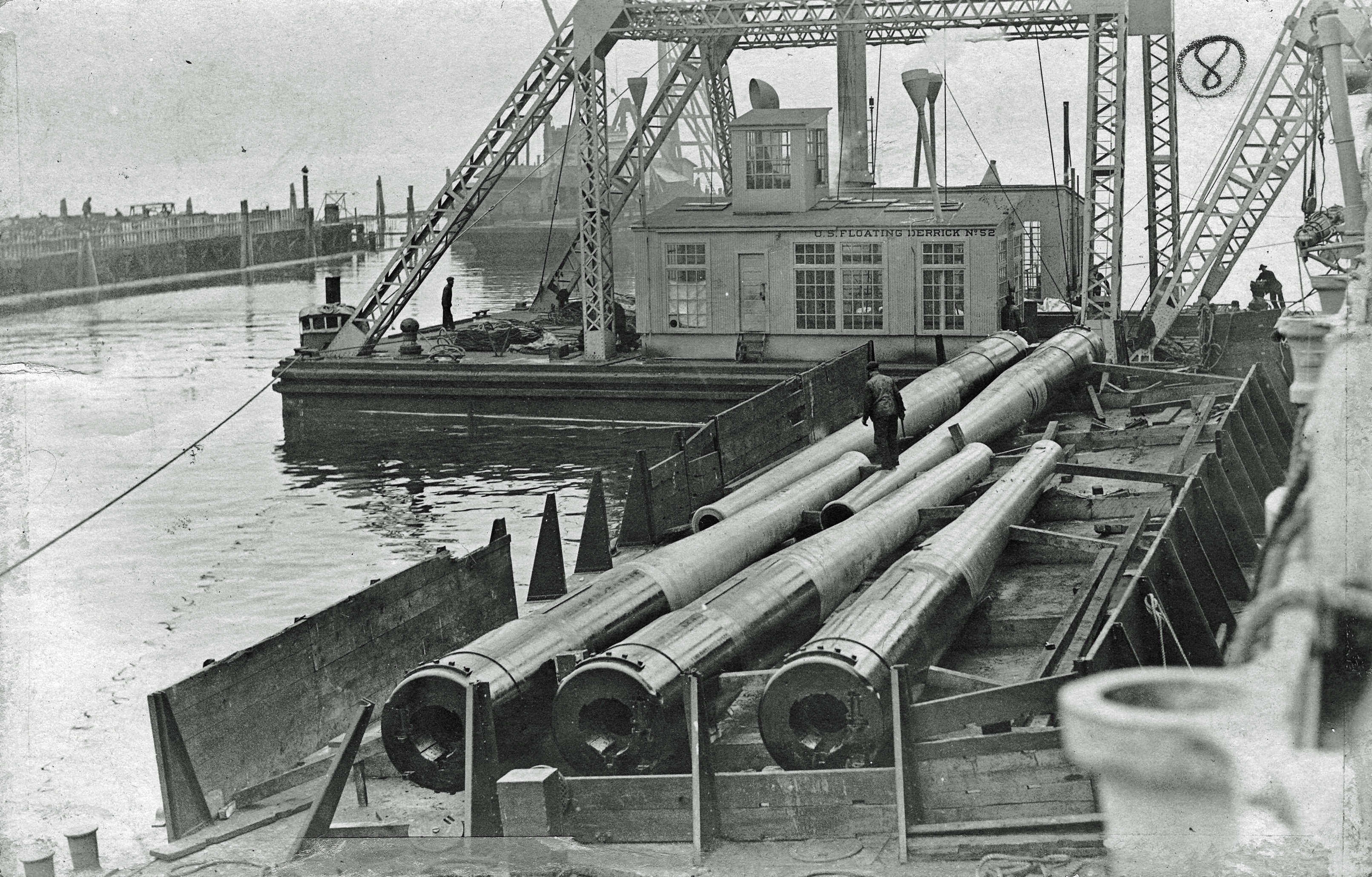
The first USN weapon in this caliber, it proved to be a reliable weapon although early units suffered from droop as the hoops were not adequately locked together.
The Mark 1 ran through fourteen modifications, the most notable being Mod 6 with the introduction of down-swinging breech plugs for confined turret spaces and Mod 12 which had an increased chamber size to allow for larger charges and thus higher muzzle velocities. The original design of Mark 1 Mod 1 was A tube without liner, jacket, eight hoops and a screw box liner. The drooping problem was rectified by adding four hoop-locking rings and replacing the foremost hoop of the outer layer with a longer one. Most guns were also relined during this modification.
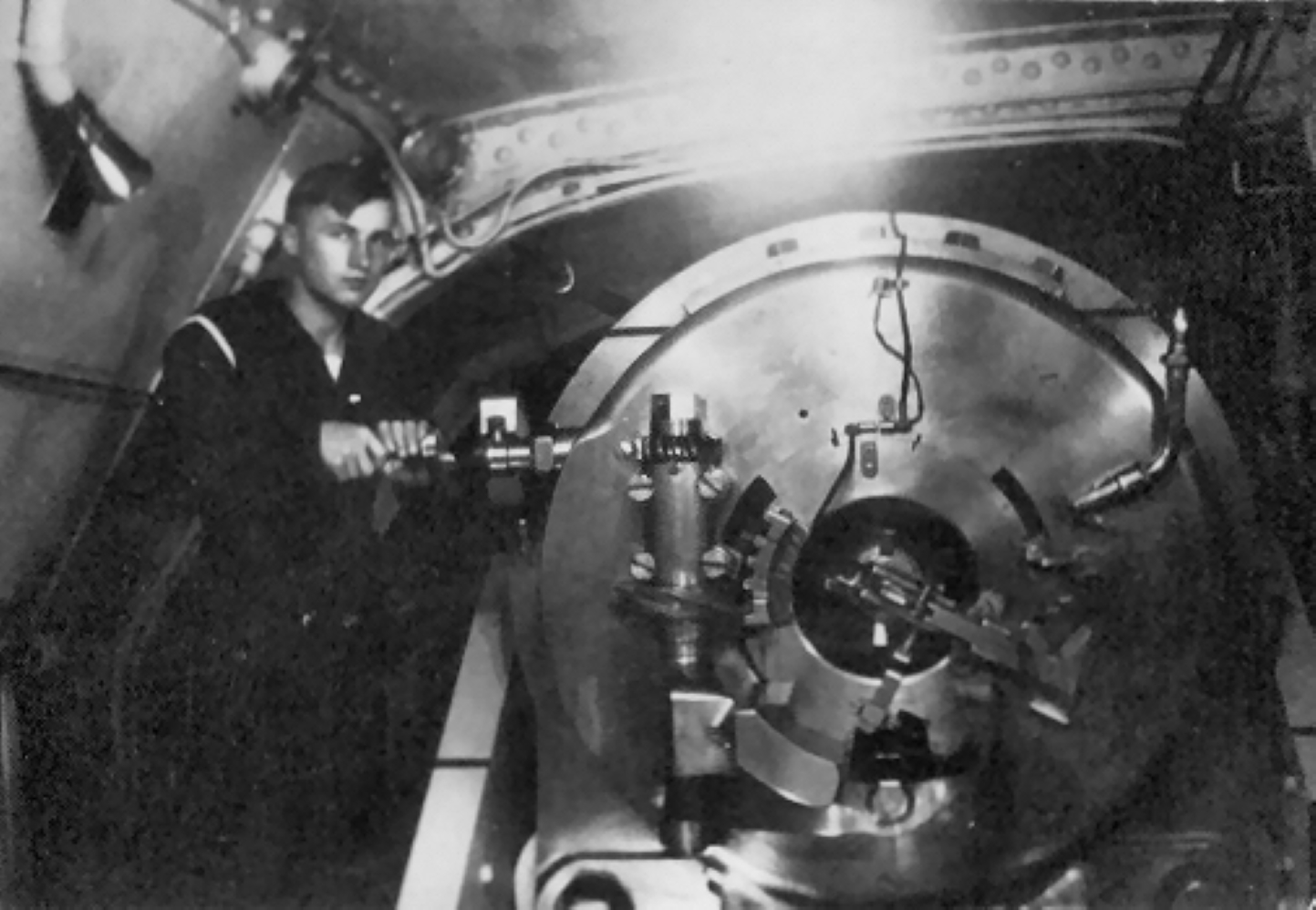
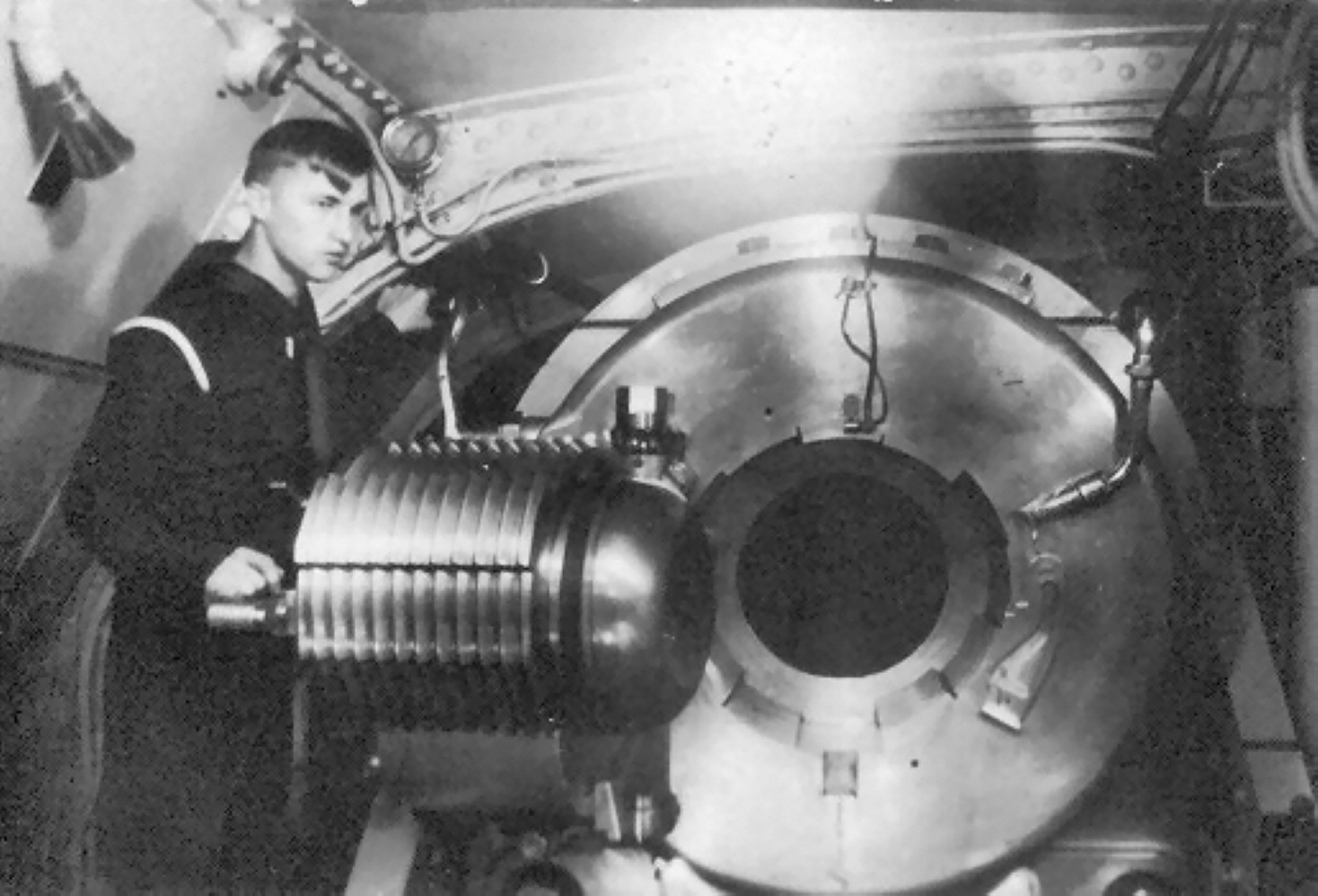
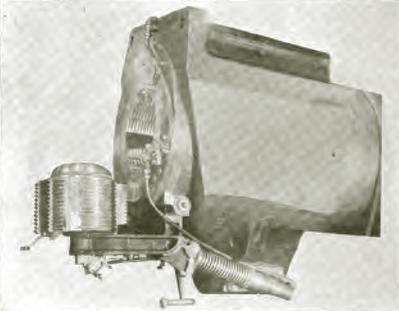
The Mark 2 was very similar to the Mark 1, the Mark 3 introduced a longer slide and had only three hoop locking rings and the Mark 5 was of simpler construction with only five hoops. These guns were interchangeable and most battleships had a combination of Mark numbers. The Marks and Mods used on USS New York (BB-34) and USS Texas (BB-35) used Fletcher side-swinging breech mechanisms while those Marks and Mods used on the later battleship classes used Smith-Asbury down-swinging breech mechanisms. All guns used Welin breech plugs.
These guns were rebuilt and redesignated in the 1930s. See the 14"/45 (35.6 cm) Mark 8 data page for information.
There is a myth that these guns were used at Fort Drum in the Philippines. Actually, those guns were Army 14"/40 (35.6 cm) Model 1909, which were unusual for US guns in being wire-wound.
| Designation | 14"/45 (35.6 cm) Marks 1, 2, 3 and 5 |
|---|---|
| Ship Class Used On | New York (B-34), Nevada (B-36) and Pennsylvania (B-38) classes |
| Date Of Design | About 1910 |
| Date In Service | 1914 |
| Gun Weight | Without Breech: 140,670 lbs. (63,807 kg)
With Breech: 142,492 lbs. (64,633 kg) |
| Gun Length oa | 642.5 in (16.318 m) |
| Bore Length | 630 in (16.002 m) |
| Rifling Length | 542.7 in (13.530 m) |
| Grooves | 84 |
| Lands | N/A |
| Twist | Mark 1 Mods 1 to 6: Increasing RH 1 in 50 to 1 in 32 at the muzzle
Mark 1 Mod 7 to 14: Uniform RH 1 in 32 Marks 2, 3 and 5: Uniform RH 1 in 25 |
| Chamber Volume | Original Design: 15,332 in3 (251.2 dm3)
Mark 1 Mod 12: 18,200 in3 (298.2 dm3) |
| Rate Of Fire | New York class - about 1.25 - 1.5 rounds / minute 1 Nevada and Pennsylvania classes - about 1.5 - 1.75 rounds / minute 2 |
- ^The ammunition handling on the New York class was very labor intensive; it took much manual handling to get the shells and cartridges into the breech. The ROF given above is based upon estimates provided by Tom Scott of Battleship Texas.
- ^The Nevada class added power ramming and had a smoother ammunition flow to the guns, thus improving their ROF.
| Type | Bag |
|---|---|
| Projectile Types and Weights 1a | AP Marks 5, 6 and 7 (Early AP): 1,400 lbs. (635.0 kg)
AP Mark 8 Mods 1 to 10: 1,400 lbs. (635.9 kg) - 1,402 lbs. (635.9 kg) 2a: Class B (Common) Mark 9: 1,400 lbs. (635.0 kg) Class B (Common) Mark 11: 1,177.4 lbs. (534.1 kg) Target Mark 4: 1,400 lbs. (635.0 kg) |
| Bursting Charge | Early AP: 30.5 to 31.5 lbs. (13.8 to 14.3 kg) Explosive D
AP Mark 8: 29.5 to 31.5 lbs. (13.4 to 15.6 kg) - 34.3 lbs. (15.5 kg) Explosive D 2a Class B (Common) Mark 9: 88.4 lbs. (40.1 kg) Explosive D Class B (Common) Mark 11: 135.0 lbs. (61.2 kg) Explosive D |
| Projectile Length | AP: 49.44 in (125.6 cm) 3a Class B (Common) Mark 9: 56.0 in (142.2 cm) Class B (Common) Mark 11: 62.05 in (157.6 cm) Target Mark 4: 49.39 in (125.4 cm) |
| Propellant Charge 4a | Original charge (for original chamber): 365 lbs. (165.6 kg) SPD
Enlarged charge (for modified chamber): 420 lbs. (190.5 kg) SPD |
| Muzzle Velocity | With original charge: 2,600 fps (792 mps)
With enlarged charge: 2,700 fps (823 mps) |
| Working Pressure | 18 tons/in2 (2,835 kg/cm2) |
| Approximate Barrel Life | 150 rounds |
| Ammunition stowage per gun | 100 rounds |
- ^The AP Mark 8 had a thin cap and a very small windshield. Common was obsolete by 1915 and no longer in production.
- ^Each Contractor was responsible for the design and function of the AP Cap and windshield. As a result, the overall shell length of each Mod could be slightly different from the other Mods. The length shown above is an average.
- ^Propellant was in four bags.
- Bourrelet diameter was either 13.977 or 13.985 inches (35.50 or 35.52 cm)
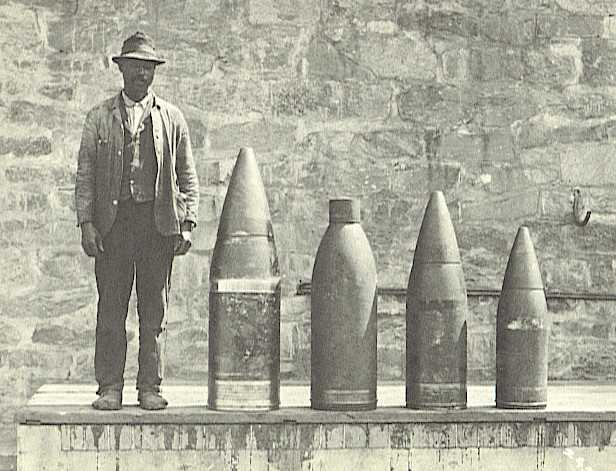
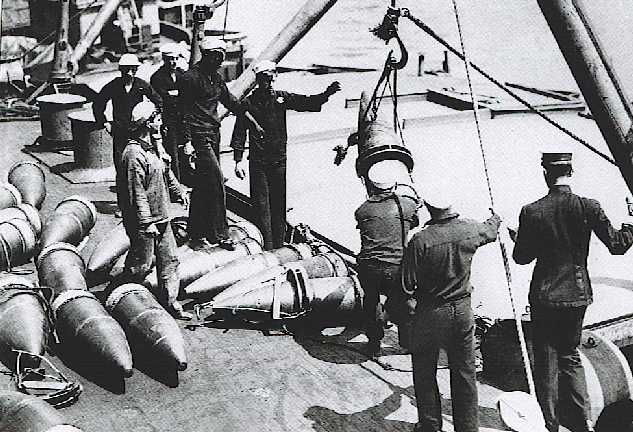
- The New York class used padeyes attached the base of the projectile for handling. These were removed before firing. See photograph below.
| Elevation | Range | Angle of Fall | Time of Flight | Striking Velocity | Maximum Ordinate |
|---|---|---|---|---|---|
| 1.78 degrees | 4,000 yards (3,658 m) | 1.93 degrees | 4.91 seconds | 2,303 fps (702 mps) | 97 ft (30 m) |
| 3.88 degrees | 8,000 yards (7,315 m) | 4.58 degrees | 10.47 seconds | 2,033 fps (620 mps) | 442 ft (129 m) |
| 5.08 degrees | 10,000 yards (9,144 m) | 6.25 degrees | 13.55 seconds | 1,910 fps (582 mps) | 739 ft (225 m) |
| 6.41 degrees | 12,000 yards (10,973 m) | 8.18 degrees | 16.84 seconds | 1,797 fps (548 mps) | 1,141 ft (348 m) |
| 9.44 degrees | 16,000 yards (14,630 m) | 13.02 degrees | 24.12 seconds | 1,604 fps (489 mps) | 2,344 ft (714 m) |
| 13.08 degrees | 20,000 yards (18,288 m) | 19.12 degrees | 32.40 seconds | 1,457 fps (444 mps) | 4,248 ft (1,294 m) |
| 15.17 degrees | 22,000 yards (20,117 m) | 22.58 degrees | 36.93 seconds | 1,401 fps (427 mps) | 5,515 ft (1,681 m) |
- ^Values for AP Mark 8 from BuOrd OP 1188 page 44.
- ^As originally commissioned, all of these battleships had a maximum gun elevation of 15 degrees. At that elevation, for MV = 2,600 fps (792 mps) the range would be about 21,500 yards (19,660 m).
| Elevation | Range | Angle of Fall | Time of Flight | Striking Velocity | Maximum Ordinate |
|---|---|---|---|---|---|
| 1.66 degrees | 4,000 yards (3,658 m) | 1.80 degrees | 4.74 seconds | 2,374 fps (724 mps) | 90 ft (27 m) |
| 3.63 degrees | 8,000 yards (7,315 m) | 4.30 degrees | 10.15 seconds | 2,089 fps (637 mps) | 414 ft (126 m) |
| 4.75 degrees | 10,000 yards (9,144 m) | 5.88 degrees | 13.12 seconds | 1,962 fps (598 mps) | 693 ft (211 m) |
| 5.97 degrees | 12,000 yards (10,973 m) | 7.70 degrees | 16.29 seconds | 1,846 fps (563 mps) | 1,064 ft (324 m) |
| 8.75 degrees | 16,000 yards (14,630 m) | 12.13 degrees | 23.21 seconds | 1,653 fps (504 mps) | 2,176 ft (663 m) |
| 12.03 degrees | 20,000 yards (18,288 m) | 17.67 degrees | 30.99 seconds | 1,506 fps (459 mps) | 3,905 ft (1,190 m) |
| 13.88 degrees | 22,000 yards (20,117 m) | 20.78 degrees | 35.24 seconds | 1,450 fps (442 mps) | 5,035 ft (1,535 m) |
| 15.91 degrees | 24,000 yards (21,946 m) | 24.13 degrees | 39.75 seconds | 1,407 fps (429 mps) | 6,390 ft (1,948 m) |
| Range | Side Armor | Deck Armor |
|---|---|---|
| 6,000 yards (5,490 m) | 17.2" (437 mm) | --- |
| 9,000 yards (8,230 m) | 14.4" (366 mm) | --- |
| 12,000 yards (10,920 m) | 11.9" (302 mm) | --- |
| 16,000 yards (14,630 m) | 8.9" (226 mm) | --- |
| 20,000 yards (18,290 m) | 6.7" (170 mm) | --- |
- This data is from BuOrd table "Elements of US Naval Guns" of 17 May 1918 as published in "US Naval Weapons" and is for face-hardened (Harvey) plates.
| Designation | Two-gun Turrets
New York (5) and Nevada (2) Triple Turrets 1e |
|---|---|
| Weight | Two-gun Turret
New York Class: 506 tons (514 mt) Nevada Class: 532 tons (541 mt) Triple Turret
|
| Elevation | -5 / +15 degrees |
| Rate of Elevation | 4 degrees per second |
| Train | about -150 / +150 degrees |
| Rate of Train | 1.7 degrees per second |
| Gun Recoil | 40 in (102 cm) |
| Loading Angle | 0 degrees |
- ^A prototype triple turret was completed in August 1911. Firing tests with it in 1912 showed excessive dispersion. To correct the problems, the turrets had a 0.10 second delay added between guns. The firing order was center, right, left. This reduced the dispersion to 69 yards (63 m) in range and 7 yards (6 m) in deflection (range not given). This was considered to be at least as good as a single gun.
- The two-gun turrets were individually sleeved but the triple turrets were not. All turrets were electrically powered with hydraulic drive gears for training and elevation.
- The New York class used a 25 hp motor for training while the later ships used a 50 hp motor. Each gun on the New York class had a 15 hp motor for elevation. The Nevada class had a 30 hp elevation motor for each gun in the two-gun turrets, while the triple turrets on this class and all turrets on the Pennsylvania class had a single 40 hp elevation motor.
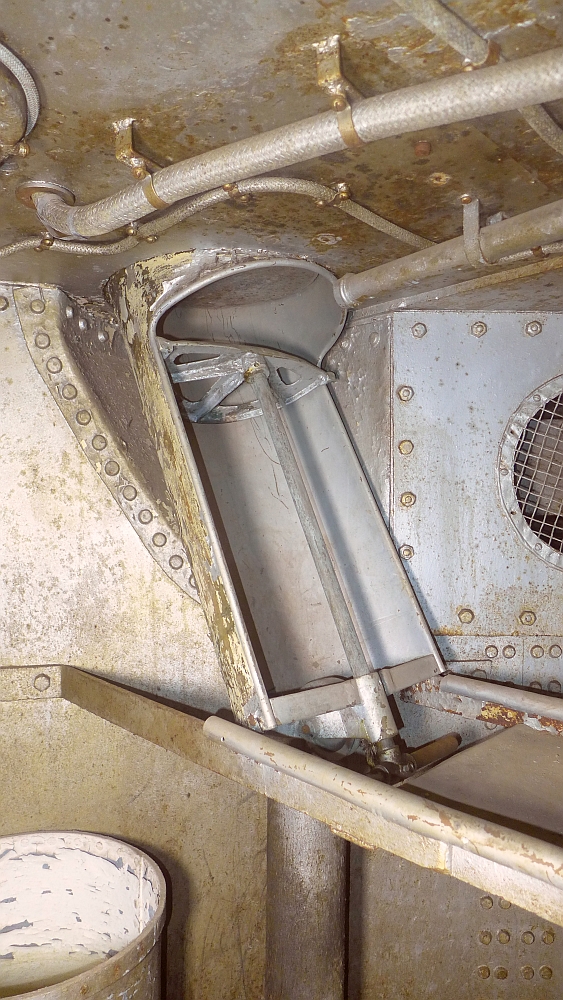
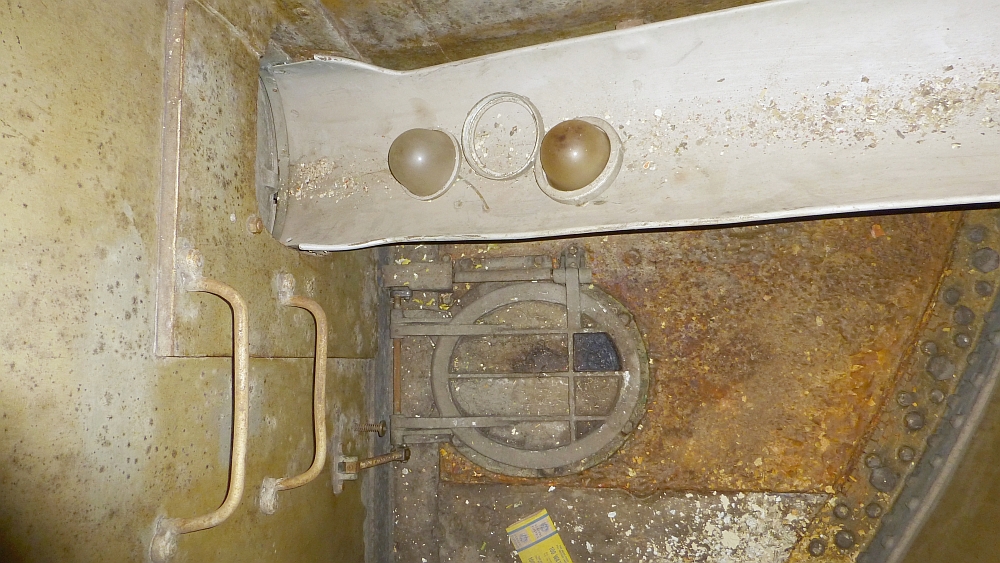
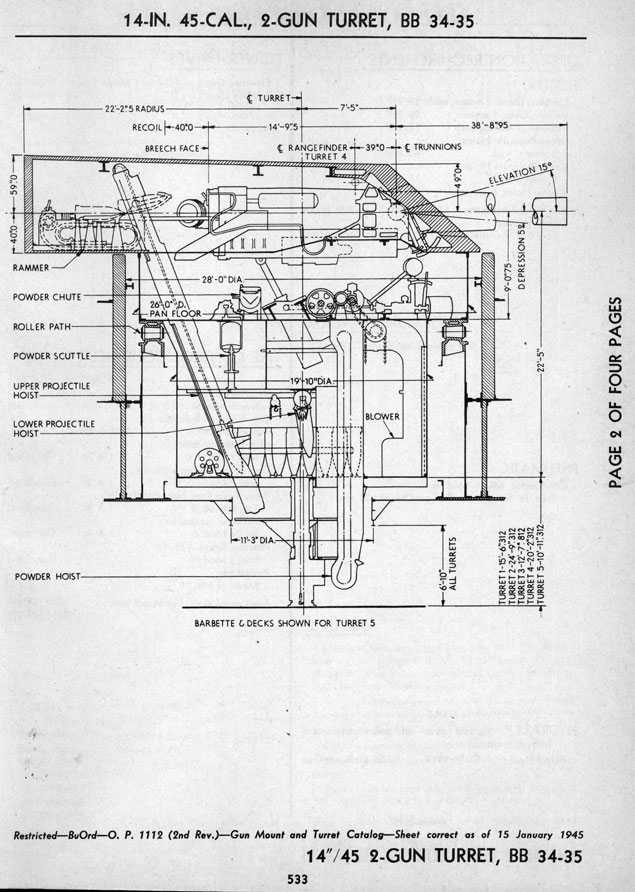
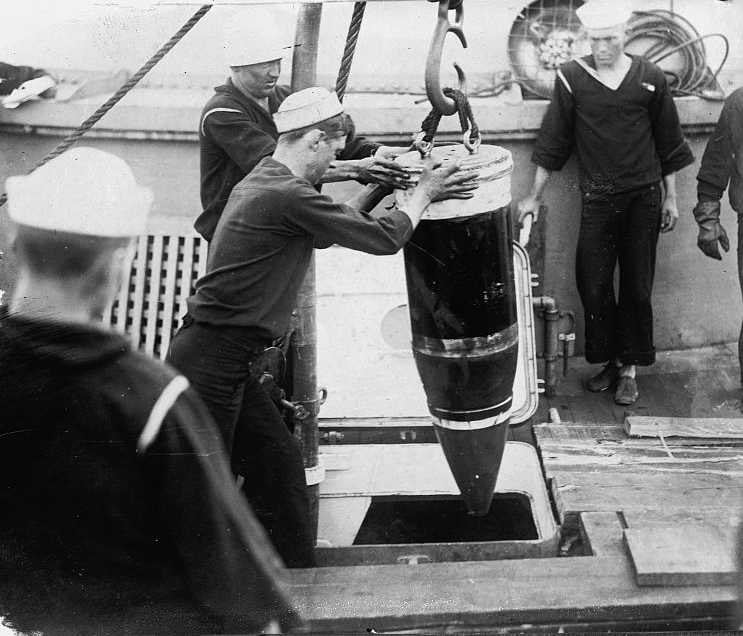
- The New York class stored projectiles nose-downwards in the shell rooms. These were moved by man-powered block and tackle on a chain trolley to a lower handling room. From here, a lower projectile hoist, powered by a 10 hp motor, ran between the lower shell handling room and an upper shell handling room located within the rotating structure. This upper handling room held 15 ready projectiles per gun. Each gun in the two-gun turrets had a bucket hoist which ran between the upper shell handling room up to the loading position. The bucket hoists were powered by 40 hp motors. Projectiles were stored, handled and hoisted nose-downwards at all times until they reached the loading station. There was a single lower powder hoist for each turret that went to a handling room directly below the gun house. From there the charges were moved via a manually worked "hoist car" (labeled as "Powder Scuttle" in the sketch below) up to a small "side pocket" compartment and thence to the guns. See photographs below. A powered rammer was used for the projectiles while the charges were hand loaded into the guns. Breech mechanisms were hand operated and the breech plugs swung sideways. As mentioned above, the New York class was originally equipped with Fletcher breech mechanisms that were later replaced with Smith-Asbury breech mechanisms.
- The two-gun turrets on the Nevada class had a pusher shell hoist for each gun within the rotating structure. These ran directly from the shell handling room to the loading position. The shells were stowed on their bases and parbuckled from the fixed structure to the handling room. The powder hoists ran directly to the gun house where the charges were transferred to enclosed powder trays and then into the gun rooms.
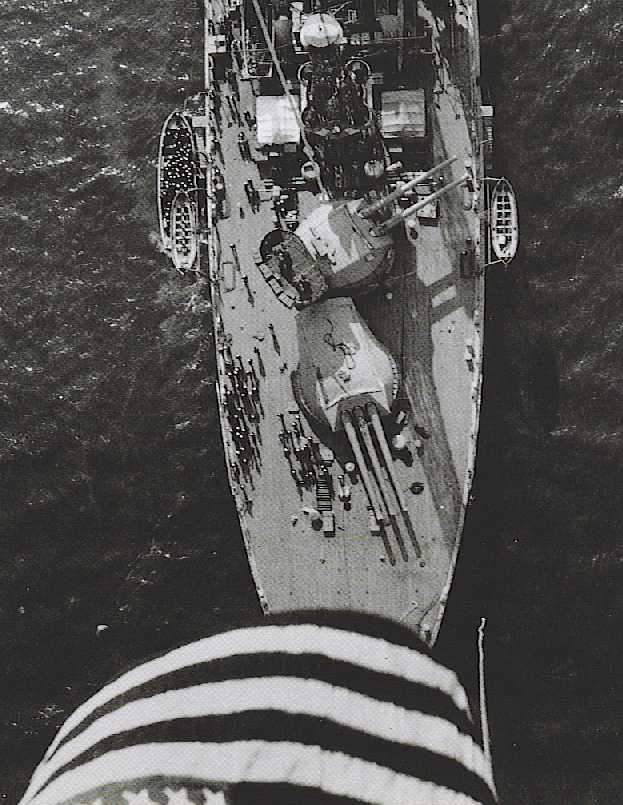
- The triple turrets were supplied by two shell and two powder hoists. The left shell hoist supplied the center gun. Shell hoists came up in-between the guns. These hoists were similar to the ones in the two-gun turrets used on the Nevada class, except that in the Nevada class the shell hoists were each powered from a 30 hp motor and by 60 hp motors on the Pennsylvania class. There were also two auxiliary shell hoists that came up outside the guns. Each powder hoist was powered by a 10 hp motor. Powder bags were taken from the storage cans in the powder magazine and passed by hand to the powder hoists. The hoists ran directly up to the gunhouse powder rooms (one on each side of the turret) where they were slid over to an enclosed "powder tray" and then passed through doors on the sides of the turret into the gunroom. This made for a two-step powder passage, meaning that there was always at least one closed door between the gunroom and the powder hoist. Once in the gunroom, the bags were passed by hand to the loaders who placed them into the loading trays. As there were only two hoists for each triple turret, powder bags for the center guns had to be lifted over the outer guns. A total of 12 bags were needed to load all three guns with a full charge. Both shells and bags were rammed mechanically.
- A Note on Sources: "Naval Weapons of World War Two" mistakenly says three powder hoists per turret, but diagrams in my possession clearly show that there were only two, one on each side of the turret.
- Trials with a three-gun mock up showed dispersion problems. Adding a 0.1 second delay between guns solved the problems. The guns were fired center-right-left order.
- The center gunport on the triple turrets had a rounded bottom while the outer gunports had a square bottom. The tops of all three gunports were rounded.
- The distance between gun axes on USS Texas was measured at 87.25 inches (221.6 cm) by the assistant curator in 2009. The distance between gun axes on the triple turrets was about 59 in (150 cm).
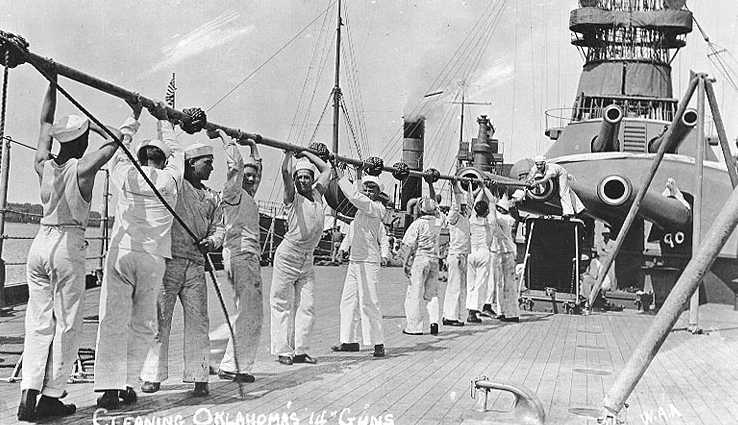
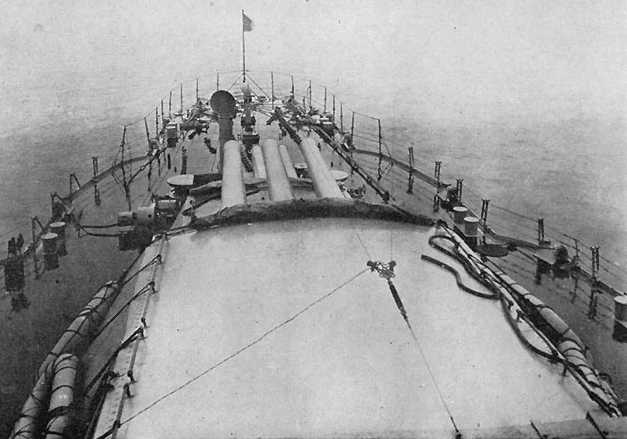
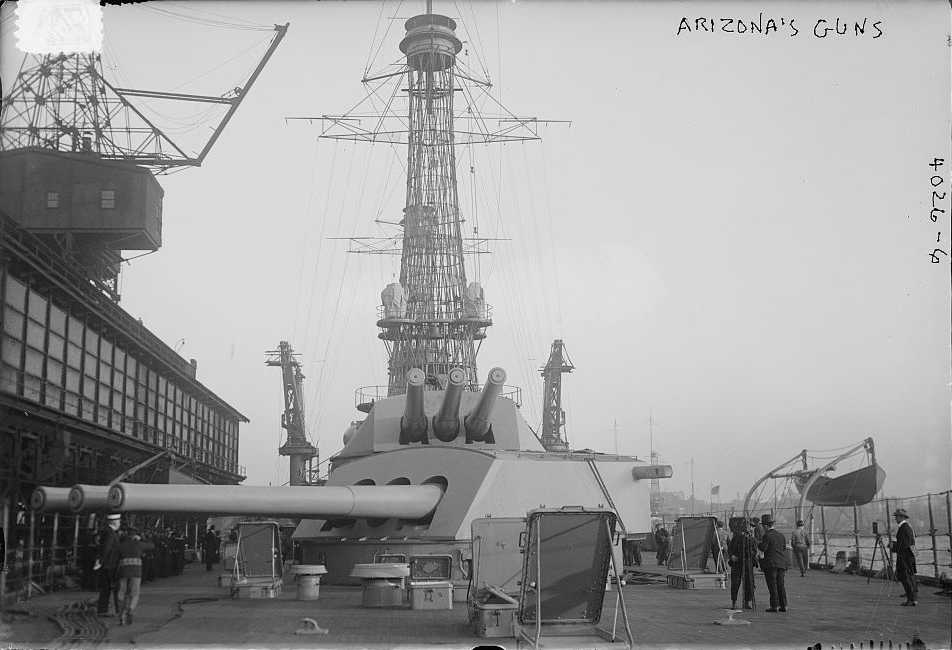
Tom Scott documents and videos of Battleship Texas:
- How 14" (35.6 cm) shells were stored
- Operation of 14" and other guns
- 14"/45 (35.6 cm) Gun Design
---
Gene Slover's Navy Pages
"Naval Weapons of World War Two" by John Campbell
"Powder and Propellants: Energetic Materials at Indian Head, Maryland, 1890-2001 - Second Edition" by Rodney Carlisle
"Naval Weapons of World War One, "US Battleships: An Illustrated Design History", "Battleship Design and Development 1905-1945" and "US Naval Weapons" all by Norman Friedman
"Battleships: United States Battleships, 1935-1992" by W.H. Garzke, Jr. and R.O. Dulin, Jr.
Seacoast Fortifications of the United States: An Introductory History" by Emanuel Raymond Lewis
"Round Shot to Rockets: A History of the Washington Navy Yard and the United States Naval Gun Factory" by Taylor Peck
"Battleships" by Paul Stillwell
---
"Main Battery Guns of Battleship Texas (BB-35)" an unpublished monograph dated 26 August 2002 by Christopher C. Wright, Editor, Warship International
---
"Naval Ordnance - A Text Book" revised in 1915 by Lt. Cmdr. Roland I. Curtain and Lt. Cmdr. Thomas L. Johnson
"Navy Ordnance Activities: World War, 1917-1918 by Bureau of Ordnance (BuOrd), Department of the Navy, Department of Ordnance and Gunnery, U.S. Naval Academy
"Range and Ballistic Tables 1935" by Department of Ordnance and Gunnery, U.S. Naval Academy
"Breech Mechanism - General Description of All 14-inch Breech Mechanisms in Service - Ordnance Pamphlet No. 283 - April 1930" by Department of the Navy
"Abridged Range Tables for U.S. Naval Guns - Ordnance Pamphlet No. 1188 - 13 June 1944" by Bureau of Ordnance (BuOrd), Department of the Navy
"U.S. Explosive Ordnance - Ordnance Pamphlet No. 1664 - May 1947" by Bureau of Ordnance (BuOrd), Department of the Navy
---
Special help from Lee McIntire, Tom Scott, Travis Davis, William Jurens and Steve Blake
15 August 2008 - Benchmark
17 January 2009 - Added photograph of 14" (35.6 cm) shell being stowed
19 January 2009 - Updated ammunition information
15 September 2009 - Removed photograph mislabeled as "New York"
26 November 2009 - Added axes measurement for two-gun turrets
20 September 2010 - Added information on USS Texas turret arrangements, updated links to Tom Scott's website
22 April 2015 - Redid photograph of USS New York
11 July 2016 - Converted to HTML 5 format
04 October 2018 - Reorganized notes
10 March 2022 - Changed links to point at Wayback Archive, updated ROF, minor formatting changes
26 May 2023 - Added link to Gun Design video
22 June 2023 - Added comment about Fletcher and Smith-Asbury breech mechanisms
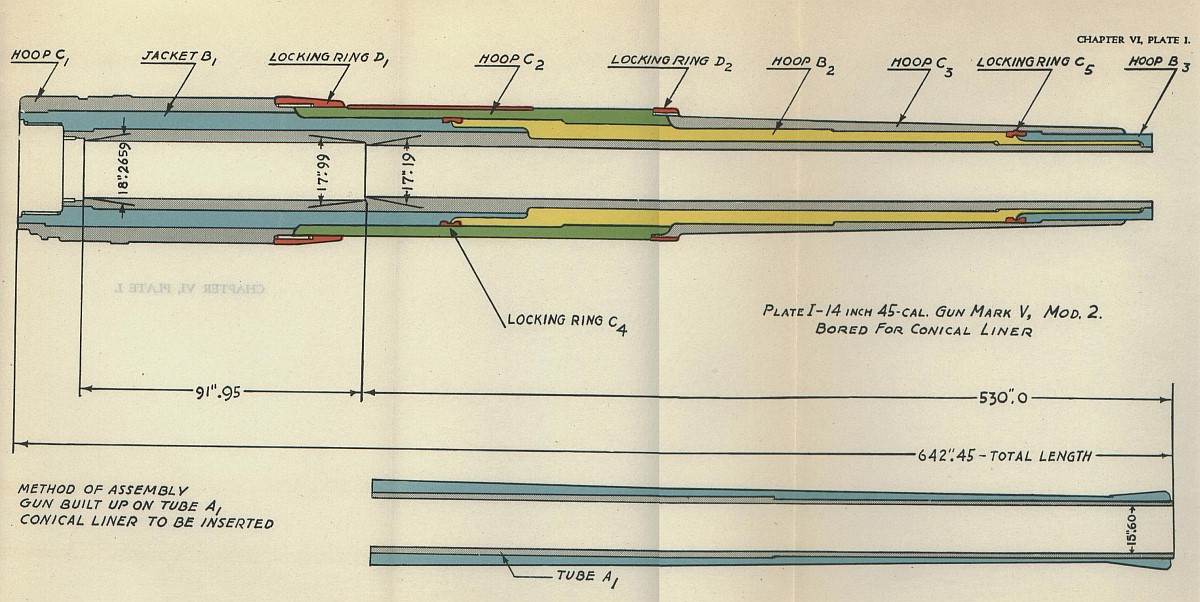
31 August 2023 - Added notes for ROF, revised range tables and added sketch of gun barrel
24 September 2023 - Added photographs of Fletcher Breech Mechanism on USS Texas
07 May 2025 - Added photographs showing hoist car and side pocket on the New York class and redid mounting notes regarding shell and powder hoists
28 August 2025 - Minor changes
20 December 2025 - Added information on Common projectiles and notes about shell weights, burster weights and shell length
03 February 2026 - Added details about shell and powder hoists in triple turrets