
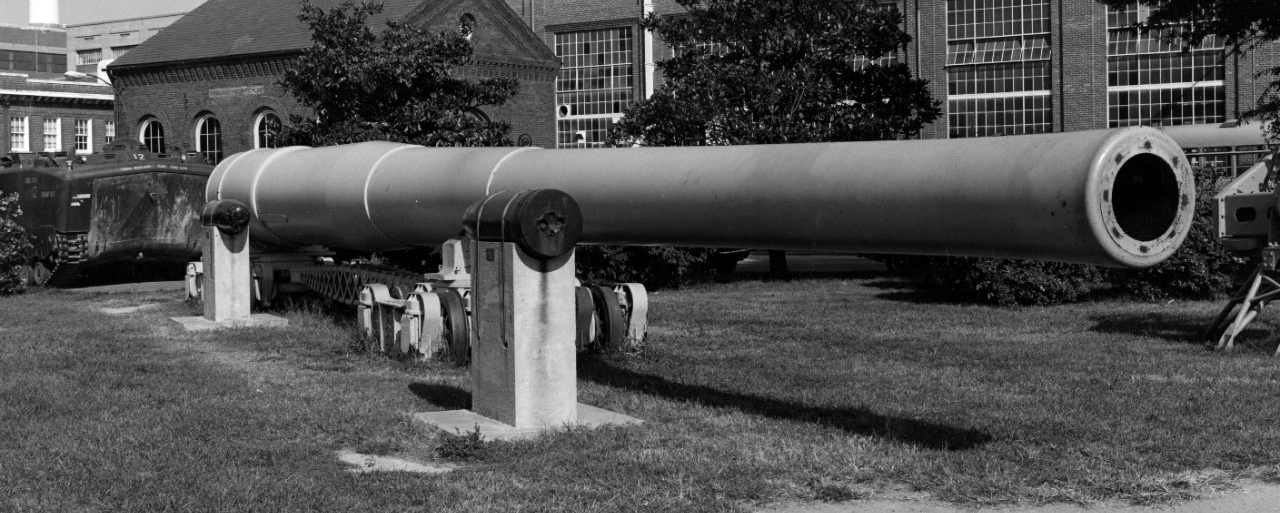
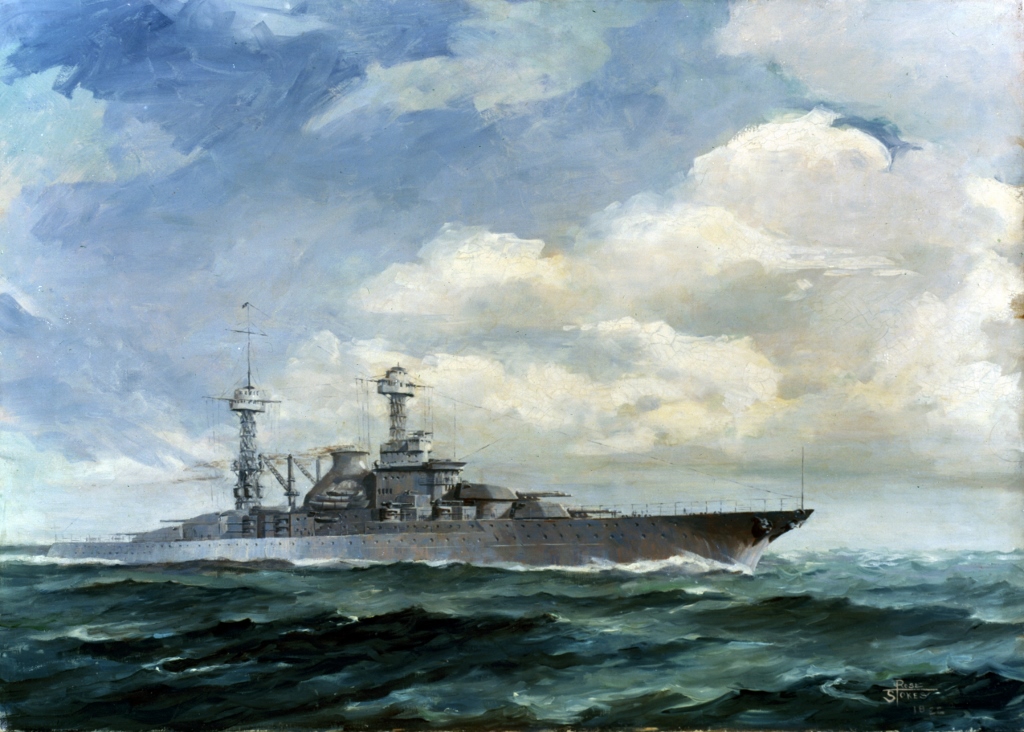
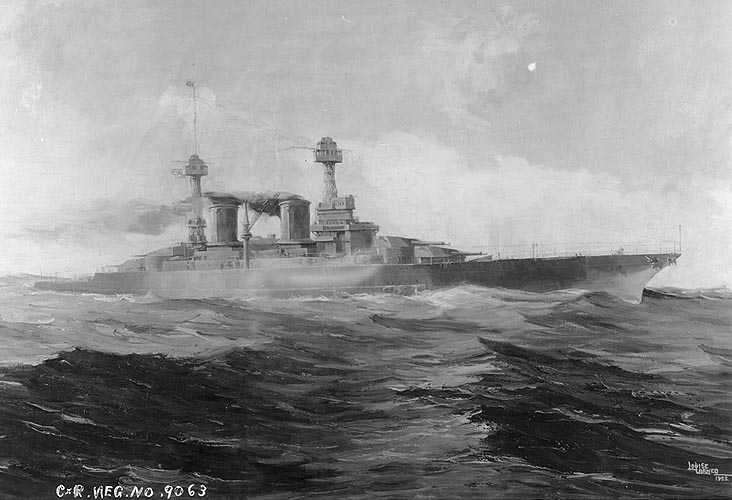
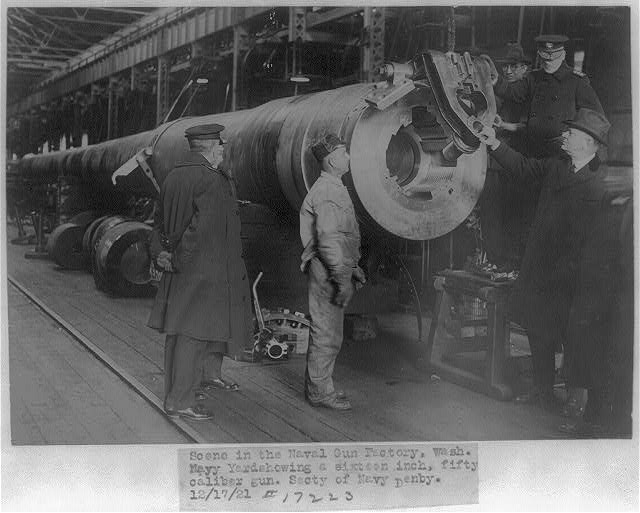
The prototype for this gun was proved on 8 April 1918 and production started soon afterwards, but these guns were destined never to be used on a warship. They were originally intended for the Lexington (CC-1) class battlecruisers and for the South Dakota (BB-49) class battleships, all of which were cancelled in 1922 as a result of the Washington Naval Limitation Treaty. In the late 1930s, it was planned to use these weapons to arm the Iowa class (BB-61) battleships but, through a comedy of errors, the ship barbette design and the mounting design were incompatible with each other. This forced BuOrd into a new gun design and development for the Iowa class battleships, which fortunately resulted in the excellent 16"/50 (40.6 cm) Mark 7.
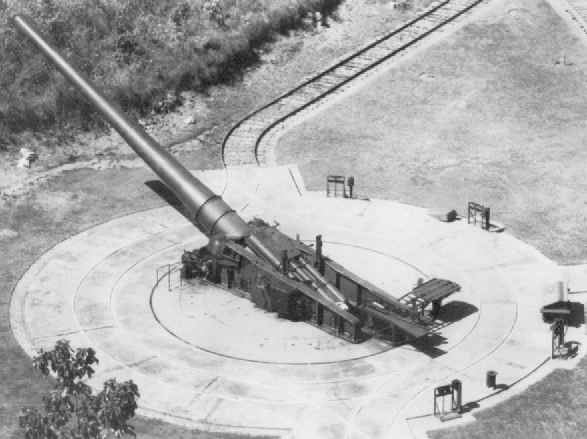
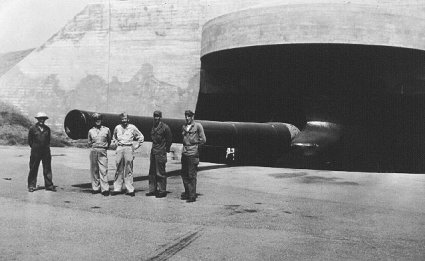
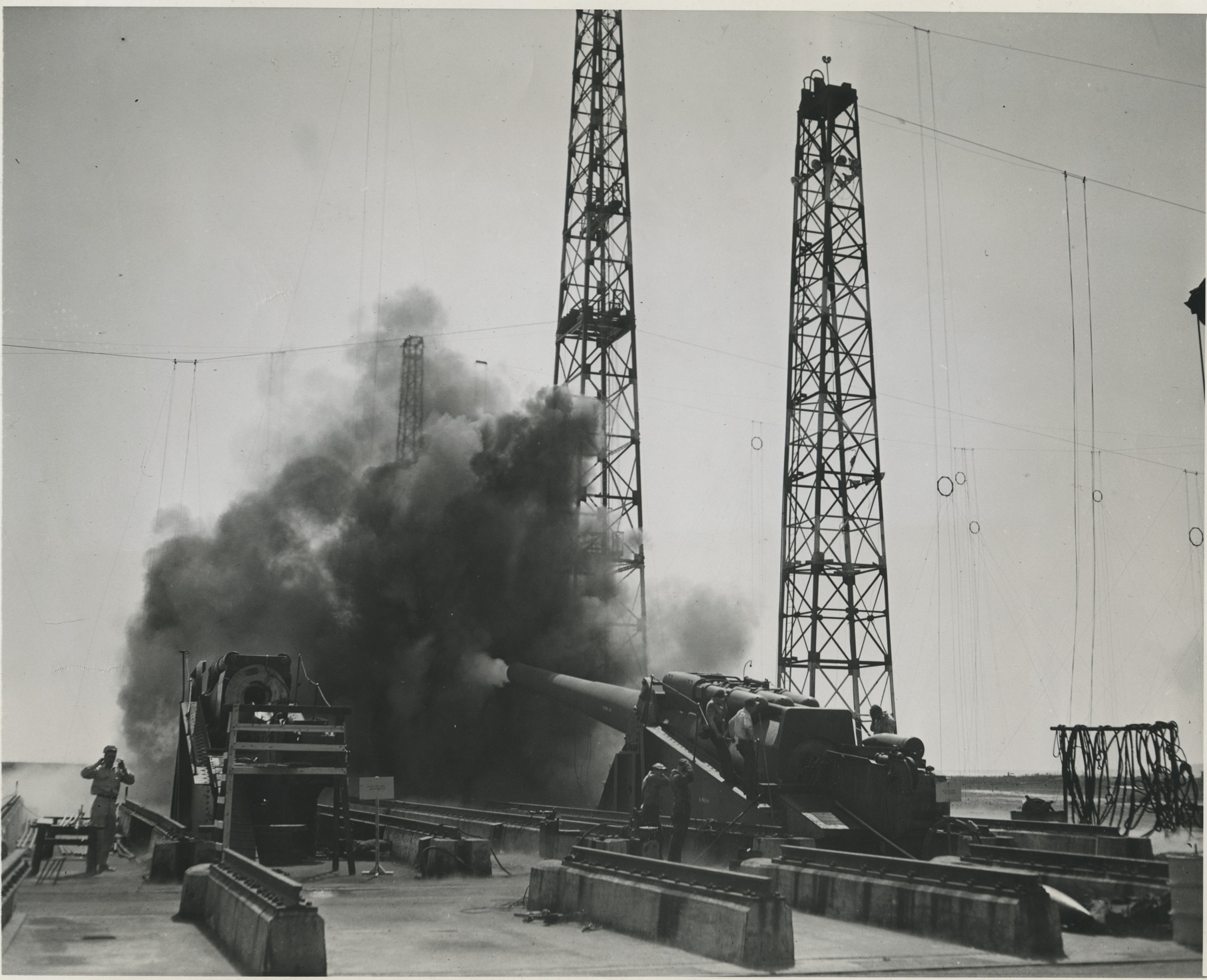
As a result of these ship cancellations and redesigns, most of these Mark 2 and Mark 3 guns wound up being used by the US Army as Coast Defense Artillery. Twenty guns were transferred to the Army between 1922 and 1924 and all but three of the remaining guns were transferred in January 1941 following the Iowa fiasco. The Army considered these guns to be excellent weapons in that role and used them along with their own 16"/50 (40.6 cm) M1919. By August 1945 there were forty of these ex-naval guns in active coast defense batteries.
The Mark 2 was constructed of a liner, A tube, jacket, seven hoops, four hoop-locking rings and a screw box liner. Mod 0 had increasing twist while Mod 1 had uniform twist with a different groove pattern. The Mark 3 was very similar to the Mark 2, the only difference being that the Mark 3 had a one-step conical liner. Mark 3 Mod 0 had increasing twist while Mod 1 had uniform twist.
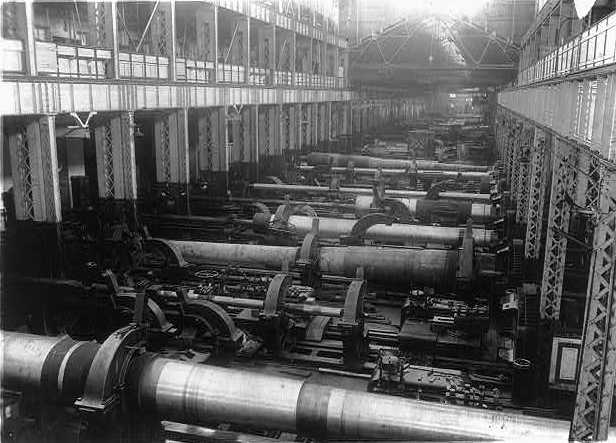
In October 1919, 88 guns were on order or contracted for and 62 additional guns were planned. Of the guns on order, 24 were to be finished at Bethlehem Steel Works, 24 by Midvale Steel Works and 40 by the Naval Gun Factory from forgings manufactured by Bethlehem and Midvale. When the battleships and battle cruisers were cancelled in 1922, 71 guns including the prototype had been completed and another 44 were in progress. At least five of the finished guns still exist as of this time (2019):
16"/50 (40.6 cm) Mark 2 No. 96 at the Naval Surface Warfare Center, Dahlgren, Virginia
16"/50 (40.6 cm) Mark 2 No. 100 at the Naval Surface Warfare Center, Dahlgren, Virginia
16"/50 (40.6 cm) Mark 2 No. 111 at the U.S. Navy Museum, Washington Navy Yard, Washington, DC
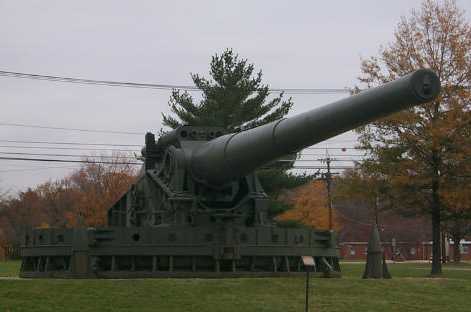
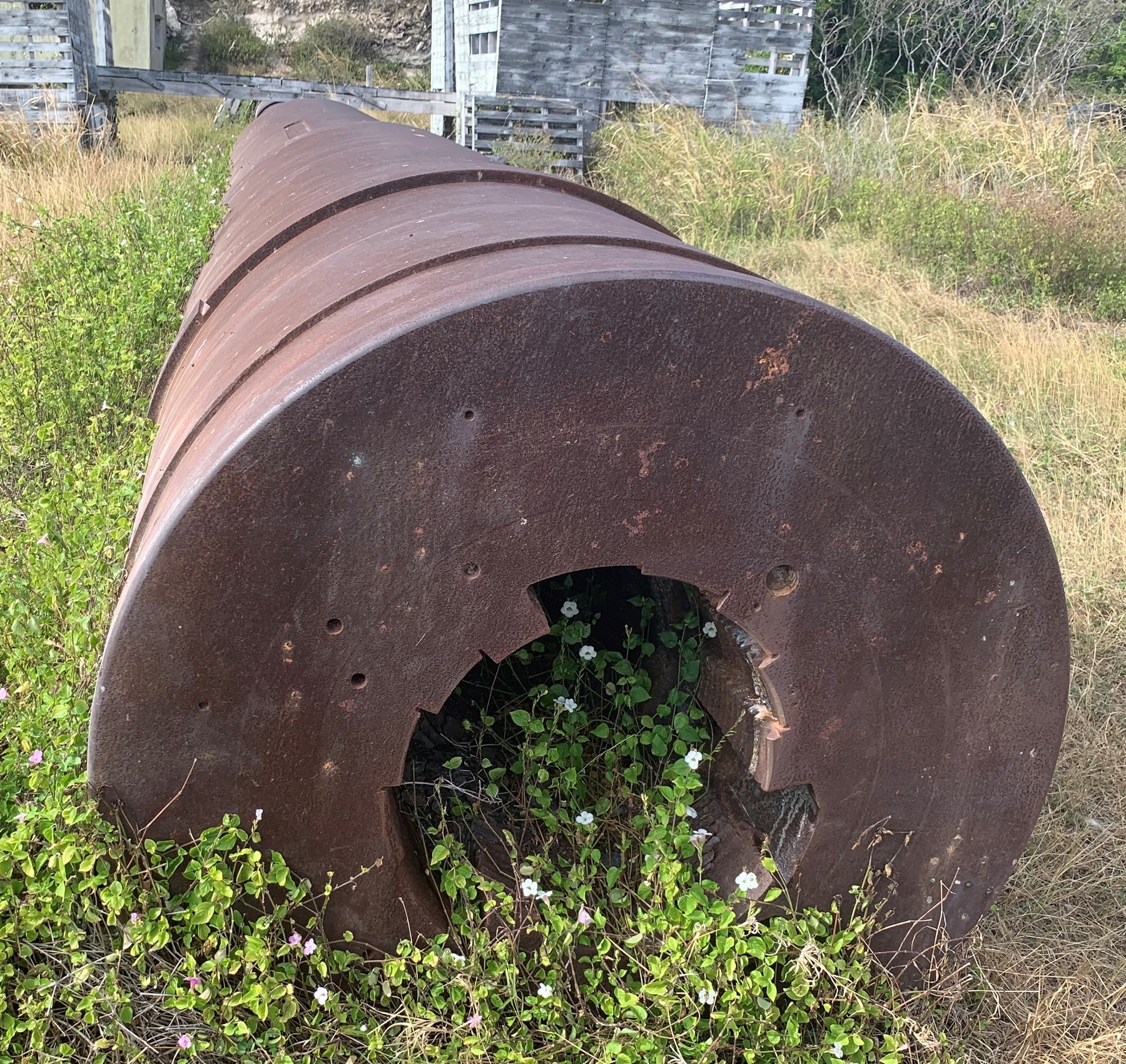
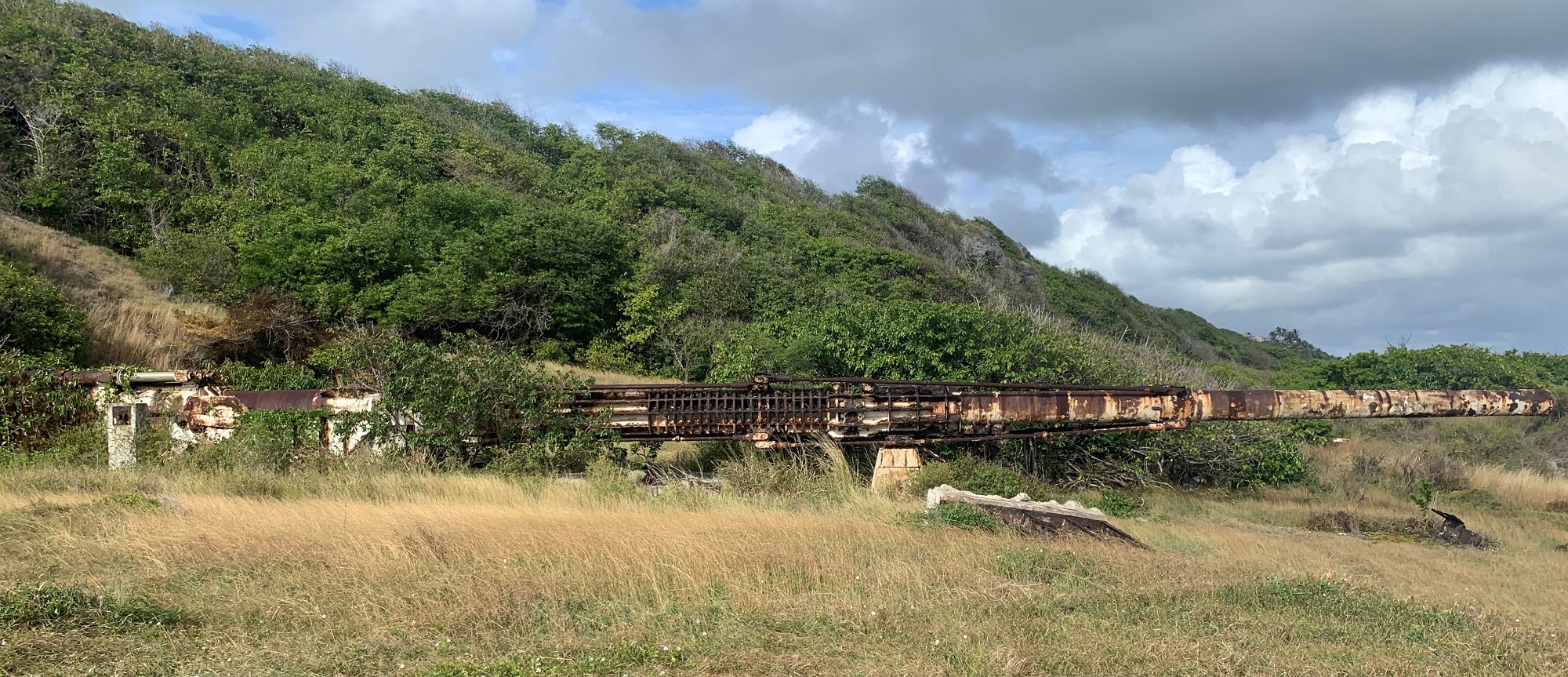
16"/50 (40.6 cm) Mark 2 Mod 1, No. 114 on the Island of Barbados
16”/50 (40.6 cm) Mark 3 Mod 1, No. 138 at the Aberdeen Proving Ground, Maryland
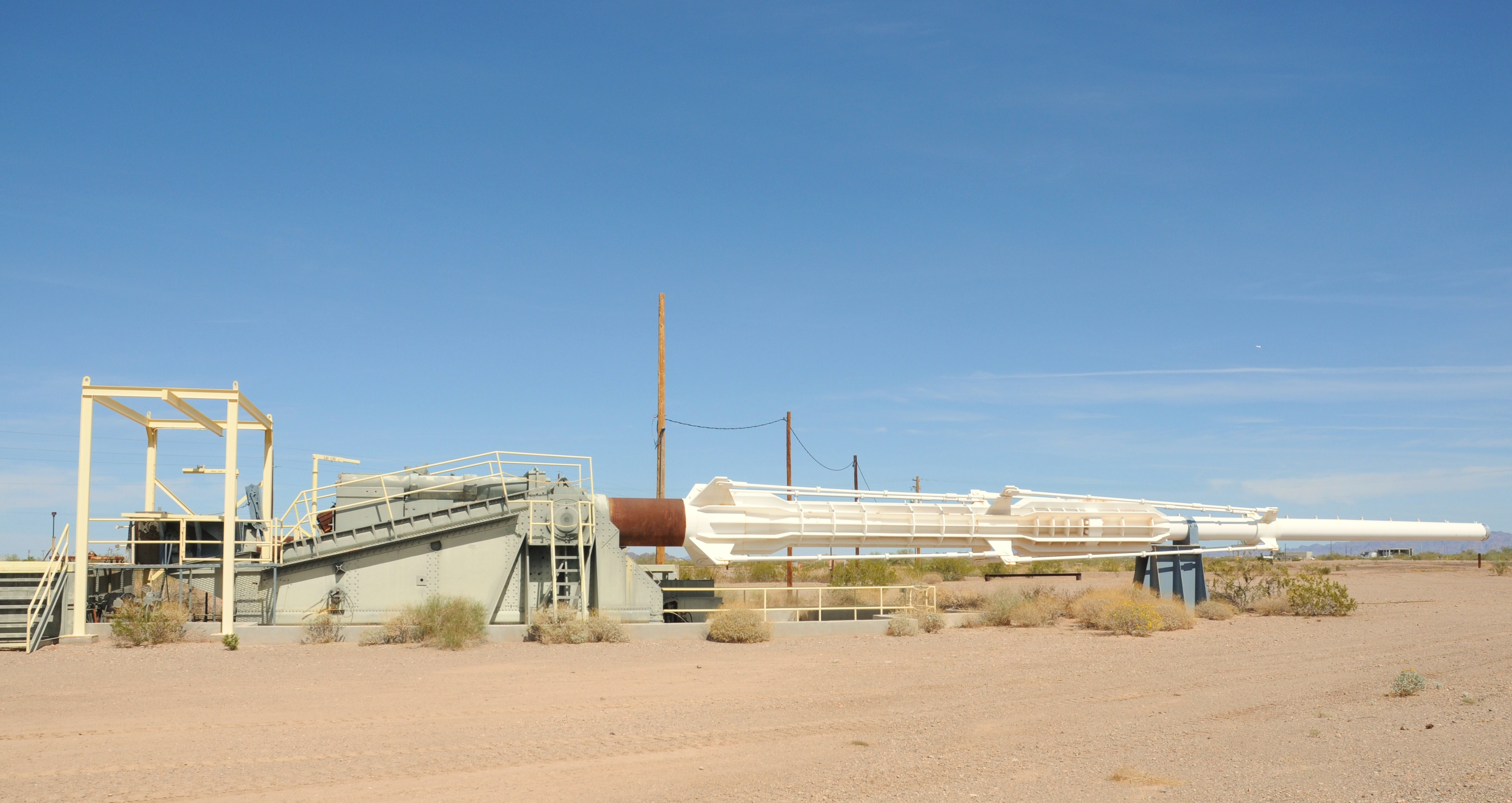
In the late 1930s, a sixth gun, 16"/50 (40.6 cm) Mark 3 Mod 1, No. 131, was modified to become a prototype for the Mark 7 and was then redesignated as the Mark D Mod 0. The Mark D prototype was later welded to a portion of a seventh barrel (Mark and serial number unknown) to create an extra long gun as part of the High Altitude Research Project (HARP) program of the 1960s. The Mark 2 Mod 1 No. 114 gun listed above was also used as part of the HARP program. Both of these guns were left in place and abandoned on Barbados when the HARP program ended. Another two 16" (40.6 cm) guns (Mark and Serial Numbers unknown) were used to create a second HARP double gun which is now located at the Yuma Proving Grounds in Arizona. See photographs below for more information on the guns used for the HARP program.
A Note on Sources: It is stated in some of the references listed below that no Mark 3 guns were ever completed. This is incorrect, as there were at least two Mark 3 guns completed: The 16"/50 (40.6 cm) Mark 3 Mod 1 No. 138 gun on display at the Aberdeen Proving Grounds Museum in Maryland and the Mark 3 Mod 1 No. 131 gun that was modified to become the Mark D Mod 0. This error is apparently due to notes in the BuOrd publication OP 127 "United States Naval Guns: Their Marks and Modifications" of 1942 which states "No Guns" for both the Mark 3 and the Mark 3 Mod 1. I believe that these BuOrd notes actually mean "no guns in active naval service" as they had all been transferred to the Army as described above or were being used for testing purposes.
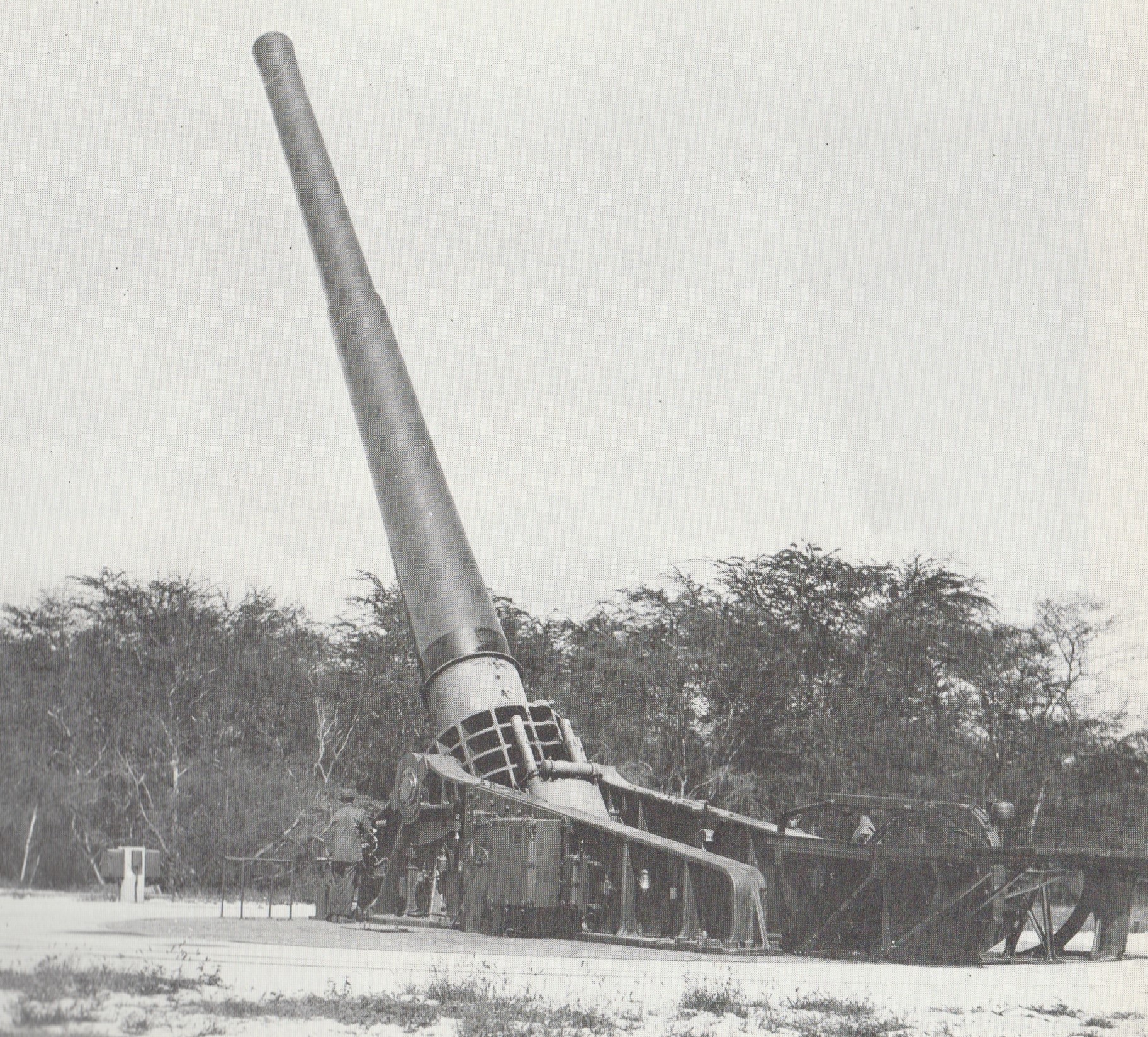
The US Army's 16"/50 (40.6 cm) M1919 coastal defense gun was an almost completely different design and was one of the few wire wound guns ever built in the USA. It weighed nearly 24 tons (25 mt) more than the Mark 2 and was about 0.5 calibers longer. A total of eight of these guns were built with six being used in three two-gun coastal defense batteries, the first of which was installed during 1923-1924 at Battery Williston, on the west side of the entrance to Pearl Harbor, "where they had a field of fire that completely encircled the island of Oahu [Hawaii] and reached beyond its shores at every point" - from "Seacoast Fortifications of the United States." The other two batteries were installed at Long Island, New York and at Boston, Massachusetts. All other 16" (40.6 cm) coastal batteries used the former naval guns.
| Designation | 16"/50 (40.6 cm) Mark 2 and Mark 3 |
|---|---|
| Ship Class Used On | Lexington (CC-1) and South Dakota (BB-49) classes |
| Date Of Design | 1916 |
| Date In Service | N/A - was to enter service in 1923 |
| Gun Weight | 128.15 tons (130.2 mt) |
| Gun Length oa | 816.0 in (20.726 m) |
| Bore Length | 800 in (20.320 m) |
| Rifling Length | 676.0 in (17.170 m) |
| Grooves | 96 |
| Lands | N/A |
| Twist | Mod 0: Increasing RH 1 in 50 to 1 in 32 at the muzzle
Mod 1: Uniform RH 1 in 32 |
| Chamber Volume | 30,000 in3 (491.6 dm3) |
| Rate Of Fire | 2 rounds per minute 1 |
- ^Coastal Defense guns had a ROF of one shot per minute.
| Type | Bag |
|---|---|
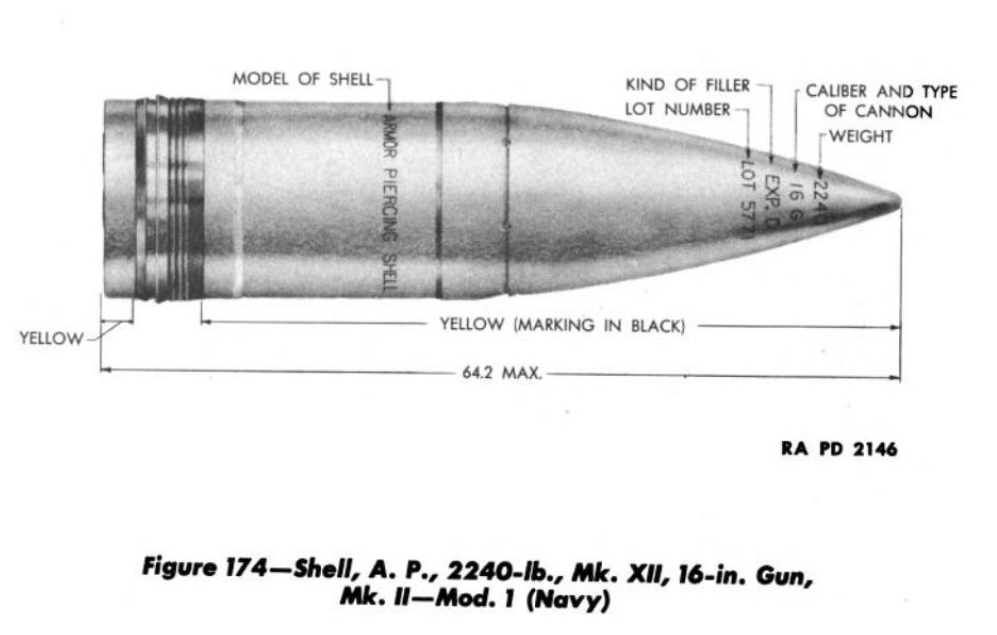
| Projectile Types and Weights | Ships
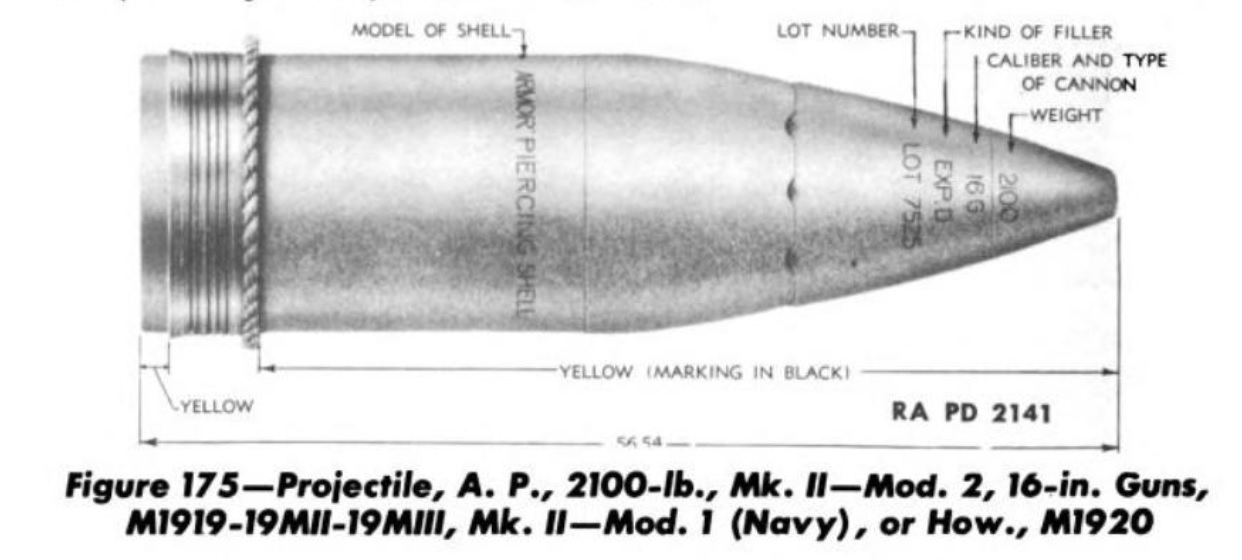
Navy AP Mark 3 - 2,110 lbs. (957.1 kg) Coastal Artillery
|
| Bursting Charge | Ships
AP Mark 3 - 57.5 lbs. (26.1 kg) Explosive D Coastal Artillery
|
| Projectile Length | Ships
AP Mark 3 - 56.5 in (143.5 cm) Coastal Artillery
|
| Propellant Charge 3a 4a | Ships
AP Mark 3 - 700 lbs. (318 kg) Coast Defense Batteries
|
| Muzzle Velocity | Ships
AP Mark 3 - 2,800 fps (853 mps) Coast Defense Batteries
|
| Working Pressure | 18.0 tons/in2 (2,835 kg/cm2) |
| Approximate Barrel Life | 250 rounds |
| Ammunition stowage per gun | 120 rounds 6a |
- ^The Army AP Mark 2 was the Navy AP Mark 3 with a different fuze and different markings.
- ^The Army AP Mark 12 was the Navy AP Mark 5 with a different fuze and different markings.
- ^These charge weights for the Coastal Defense batteries are not misprints. The lighter projectile did indeed use a larger propellant charge. This may have been to allow both projectiles to use the same range table at longer ranges
- ^The propellant charge was in six bags.
- ^The charges for the AP Mark 12 each had a 0.77 lbs. (0.350 kg) black powder igniter.
- ^Shell stowage for the South Dakota class was to be as follows:
- Each of the four mountings had 212 projectiles distributed as follows:
- 62 projectiles in the shell handling room
- 138 projectiles in the turret stool
- 12 projectiles in the shell hoists
- Turret #2 had 48 projectiles on the third deck.
- There were an additional 541 projectiles stowed in shell rooms on the first platform deck.
In total, the planned stowage was 1,437 projectiles.
- Each of the four mountings had 212 projectiles distributed as follows:
| Elevation | AP Mark 3 | AP Mark 12 |
|---|---|---|
| Range @ 45 degrees | 44,500 yards (40,691 m) | --- |
| Range @ 46 degrees | --- | 45,100 yards (41,240 m) |
These ranges are for the coast defense mounting in World War II. By way of comparison, the Army's 16"/50 (40.6 cm) M1919 gun at a muzzle velocity of 2,700 fps (823 mps) and at a 48 degree elevation using a 2,340 lbs. (1,061 kg) AP projectile had a range of 49,140 yards (44,930 m).
| Range | Side Armor | Deck Armor |
|---|---|---|
| 6,000 yards (5,490 m) | 29.0" (737 mm) | --- |
| 9,000 yards (8,230 m) | 23.1" (587 mm) | --- |
| 12,000 yards (10,920 m) | 21.5" (546 mm) | --- |
| 16,000 yards (14,630 m) | 17.3" (439 mm) | --- |
| 20,000 yards (18,290 m) | 13.5" (343 mm) | --- |
This data is from "Elements of US Naval Guns" of 17 May 1918 and General Board file 430 (1916) as published in "US Naval Weapons." It is corrected for angle of fall.
| Designation | Two-gun Turrets
Lexington (4) Three-gun Turrets
|
|---|---|
| Weight | Two-gun Turrets
N/A Three-gun Turrets
|
| Elevation | -4 / +40 degrees |
| Elevation Rate | N/A |
| Train | +145 / -145 degrees |
| Train Rate 2b | 1.7 degrees per second |
| Gun recoil | 48 in (121.9 cm) nominal, 49 in (124.5 cm) maximum |
| Loading Angle | +5 degrees 3b |
- ^Turret II on the South Dakota class was a secondary command position, hence the extra weight.
- ^The maximum training speed using the primary motors was 100 degrees per minute and the minimum was 0.25 degrees per minute. The auxiliary electric motor could train at 25 degrees per minute. Manual training by hand was about 1.77 degrees per minute.
- ^Coastal Defense guns had a loading angle of +3.8 degrees.
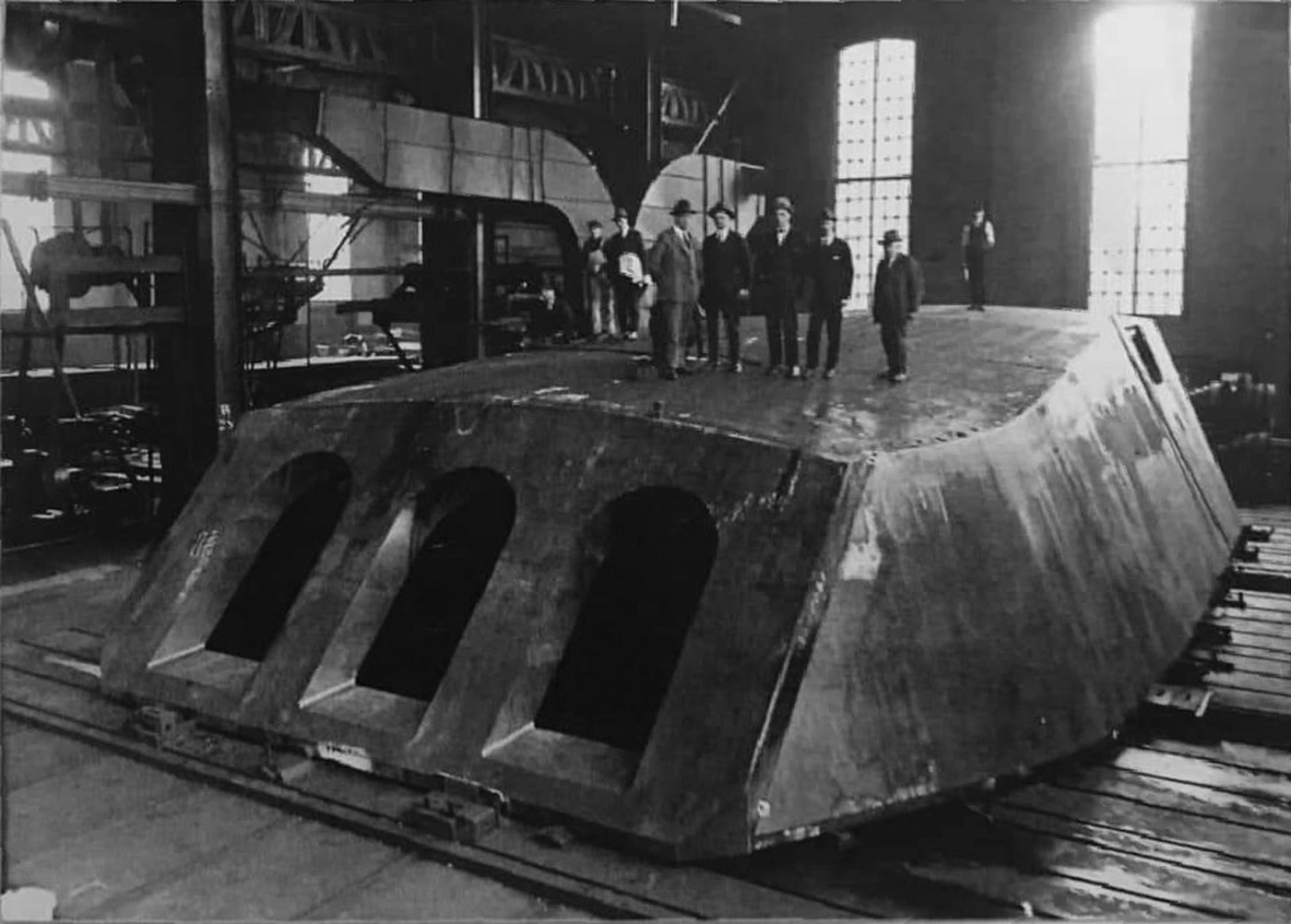
- The gun axes were 82 in (208 cm) apart for both the two-gun and three-gun turrets.
- Each gun had its own shell and powder hoists. In addition, the South Dakota class had auxiliary shell and powder hoists on both sides of the turrets.
- Guns on the South Dakota class were individually sleeved with a 50 HP 400 rpm electric motor driving each elevation screw. Each rammer was driven by two 50 HP 600 rpm electric motors coupled to a common shaft. There was a 0.1875 in (0.48 cm) bulkhead between each gun, but the gun compartments may not have been individually flashtight. It is believed that the turrets for the Lexington class would have been similar in design to those of the South Dakota class but with thinner armor.
- Armor thickness for South Dakota class as given in "The Last American Dreadnought" by Duane D. Borchers:
Face: 18.0 in (45.7 cm)
Sides: 10.0 in (25.4 cm)
Rear: 12.0 in (30.5 cm)
Roof: 8.0 in (20.3 cm)Armor thickness for Lexington class as given in "US Cruisers: An Illustrated Design History" by Norman Friedman:
Face: 12.0 in (30.5 cm)
Sides: 8.0 in (20.3 cm)
Rear: 8.0 in (20.3 cm)
Roof: 4.0 in (10.2 cm)
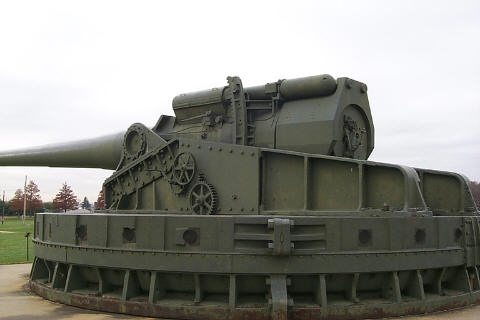
Plaque for this weapon reads as follows:
16 inch Coastal Defense Gun
This weapon represents the most powerful coastal defense gun built and is the last remaining example of its type. Originally designed as a naval weapon it is emplaced on an Army barbette mount. The class of battleships it was originally designed for were not built as a result of the Washington Treaty of 1922 and the weapons were transferred to the Army for use in coast defense. This gun was brought to Aberdeen to test powder and projectiles.
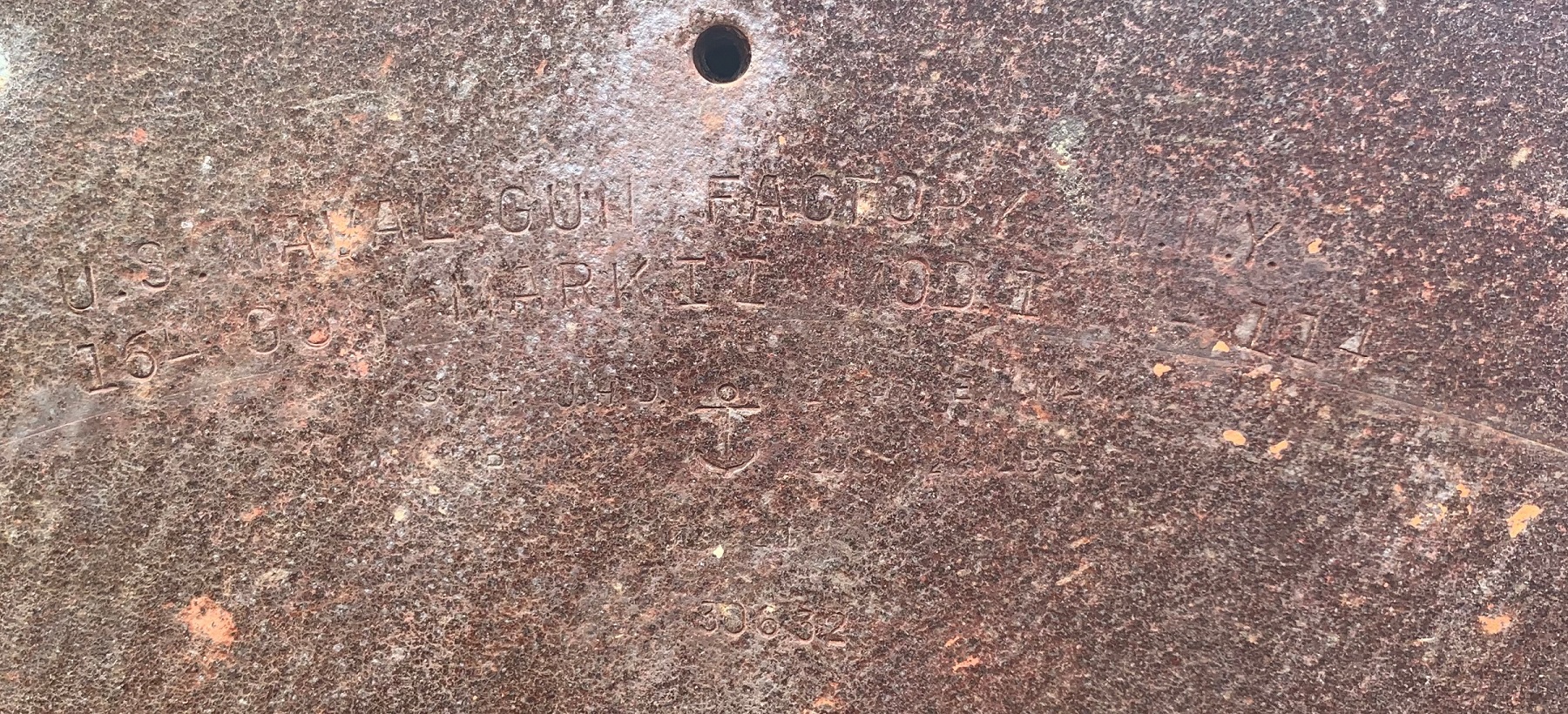
Engraving reads as follows:
| Engraving | Explanation |
|---|---|
| U.S. Naval Gun Factory W.N.Y. | U.S. Naval Gun Factory at the Washington Navy Yard in Washington D.C. |
| 16in - 50 Mark II Mod 1 No. 114 | 16"/50 (40.6 cm) Mark II Mod 1 Gun Serial Number 114 |
| SUPT. J.H.D. | Initials of Superintendent |
| (Illegible) LBS. | Actual Gun Weight in USA pounds. Nominal weight was 128.15 tons (130.2 mt). |
Photographs of the US Army 16"/50 (40.6 cm) M1919 gun may be found at the U.S. Naval Historical Center at this webpage for USS Capella (AK-13). Click on the "Next" button to see additional photographs in this series.
"The Last American Dreadnought, American Battleships, South Dakota (BB-49) Class, A Study in Blueprints" by Duane D. Borchers
"Naval Weapons of World War Two" by John Campbell
"US Battleships: An Illustrated Design History," "US Cruisers: An Illustrated Design History" and
"US Naval Weapons" all by Norman Friedman
"Seacoast Fortifications of the United States: An Introductory History" by Emanuel Raymond Lewis
"Round Shot to Rockets: A History of the Washington Navy Yard and the United States Naval Gun Factory" by Taylor Peck
---
"16-inch Seacoast Gun Material - Gun Mk. II M1; Barbette Carriage M4" Technical Manual No. 9-471, War Department, November 3, 1942
---
"Memorandum for Chief of Bureau; Subject: 16-inch 50-caliber guns" dated October 18, 1919, signature illegible
---
Navy Pages by Gene Slover
"Surviving American Seacoast Artillery Weapons" by the Coast Defense Study Group
---
"High Altitude Research Project (HARP) 1962 – 1967" by William Burton
---
"United States Naval Guns: Their Marks and Modifications" Ordnance Pamphlet No. 127, December 1916, Revised April 1942
---
Special help by Nathan Okun, James Poynor and Robert Darby
26 July 2008 - Benchmark
17 January 2009 - Added picture of Secretary of the Navy Denby inspecting 16" (40.6 cm) gun
26 January 2009 - Added information on shell stowage for South Dakota class
14 April 2014 - Added armor protection and minor changes to Mount / Turret notes
28 March 2015 - Redid painting of South Dakota
29 March 2015 - Fixed link to USS Capella and redid photograph of gun at the Washington Navy Yard
16 February 2016 - Updated Armor Penetration table and added armor thickness for Lexington class
08 July 2016 - Converted to HTML 5 format
23 May 2019 - Reorganized notes, added notes on four remaining guns
31 December 2019 - Added comment and photographs of guns on Barbados
30 March 2021 - Added photograph of Mark D gun
24 February 2022 - Added photographs of US Army 16"/50 (40.6 cm) Model 1919 and Yuma HARP gun and additional details on guns used for HARP program
20 March 2022 - Added photographs of Army AP projectiles
23 August 2022 - Added photograph of turret shell
18 December 2022 - Minor formatting changes, modified note for igniter patches and added source for armor penetration table
21 June 2024 - Added details for coastal defense guns
07 May 2025 - Minor changes
29 August 2025 - Updated location of Battery Williston
29 April 2026 - Added to description for the number of guns planned, finished and partially finished