

After the design of the Ersatz Monarch (improved Tegetthoff) battleships armed with 35 cm G. L/45 K10 guns was completed in 1914, the Marinetechnische Komitee (MTK) - "Naval Technical Committee" - turned to contemplating what sort of battleship would follow these ships. Initial planning was for battleships of about 24,500 tonnes (24,100 tons), but after the start and early naval battles of World War I, MTK then favored a battlecruiser design as the committee had been impressed with the performance of Goeben during her raids on French targets and her run to Turkish waters. They also looked favorably upon the combat capabilities of the British Battlecruisers Inflexible and Indomitable as shown at the Falklands Battle. In September 1915 MTK ordered a battlecruiser design study known as Vorstudie Ia (Project Ia) and then four more battlecruiser studies (Projects Ib to If) over the next year. These were all for ships of about 30,000 tonnes (29,500 tons) armed with the same 35 cm gun as planned for the Ersatz Monarch class in twin or triple turrets. These were reasonable designs that could be handled by the slipways at Danubius while those at STT could easily be enlarged for them to build the new ships. In addition, a 40,000 tonnes (39,330 tons) floating dry dock ordered from Germany was almost ready to be delivered.
However, work on these new designs was suspended for six months following the Jutland (Skagerrak) battle so that the results could be analyzed. It was not until March of 1917 that meetings between MTK, senior naval officers and Škoda officials resumed. One of the major conclusions from these meetings was that since other European nations were in a caliber race, building or planning ships with ever larger guns, the K.u.K. Kriegsmarine should follow suit and their new ships would now be armed with 38 cm or 42 cm guns. As a result, Škoda was tasked with building one gun of each caliber for comparison purposes. Another result was that the earlier projects were discontinued and in their place were a new battlecruiser design (Project II) armed with six 35 cm guns and a new battleship design (Project III) armed with eight 35 cm guns, both of 30,000 tonnes (29,500 tons).
Three more projects were started later in 1917: Project IV was an alternative battlecruiser design of 33,000 tonnes (33,560 tons) and armed with six 38 cm guns; Project V was for a battleship design of 37,000 tonnes (37,630 tons) and armed with eight 42 cm guns; and finally Project VI which envisioned a "HMS Courageous" equivalent of a 33,000 tonne (33,560 tons) battlecruiser armed with four 42 cm guns in two twin turrets.
Politically and financially, all of these projects were unrealistic given the state of the war in 1917, but it should be kept in mind that negotiations between the Central Powers (Germany, Austria-Hungary, the Ottoman Empire and Bulgaria) and Russia were on-going, giving hope that the situation would be turned around. The Treaty of Brest-Litovsk between Soviet Russia and the Central Powers, signed on 3 March 1918 and by which Russia withdrew from World War I, seemed to encourage these hopes, only to have them dashed with the Spring and Summer battles and the final collapse of the Central Powers a short time later.
As none of the 38 cm and 42 cm guns were ever finished and tested, the data given below must be seen as preliminary, but it is based upon official documents found in the Austrian and Hungarian archives as listed in Sources below.
Construction would have been similar to other large-caliber Škoda guns and would have used a hydraulically operated horizontally sliding wedge breech.
| Designation 1 | 38 cm (14.96") G. L/45 K/19 Škoda
42 cm (16.54") G. L/45 K/19 Škoda |
|---|---|
| Ship Class Used On | 38 cm: Projects II, III and IV (none actually built)
42 cm: Projects V and VI (none actually built) |
| Date Of Design | 1915 - 1918 |
| Date In Service | None Completed |
| Gun Weight 2 | 38 cm: 198,410 lbs. (90,000 kg)
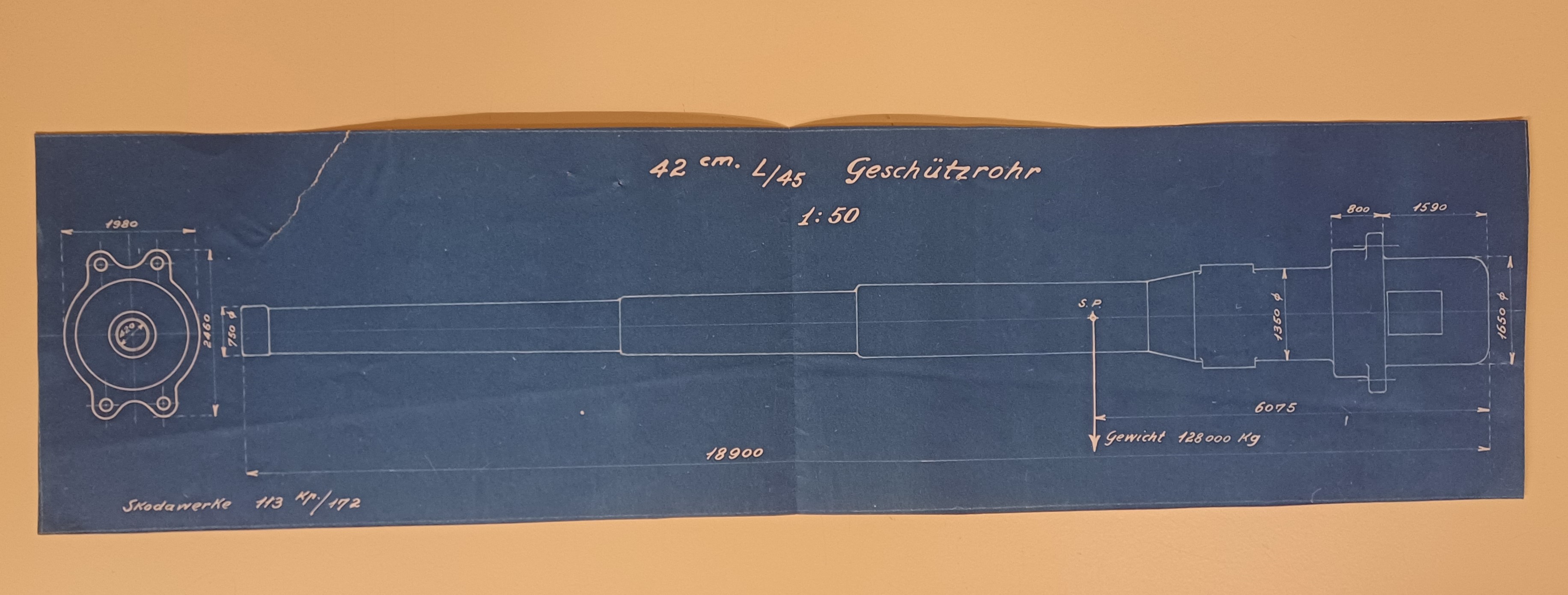
42 cm: 297,625 lbs. (135,000 kg) 3 |
| Gun Length oa | 38 cm: 673.2 in (17.100 m)
42 cm: 744.1 in (18.900 m) |
| Bore Length | N/A |
| Rifling Length | N/A |
| Grooves 4 | N/A |
| Lands | N/A |
| Twist | (N/A) Uniform RH 1 in 25 |
| Chamber Volume | N/A |
| Rate Of Fire | about 1.5 rounds per minute |
- ^Formal designations for these two guns were never assigned. The K.u.K. Kriegsmarine normally assigned a model date when the first prototype gun was produced. At the time of the 1917 meetings described above, Škoda estimated that the two prototype guns would take 1.5 to 2 years to produce, meaning that the model date would have been 1919. Of course, this date would have actually been after the dissolution of the Austro-Hungarian Empire at the end of World War I.
- ^Weights as estimated in 1917.
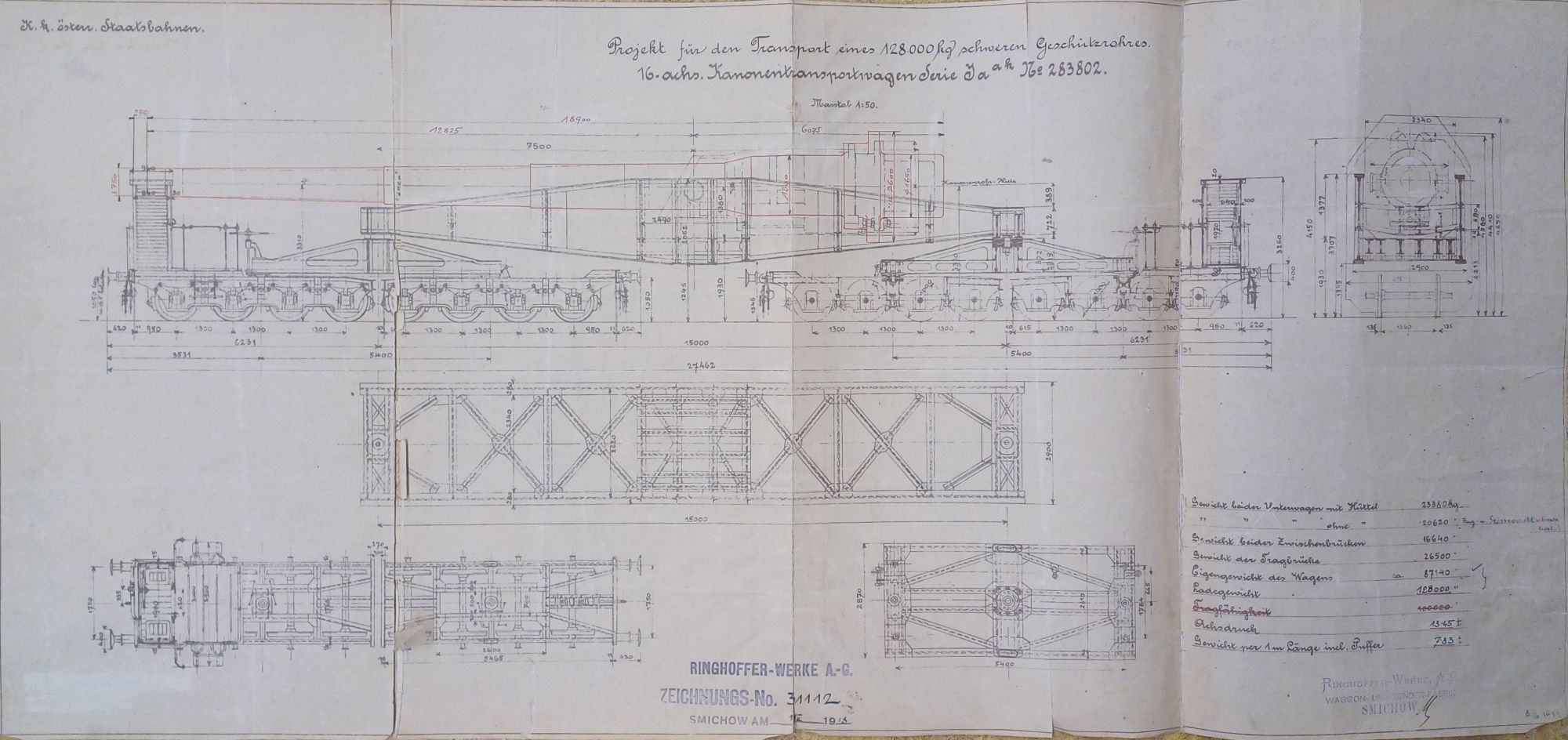
- ^The 42 cm gun barrel was too heavy for the existing railway transport car, so a new, 16-axle gun transport car was designed with 140 mt (140.3 ton) transport capacity. In 1918, Škoda pledged that the barrel weight of the 42 cm gun would not exceed 126 tons (128 mt).
- ^Rifling was to be similar to that of the 35 cm gun.
| Type | Separate |
|---|---|
| Projectile Types and Weights 1a 2a | 38 cm APCBC: 1,675.5 lbs. (760 kg)
38 cm SAPCBC: 1,675.5 lbs. (760 kg) 42 cm APCBC: 2,425.1 lbs. (1,100 kg)
|
| Bursting Charge | 38 cm APCBC: 50.3 lbs. (22.8 kg)
38 cm SAPCBC: 134.0 lbs. (60.8 kg) 42 cm APCBC: 72.8 lbs. (33.0 kg)
|
| Projectile Length | N/A |
| Propellant Charge 3a | 38 cm: 549.0 lbs. (249 kg) RP M/97X
42 cm: about 749.6 - 771.6 lbs. (340 - 350 kg) RP M/97X |
| Cartridge Case Type, Size and Empty Weight 4a | Brass, N/A, N/A |
| Muzzle Velocity | 38 cm: 2,725 fps (830 mps)
42 cm: 2,625 fps (800 mps) |
| Working pressure | 18 tons/in2 (2,800 kg/cm2) |
| Approximate Barrel Life | N/A |
| Ammunition stowage per gun | 80 - 100 rounds 5a |
- ^About 1910 the Navy purchased licenses from the British firm of Firth and Sons, Limited, for manufacturing AP caps and ballistic caps. These were introduced on the 30.5 cm/45 K10 guns used on the Tegetthoff class and would have been used on all subsequent capital ships.
- ^
Actual designations for Projectiles 38 cm APCBC 38 cm bekappte Panzergranate (length unknown) 38 cm SAPCBC 38 cm bekappte Zündergranate (length unknown) 42 cm APCBC 42 cm bekappte Panzergranate (length unknown) 42 cm SAPCBC 42 cm bekappte Zündergranate (length unknown) - ^There was some discussion of developing a new solventless propellant for these gun. Plans were that the Monarchy would build a new factory to produce it. The exact designation for it was not assigned, but probably would have been another in the M/97 series.
- ^If possible, propellant would have been in a single brass casing like other large-caliber Škoda guns, as the K.u.K. Kriegsmarine disliked having fore charges. If a fore charge had been necessary it likely would have been in a thin brass casing and not in a silk bag.
- ^Outfits would have been about 3/4ths APCBC and 1/4th SAPCBC.
| Elevation | Range | Angle of Fall | Striking Velocity |
|---|---|---|---|
| 2.3 degrees | 5,470 yards (5,000 m) | 2.7 degrees | 2,277 fps (694 mps) |
| 5.4 degrees | 10,940 yards (10,000 m) | 6.8 degrees | 1,893 fps (577 mps) |
| 15.0 degrees | 21,870 yards (20,000 m) | 23.7 degrees | 1,358 fps (414 mps) |
| 23.2 degrees | 27,340 yards (25,000 m) | 37.8 degrees | 1,270 fps (387 mps) |
| 30.6 degrees | 30,620 yards (28,000 m) | 48.6 degrees | 1,299 fps (396 mps) |
| Elevation | Range | Angle of Fall | Striking Velocity |
|---|---|---|---|
| 2.4 degrees | 5,470 yards (5,000 m) | 2.7 degrees | 2,254 fps (687 mps) |
| 5.4 degrees | 10,940 yards (10,000 m) | 6.8 degrees | 1,929 fps (588 mps) |
| 13.6 degrees | 21,870 yards (20,000 m) | 19.1 degrees | 1,565 fps (477 mps) |
| 23.2 degrees | 32,8100 yards (30,000 m) | 36.3 degrees | 1,483 fps (452 mps) |
| 29.8 degrees | 36,090 yards (33,000 m) | 42.4 degrees | 1,156 fps (462 mps) |
Range Tables from "Weisungen für Geschützturmentwürfe neuer Schlachtschiffe" Res. Nr. 3275/III B 1251 aus 1916 by MTK, which is in the KA NMA (Kriegsarchiv, Vienna, Neue Marineakten) MS/II. GG. 4/B-8/14 ex 1917 files.
| Range | Angle of Fall | Striking Velocity | APCBC | SAPCBC |
|---|---|---|---|---|
| 5,470 yards (5,000 m) | 2.7 degrees | 2,277 fps (694 mps) | 24.6 in (625 mm) | 18.9 in (480 mm) |
| 10,940 yards (10,000 m) | 6.8 degrees | 1,893 fps (577 mps) | 28.9 in (479) | 14.5 in (368 mm) |
| 21,870 yards (20,000 m) | 23.7 degrees | 1,358 fps (414 mps) | 8.5 in (215 mm) | 7.0 in (179 mm) |
| 27,340 yards (25,000 m) | 37.8 degrees | 1,270 fps (387 mps) | 7.7 in (196 mm) | 6.2 in (158 mm) |
| 30,620 yards (28,000 m) | 48.6 degrees | 1,299 fps (396 mps) | 8.0 in (202 mm) | 6.4 in (163 mm) |
| Range | Angle of Fall | Striking Velocity | APCBC | SAPCBC |
|---|---|---|---|---|
| 5,470 yards (5,000 m) | 2.7 degrees | 2,254 fps (687 mps) | 28.3 in (720 mm) | 21.7 in (551 mm) |
| 10,940 yards (10,000 m) | 6.8 degrees | 1,929 fps (588 mps) | 22.7 in (576 mm) | 17.4 in (441 mm) |
| 21,870 yards (20,000 m) | 19.1 degrees | 1,565 fps (477 mps) | 12.2 in (309 mm) | 9.8 in (249 mm) |
| 32,8100 yards (30,000 m) | 36.3 degrees | 1,483 fps (452 mps) | 11.3 in (286 mm) | 9.1 in (231 mm) |
| 36,090 yards (33,000 m) | 42.4 degrees | 1,156 fps (462 mps) | N/A | N/A |
Armor Penetration from "Weisungen für Geschützturmentwürfe neuer Schlachtschiffe" and "Vergleichstabelle für Geschossdurchschlagsvermögen" which are both part of Res. Nr. 3275/III B 1251 aus 1916 by MTK and in the KA NMA MS/II. GG. 4/B-8/14 ex 1917 files.
| Designation | Two-gun Turrets
Project II: (3) 38 cm Project III: (4) 38 cm Project IV: (3) 38 cm Project V: (4) 42 cm Project VI: (2) 42 cm |
|---|---|
| Weight | 38 cm: N/A
42 cm: 1,119 - 1,149 tons (1,100 - 1,130 mt) |
| Elevation | -5 / +30 degrees 1b |
| Rate of Elevation | N/A |
| Train | N/A |
| Rate of Train | N/A |
| Gun Recoil | N/A |
| Loading angle | Any angle or fixed +2 degrees |
- ^Some board members questioned the need of a -5 degrees depression, but this question was not settled. It is possible that -4 degrees would have been selected for the final design.
- Armor thickness for both 38 cm and 42 cm turrets:
Face: 17.7 in (45.0 cm) KC
Sides: 11.8 in (30.0 cm) KC
Rear: 11.8 in (30.0 cm) KC
Roof: 7.8 in (20.0 cm) KC - Roof armor was rated as being able to withstand a 42 cm APCBC hit from 21,870 yards (20,000 m)
"Naval Weapons of World War One" by Norman Friedman
"Großkampschiffs - Projekte des MTK aus der Zeit des Ersten Weltkrieges" (Capital ship projects of the MTK from the time of the First World War) by Erwin Sieche
as published in "Marine - Gestern, Heute: Nachrichten aus dem Marinewesen" (Navy - Yesterday and Today: News from the Navy) December 1981 Issue
---
Kriegsarchiv, Vienna, Neues Marinearchiv MS/II. GG. 4/B-5/5 ex 1916
Kriegsarchiv, Vienna, Neues Marinearchiv MS/II. GG. 4/B-8/4 ex 1917
Kriegsarchiv, Vienna, Neues Marinearchiv MS/II. GG. 4/B-8/13, 4/B-8/14 and 4/B-8/16 ex 1917
Kriegsarchiv, Vienna, Neues Marinearchiv MS/II. GG. 4/B-9/12 ex 1918
---
Original research by Mihály Krámli and Gábor Kiss
---
Special help from Harald Fiedler, Attila Süli and Zoltán Takács
Sketches and data on these ships at Viribus Unitis
See BB/BC Pre-designs (Never Builts)
12 May 2025 - New Datapage
11 June 2025 - Minor changes
28 October 2025 - Added sketch of transport car