
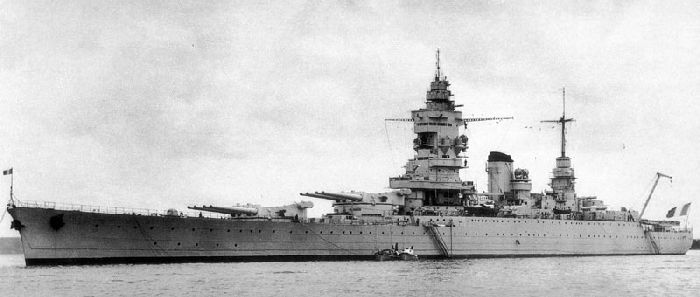
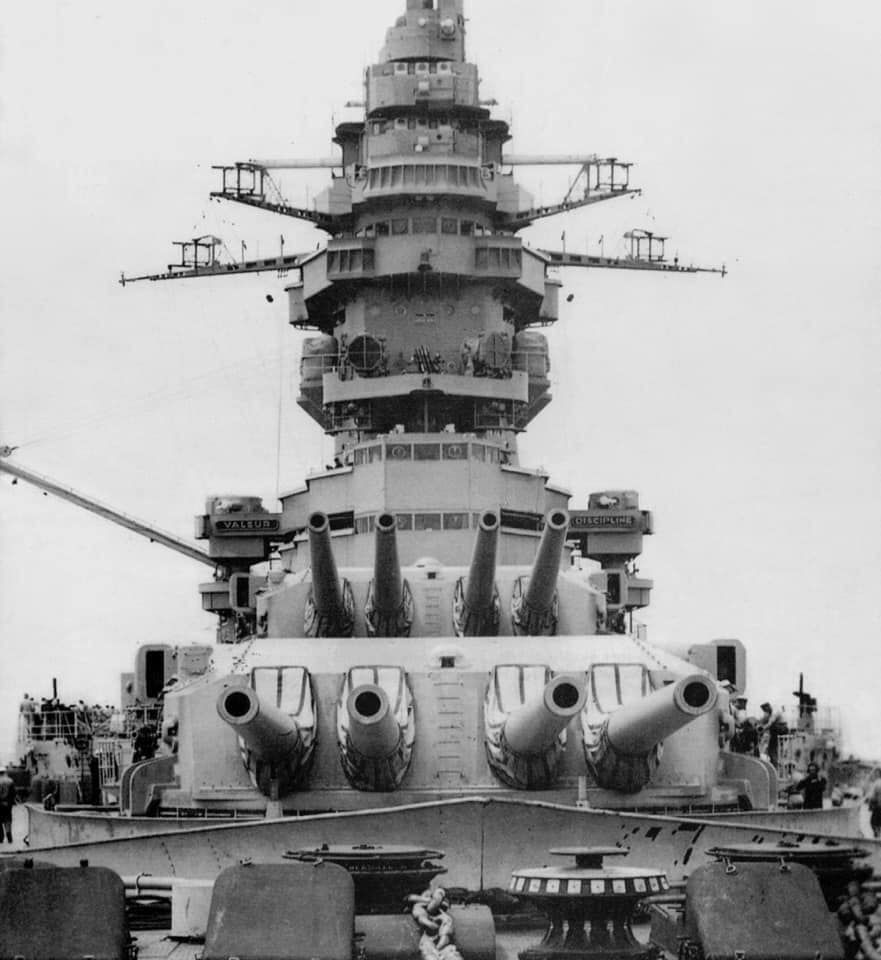
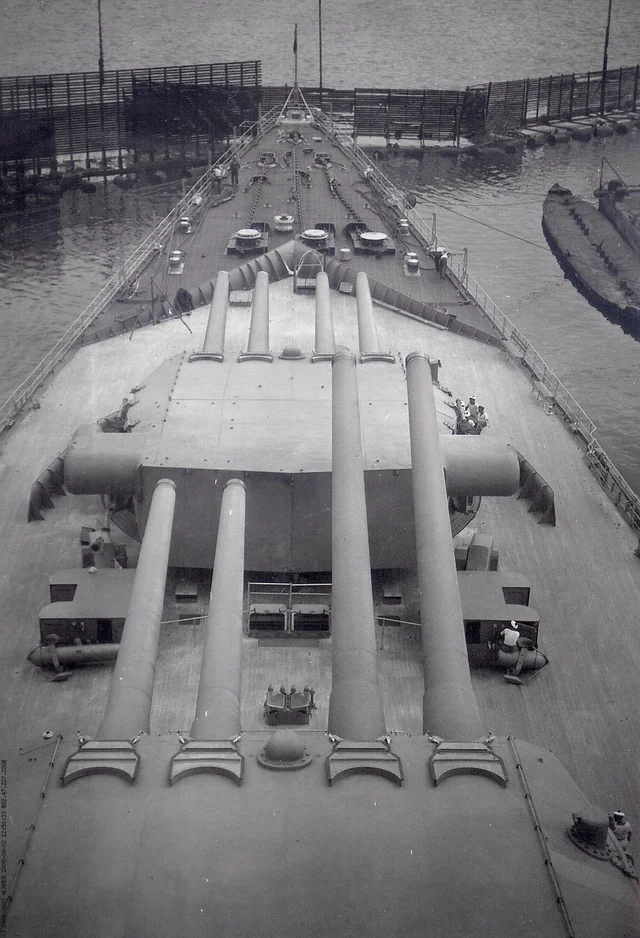
These guns were used to arm the first French capital ships built since World War I, the Dunkerque class. These weapons had a high muzzle velocity, which gave them long range and good vertical armor penetration at the cost of having poor deck penetration. They were mounted in quad turrets, which were really more of a dual-twin arrangement. The design of the quad turret was based upon one designed but never built for the Normandie class.
Although equipped with RPC, the Sautter-Harlé-Blondel gear for these turrets was apparently far from satisfactory. As the guns were closely spaced together, these ships also suffered from problems with excessive dispersion.
The dual quad-gun turret arrangement was calculated to be 27.6% lighter than a quad twin-gun arrangement, but it did mean that a single hit could eliminate half of the main battery.
The construction of these weapons is not clear, but it is believed to have been similar to that of the 380 mm/45 (14.96") guns used on the Richelieu class. This would make the construction a loose autofretted liner and A tube reinforced at the breech by a single row of short hoops along with an outer jacket. The breech mechanism was a Welin screw breech block, hydro-pneumatically powered and balanced by counterweights. The breech plug opened upwards. Actual bore length was 50.44 calibers.
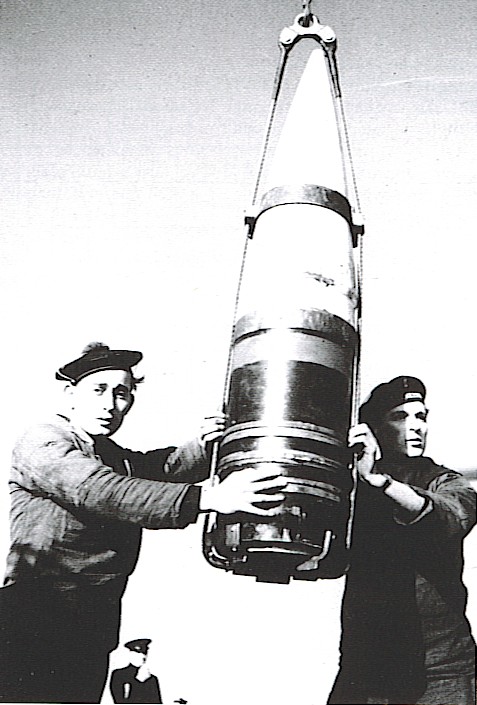
Some of the SAPC shells for these guns were converted to aircraft AP bombs in 1939.
A note on sources: "Battleships: Allied Battleships in World War II" and "Battleships of the World 1905-1970" list this weapon as "330 mm/52" but the actual bore length was 50.44 calibers.
| Designation | 330 mm/50 (13") Model 1931 |
|---|---|
| Ship Class Used On | Dunkerque Class |
| Date Of Design | 1931 |
| Date In Service | 1939 |
| Gun Weight | 155,503 lbs (70,535 kg) |
| Gun Length oa | 676.0 in (17.170 m) |
| Bore Length | 655.3 in (16.645 m) |
| Rifling Length | 548.8 in (13.940 m) |
| Grooves | (80) 0.126 in deep x 0.304 in (3.2 mm x 7.73 mm) |
| Lands | 0.205 in (5.2 mm) |
| Twist | Uniform RH 1 in 25.57 |
| Chamber Volume | 17,880 in3 (293 dm3) |
| Rate Of Fire | 1.5 - 2 rounds per minute 1 |
- ^The intended rate of fire was 3 rounds per minute. However, the shell supply arrangements in the shell rooms proved to be inadequate and the designed ROF was never met.
| Type | Bag |
|---|---|
| Projectile Types and Weights 1a | SAPC 2a 3a 4a: 1,235 lbs. (560 kg)
5a HE 6a: 1,151 lbs. (522 kg) 7a |
| Bursting Charge | SAPC: 44.7 lbs. (20.3 kg) Mn.F.Dn
HE: 140 lbs. (63.5 kg) Mn.F.Dn |
| Projectile Length | SAPC (non-K): 65.0 in (165.0 cm)
SAPC (K): 64.5 in (163.85 cm) HE: 64.4 in (163.7 cm) |
| Propellant Charge | 423 lbs. (192 kg) SD19 8a |
| Muzzle Velocity | SAPC: 2,854 fps (870 mps)
HE: 2,904 fps (885 mps) |
| Working Pressure | 20.3 tons/in2 (3,200 kg/cm2) |
| Approximate Barrel Life | 250 rounds |
| Ammunition stowage per gun | Turret I: 114 rounds
Turret II: 110 rounds |
- ^
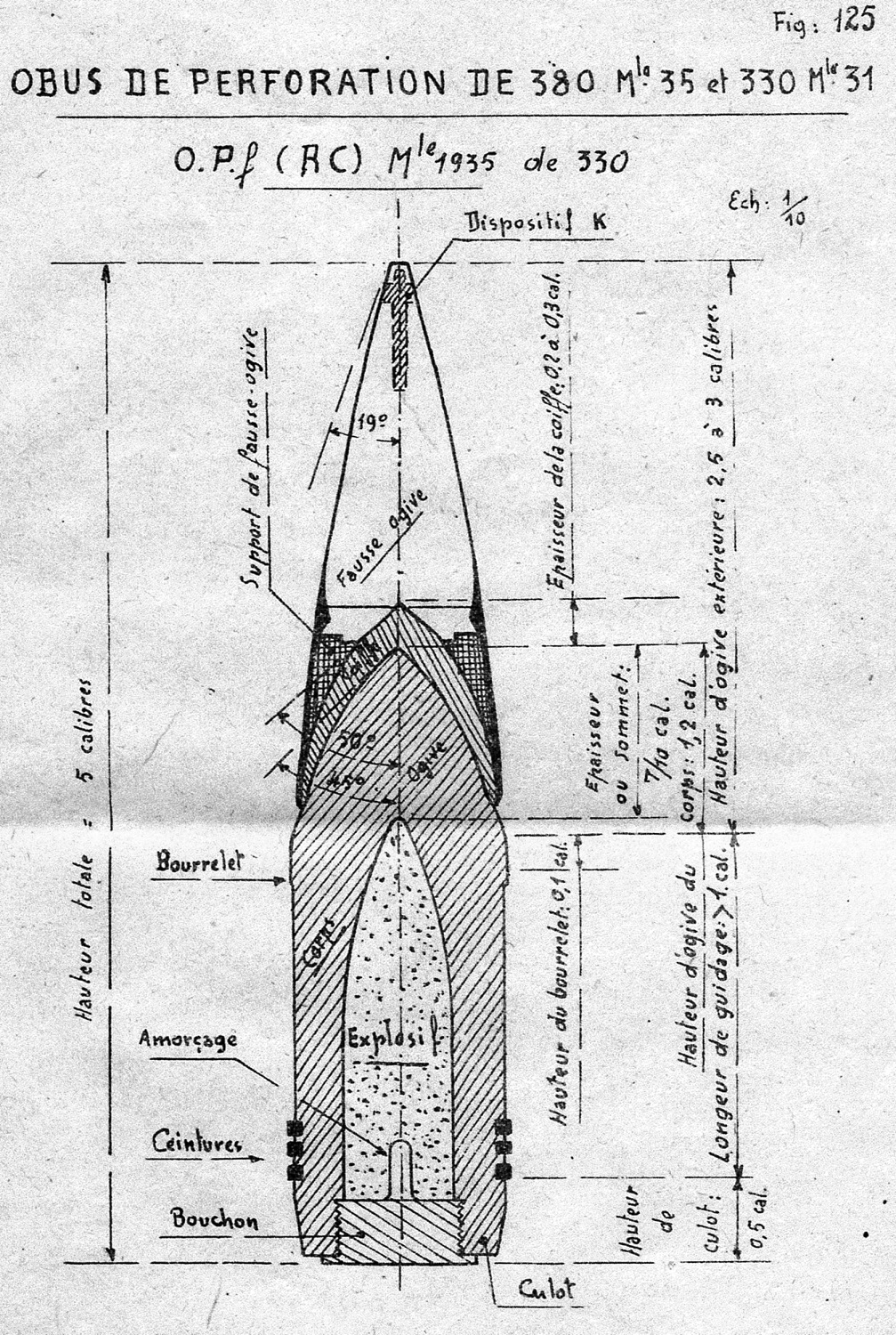
Actual designations for Projectiles SAPC (no dye) 330 mm OPf Mle 1935 SAPC (with dye) 330 mm OPfK Mle 1935 HE OEA Mle 1935 - ^Some references call this projectile an APC type, but it had a large burster cavity - about 3.6% of total projectile weight - and a thin AP cap, making it more of a SAPC type. It was intended primarily for use against the lightly armored German Panzerschiffes. The base fuze was a "double-acting" type which used the deceleration of the shell upon impact to determine the delay time.
- ^SAPC had a radius head of 6crh.
- ^'K' dye shells were introduced about 1936 and had a nose fuze with a small burster to disperse the colorant. Dye colors were probably red for Dunkerque and green for Strasbourg.
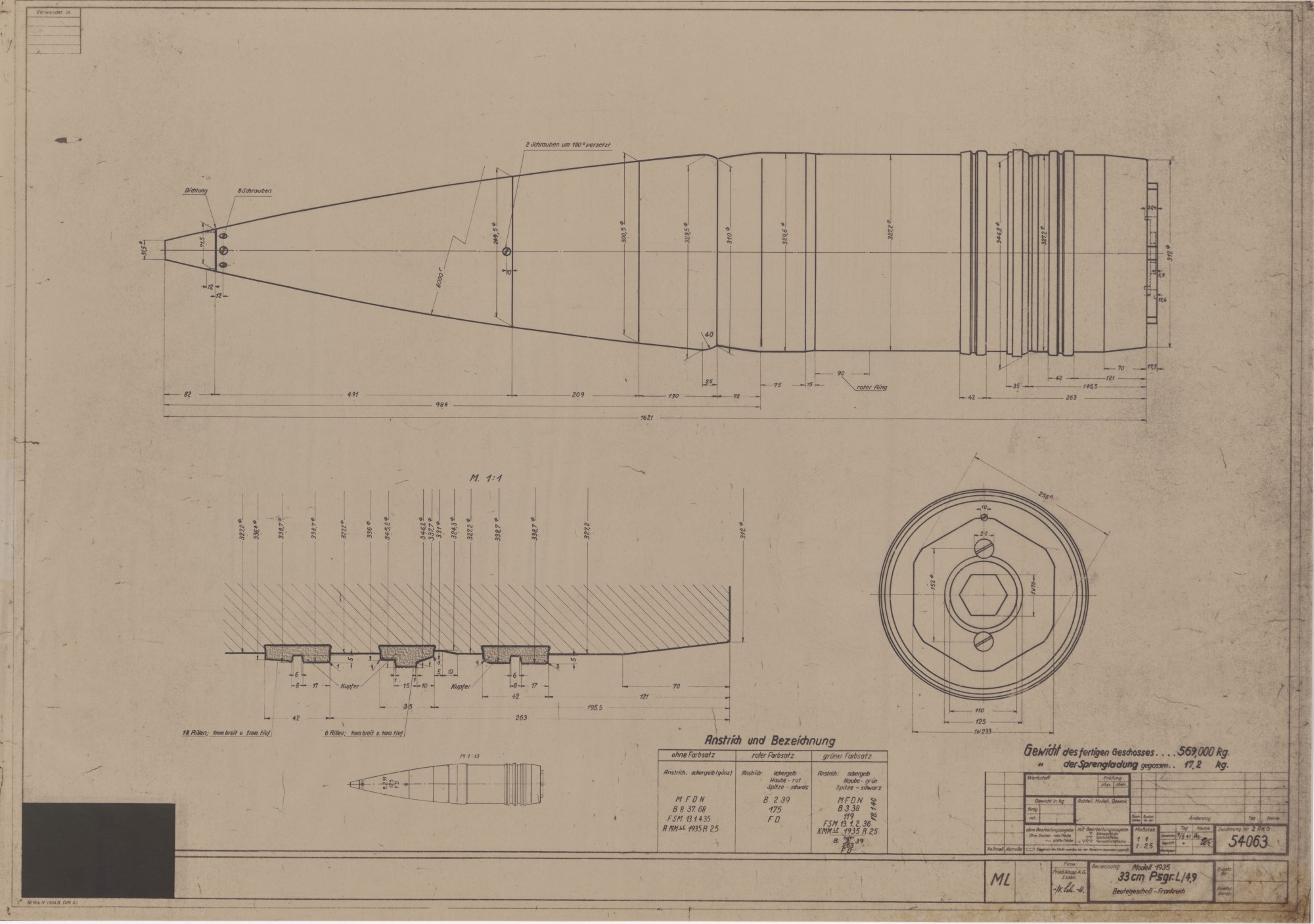
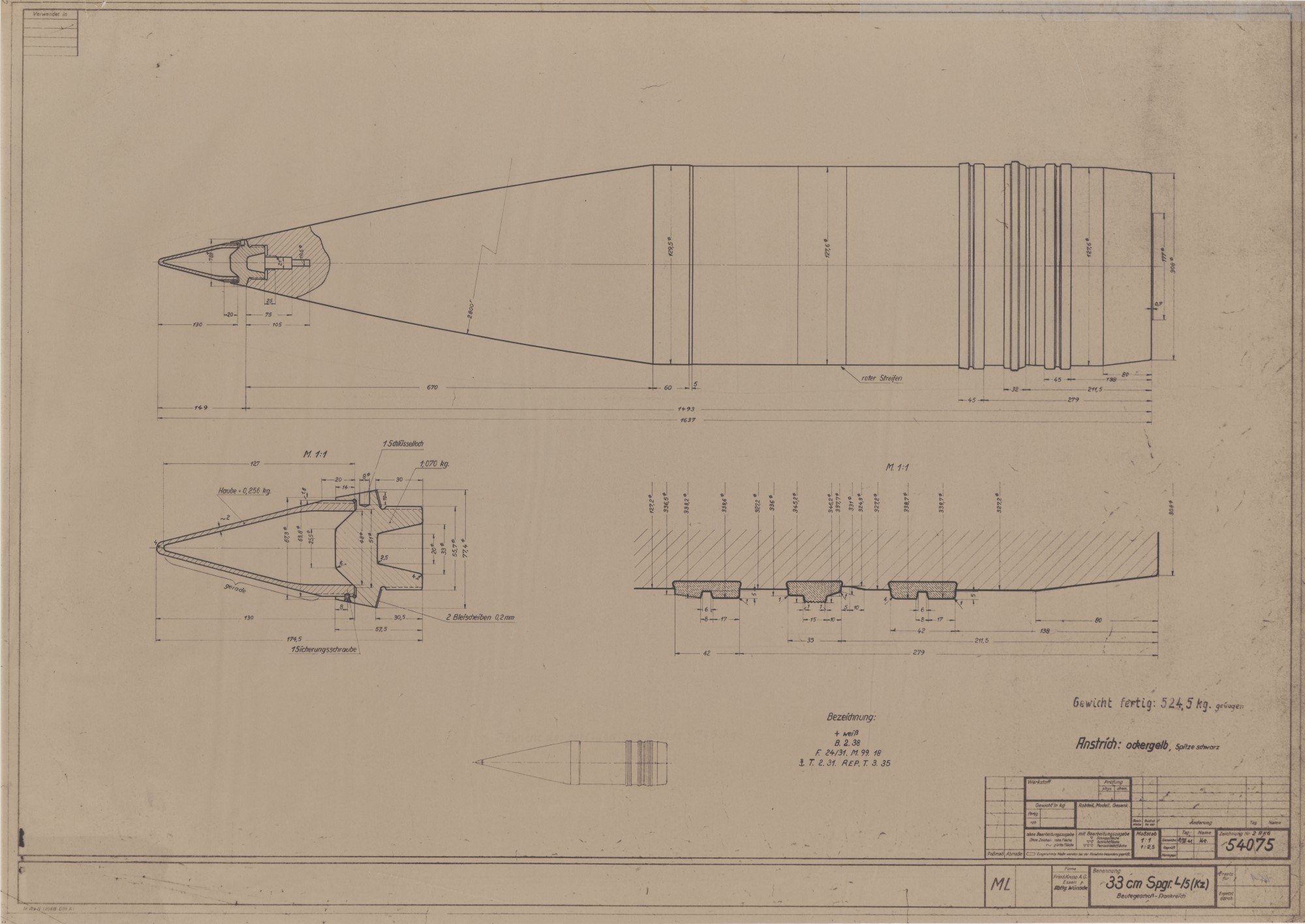
- ^HE projectiles may not have actually entered service as there is no mention of them in the wartime inventories of Dunkerque and Strasbourg. They are described in detail in "Naval Weapons of World War Two" which probably means that official documents exist in the French Naval Archives. In the revised paperback version of "French Battleships: 1922-1956" by John Jordan and Robert Dumas, it is stated that 300 of these shells are listed in a 1939-1940 document as being stored at Toulon. As neither ship was ever in Toulon prior to July 1940 - when Strasbourg fled there after escaping from Mers el-Kebir - it would appear that they were not carried before that time. German sketches drawn in 1941 of existing 330 mm OPfK and OEA shells have been found in the Bundesarchivs (see below), so it is confirmed that at least some were made pre-war.
- ^The German sketch below shows the HE weight as 524.5 kg (1,156.3 lbs.) which is the weight of this specific projectile.
- ^Propellant charges were in quarters.
- Aircraft AP bomb weighed 1,235 lbs. (560 kg) and was designated as Mle 1939.
| Elevation | Range | Striking Velocity | Angle of Fall |
|---|---|---|---|
| 4.3 degrees | 10,936 yards (10,000 m) | 2,261 fps (689 mps) | 5.2 |
| 7.2 degrees | 16,404 yards (15,000 m) | 2,005 fps (611 mps) | 9.1 |
| 10.2 degrees | 21,872 yards (20,000 m) | 1,755 fps (535 mps) | 14.2 |
| 14.8 degrees | 27,340 yards (25,000 m) | 1,614 fps (492 mps) | 21.3 |
| 19.6 degrees | 32,808 yards (30,000 m) | 1,529 fps (466 mps) | 28.8 |
| 25.4 degrees | 38,276 yards (35,000 m) | 1,512 fps (461 mps) | 36.8 |
| 35.0 degrees | 45,604 yards (41,700 m) | --- | --- |
| Elevation | Range |
|---|---|
| 35.0 degrees | 44,401 yards (40,600 m) |
| Range | Side Armor | Deck Armor |
|---|---|---|
| 0 yards (0 m) | 28.08" (713 mm) | -- |
| 25,153 yards (23,000 m) | 13.46" (342 mm) | 3.47" (87 mm) |
| 30,114 yards (27,500 m) | 11.48" (292 mm) | 4.32" (110 mm) |
This data is from "Battleships: Allied Battleships in World War II" pages 374-375 for a muzzle velocity of 2,854 fps (870 mps) and is based upon the USN Empirical Formula for Armor Penetration. On page 57, the authors state that the "armor-piercing shell . . . could penetrate 300 mm [11.81 in] of armor at 28,000 meters [30,722 yards]," but there is no mention of how this value was calculated.
| Designation | Quad Mount
Dunkerque (2): St Chamond Model 1932 |
|---|---|
| Weight | 1,473 tons (1,497 mt) 1b |
| Elevation | -5 / +35 degrees |
| Rate of Elevation | 6 degrees per second 2b |
| Train 3b | Turret I: +/- 143 degrees
Turret II: +/- 150 degrees |
| Rate of Train | 5 degrees per second 2b |
| Gun Recoil | 45.3 in (1.15 m) |
| Loading Angle | Any angle 4b |
- ^These mountings were developed by St Chamond and were electrically powered. The supporting ball race contained 152 balls of 7.17 in (18.2 cm) diameter. The magazines and shell rooms for each pair of guns were on the same deck on opposite sides of the barbette and on two levels, with those for the port pair of guns on the reinforced inner bottom and those for the starboard side on the deck directly above. Ammunition supply from the magazines was by dredger hoist, one for each pair of guns. Ammunition was transferred in the working chamber to the gun loading cages of the upper hoists. Each gun had its own hoist and the cages had three compartments, the lowest one for the shells while each of the upper compartments held two charges. Although there is only one weight given for all four turrets in all the references below, it should be noted that the rear of "B" turret on Dunkerque had 1 cm thinner armor than "A" turret and that Strasbourg had 3 cm thicker face armor and 1 cm thicker roof armor than the turrets on Dunkerque. For these reasons, I would conclude that all four turrets were of different weights.
- ^These gun arcs should be regarded as approximate as various official plans give differing figures. Some of this may be due to concerns about blast effects on the ship fittings.
- ^An electric chain rammer was carried on an extension of the gun cradle and theoretically permitted loading and any angle of elevation. In practice, it was found that shells jammed in the breech at higher elevations when the other guns were firing. As a result, loading usually took place at angles no more than 15 degrees.
- These guns were sleeved in pairs. Dunkerque was the first French battleship to have RPC for training and elevation. The turrets were powered by Léonard electric servo-motors with hydraulic drive with Sautter-Harlé-Blondel (SHB) RPC gear. However, the SHB equipment was found to be unreliable, synchronization between the directors and turrets was poor and manual intervention was needed for fine adjustment. In addition, the servo motors were underpowered, which resulted in slow tracking speeds and frequent breakdowns. Major problems were found on trials and even after modifications the system never worked properly.
- The gunhouse was divided internally by a 4 cm (1.6") bulkhead between the gun pairs. This ran down into the working chamber where it was thinned down to 2.5 cm (1").
- Heavy leather blast bags were fitted to the main gun embrasures in 1939.
- The gun axis in each pair were 66.5 in (169 cm) apart while the two inner guns were 100 in (254 cm) apart.
"Battleships of the World 1905-1970" by Siegfried Breyer
"Naval Weapons of World War Two" by John Campbell
"Battleships: Allied Battleships in World War II" by W.H. Garzke, Jr. and R.O. Dulin, Jr.
"The Big Gun: Battleship Main Armament 1860-1945" by Peter Hodges
"French Battleships: 1922 - 1956" by John Jordan and Robert Dumas
---
Special help from Zhu Shipeng and John Jordan
23 May 2006 - Benchmark
29 November 2000 - Added picture of SAPC, data on gun construction, projectiles, turret arrangements and RPC equipment
21 February 2021 - Converted to HTML 5 format, reorganized notes, added note regarding SAPC vs. APC
28 April 2021 - Added photograph of bow turrets on Strasbourg
12 April 2022 - Corrected error in armor penetration table, added note about fuze delay time and added data on SAPC shell weight
01 April 2024 - Added German sketches of French shells
18 December 2024 - Added French sketch of 330 mm OPfK shell