
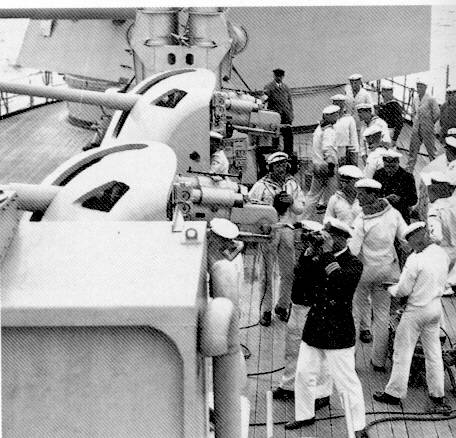
A series of weapons with similar performance that were used as anti-torpedo boat guns on pre-dreadnoughts. It was later developed into Germany's first AAA gun, the Flak L/45. These guns were also used to replace some of the 8.8 cm/35 anti-torpedo boat guns on older warships.
During the 1920s the Flak L/45 guns were used as an interim measure on the Panzerschiffe Deutschland and on the light cruisers until the new 8.8 cm/76 SK C/32 gun was available, with most ships being refitted by 1939.
During the 1930s surviving guns were modified to take the same ammunition as was used in the 8.8 cm/45 (3.4") SK C/30 and then had the same performance as did that gun.
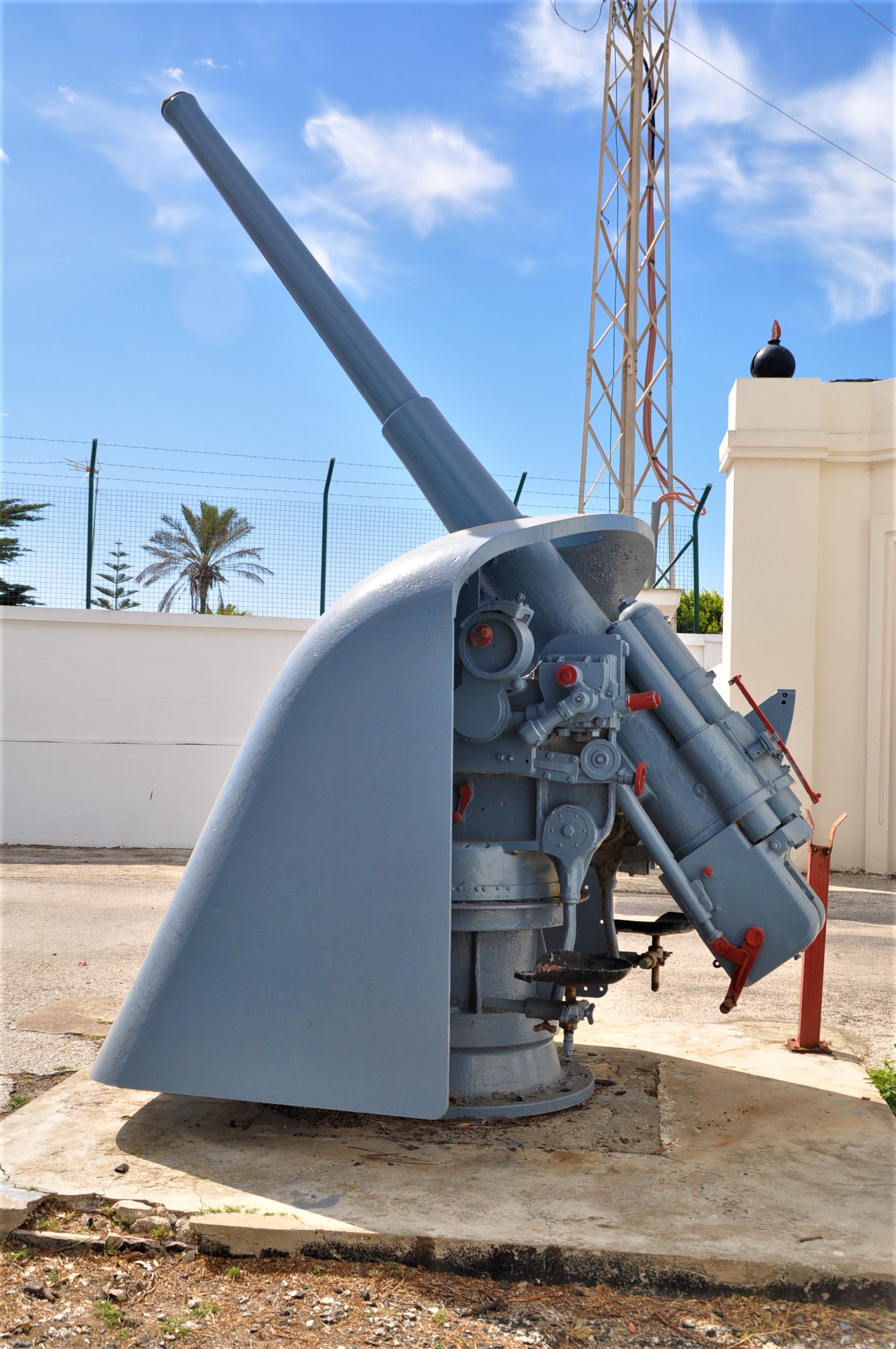
A number of these guns were sold to Spain during the Spanish Civil War and were used as mobile artillery and in coastal defense batteries.
| Designation | 8.8 cm/45 (3.46") SK L/45
8.8 cm/45 (3.46") Flak L/45 |
|---|---|
| Ship Class Used On | World War I: Most Capital Ships and Destroyers
1920s: Emden, Königsberg and Deutschland classes |
| Date Of Design | 1905 |
| Date In Service | 1906 |
| Gun Weight | 5,512 lbs. (2,500 kg) |
| Gun Length oa | about 157.5 in (4.000 m) |
| Bore length | N/A |
| Rifling Length | N/A |
| Grooves | N/A |
| Lands | N/A |
| Twist | N/A |
| Chamber Volume | N/A |
| Rate Of Fire | 15 rounds per minute |
| Type | Fixed | |
|---|---|---|
| Complete Round Weight | 33 lbs. (15 kg) | |
| Projectile Types and Weights 1 2 3 | World War I
AA L/3,9: 21.2 lbs. (9.63 kg) SAP L/3,8: 22.05 lbs. (10.0 kg) 4 HE L/3,6: 22.05 lbs. (10.0 kg) World War II
|
|
| Bursting Charge | World War I 5 | |
| AA L/3,9 | G: N/A
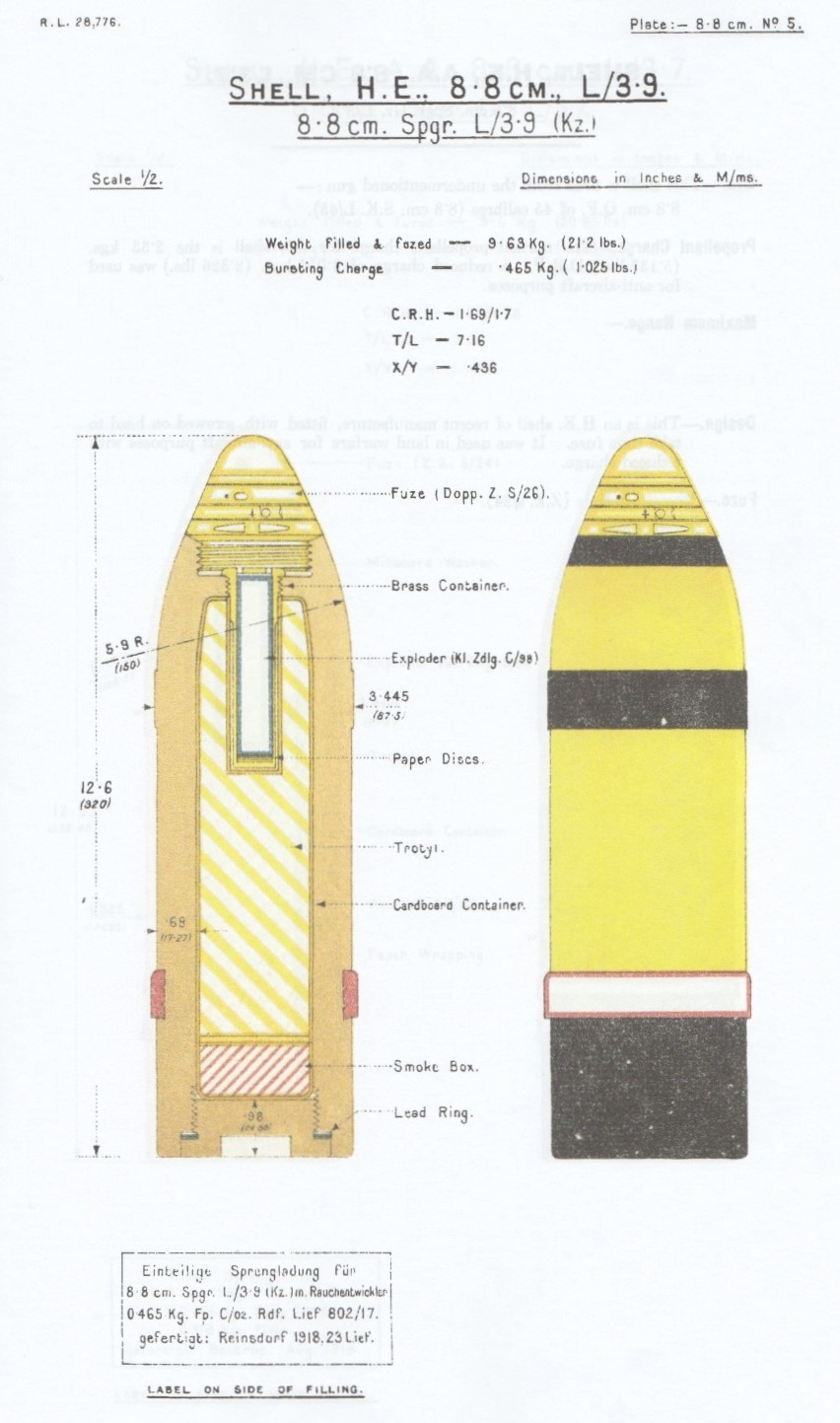
S: 1.03 lbs. (0.465 kg) TNT 6 |
|
| SAP L/3,8 | G: N/A
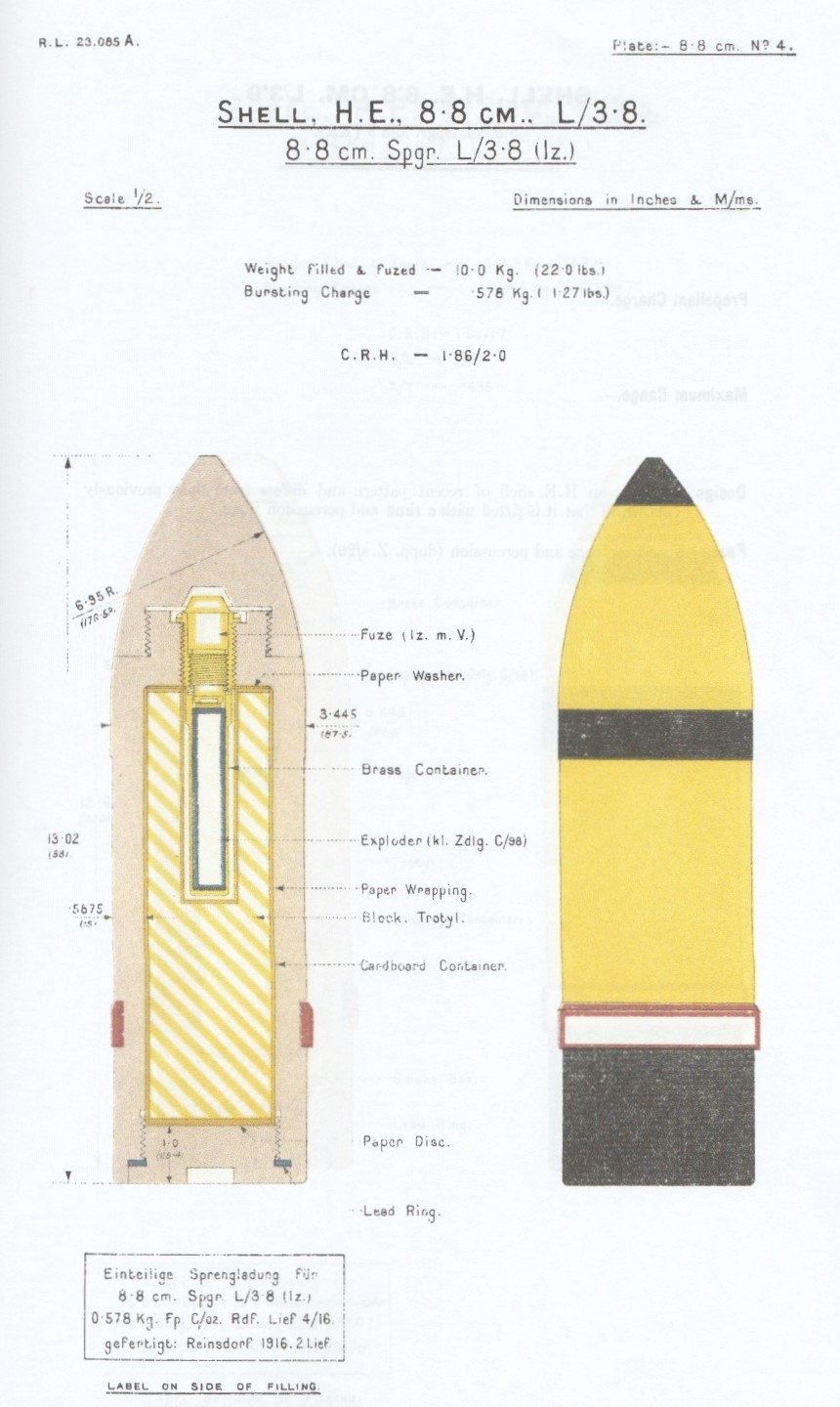
S: 1.27 lbs. (0.578 kg) TNT |
|
| HE L/3,6 | G: N/A
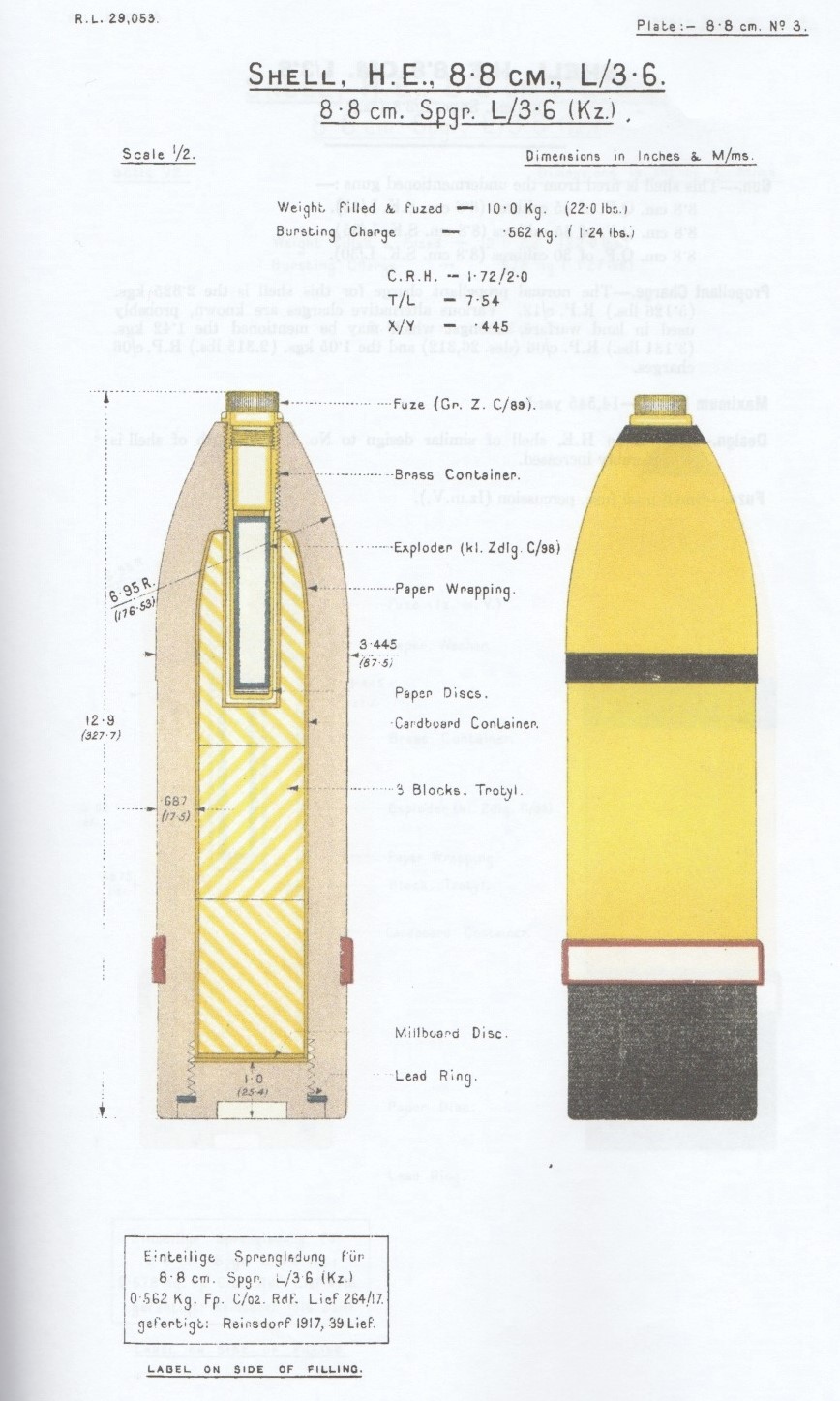
S: 1.24 lbs. (0.562 kg) TNT |
World War II 7 |
| AP 30 | G: N/A
S: 0.14 lbs. (0.064 kg) |
|
| HE L/4,5 8 | G: 1.71 lbs. (0.775)
S: 1.54 lbs. (0.698 kg) TNT |
|
| HE L/4,5 incendiary | G: N/A
S: 1.23 lbs. (0.560 kg) TNT + 1.42 lbs. (0.646) Incendiary (Brandkörper A) |
|
| Projectile Length | about 14.0 in (385.5 mm) | |
| Propellant Charge | World War I
6.6 lbs. (3.00 kg) RP C/12 World War II
|
|
| Muzzle Velocity | World War I
Flak L/45: 2,760 fps (840 mps) Other guns: 2,590 fps (790 mps) Illum L/4,4: 2,130 fps (650 mps) World War II
| |
| Working Pressure | 17.5 tons/in2 (2,750 kg/cm2) | |
| Approximate Barrel Life | 7,000 rounds | |
| Ammunition stowage per gun | World War I
Nassau: 150 rounds Helgoland and Moltke: 200 rounds Kaiser and Seydlitz: 200-350 rounds König, Von der Tann, Derfflinger and Mackensen: 400 rounds Bücher (1914): 200 rounds Torpedo boats: 150 rounds Destroyers: 120 rounds World War II
|
|
- ^There were many different kinds of ammunition for these weapons. The ones listed above are meant to be representative, but by no means is this a complete listing.
- ^
Actual German designations AA L/3,9 8,8 cm Spgr Patr L/3,9 Kz SAP L/3,8 8,8 cm Spgr Patr L/3,8 Iz HE L/3,6 8,8 cm Spgr Patr L/3,6 Kz AP 30 8,8 cm Psgr Patr 30 HE L/4,5 8,8 cm Spgr Patr 30 L/4,5 Incendiary L/4,5 8,8 cm Spgr Patr 30 L/4,5 Br Illumination L/4,4 8,8 cm Lg Patr 30 L/4,4 - ^The 8.8 cm C/30, C/32, C/35 and rebuilt SK L/45 guns used the same projectiles, but different casings which held different amounts of propellant.
- ^The SAP L/3,8 was an interesting design in that it had a large steel nose with the fuze behind it. See sketch below.
- ^Burster weights for World War I projectiles from "Diagrams of Great War."
- ^The AA L/3,9 fuze had both impact and time functions.
- ^Burster weight for World War II projectiles from M.Dv. Nr. 198.
- ^The HE L/4,5 fuze had both impact and time functions.
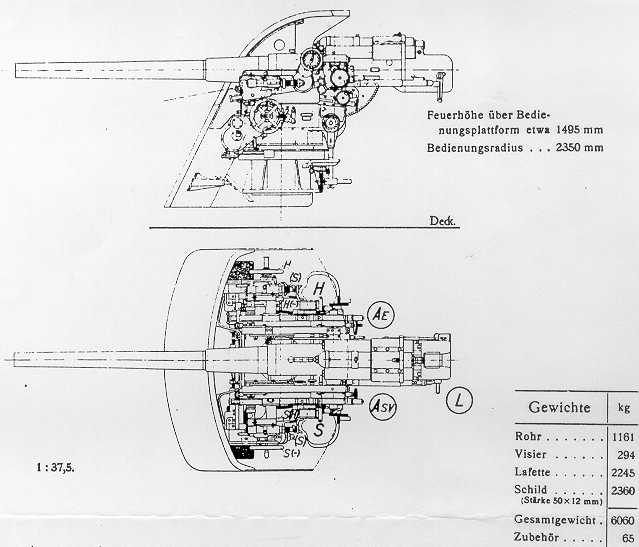
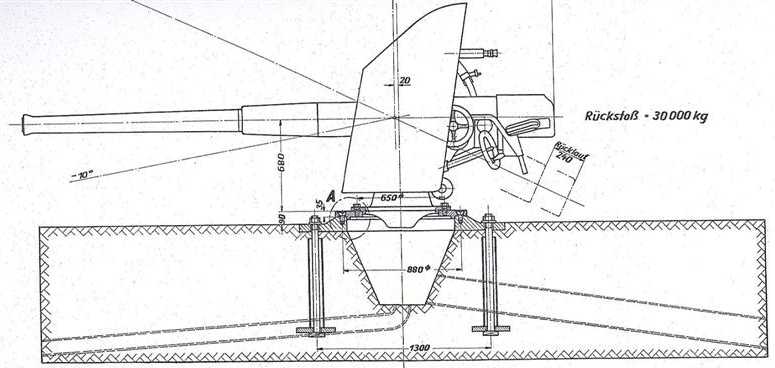
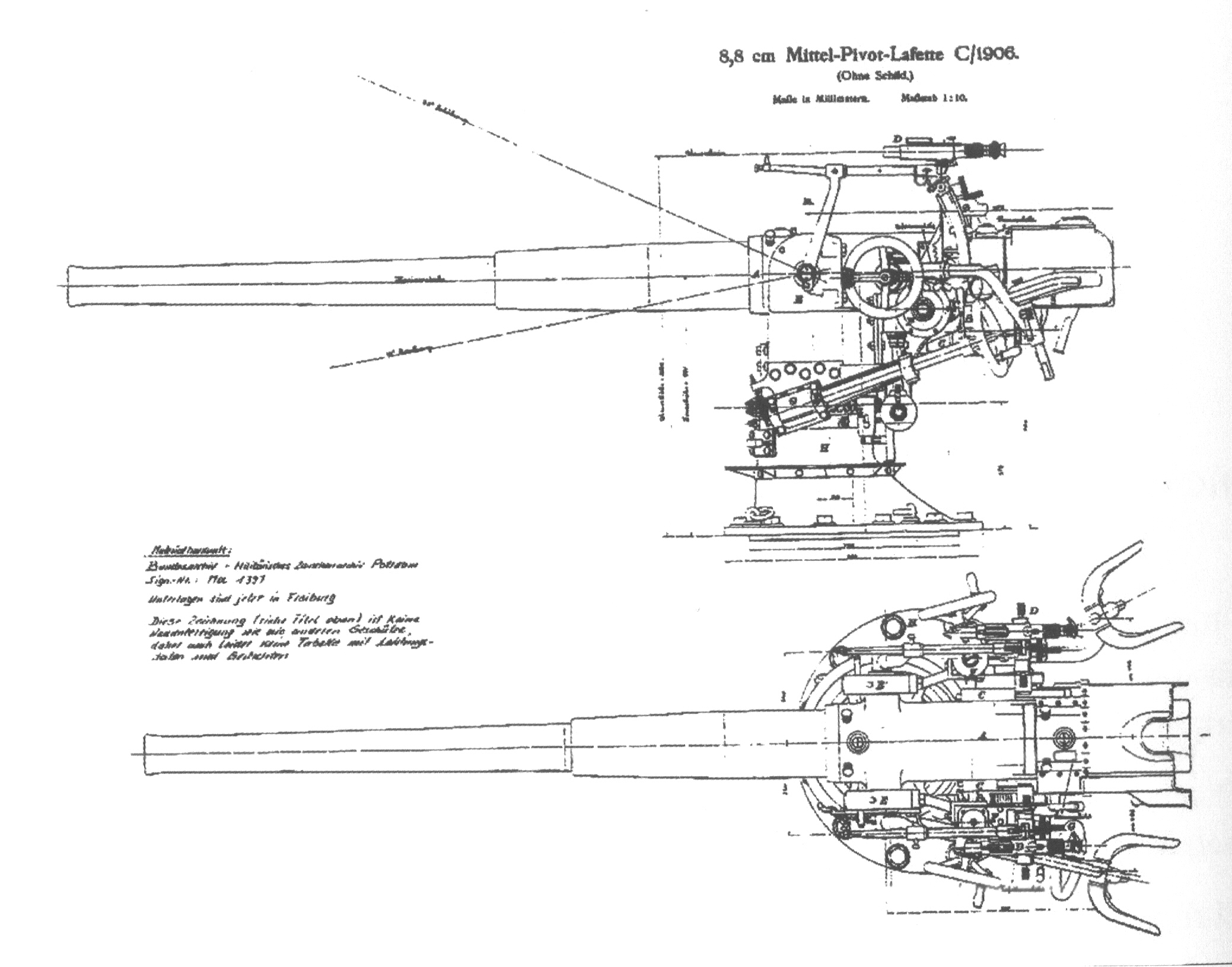
| Designation 1a | Casemate Single Mountings
Nassau (16), Helgoland (14), Kaiser (8), König (6), Von der Tann (16), Moltke (12), Seydlitz (12), Derfflinger (4) and Blücher (16): MPL C/01-06 Flak Single Mountings
1925 - 1945
|
|---|---|
| Weight | N/A |
| Elevation | MPLC/01-06: -10 / +25 degrees
MPLC/13: -10 / +70 degrees |
| Elevation Rate | Manual operation, only |
| Train | N/A |
| Train Rate | Manual operation, only |
| Gun recoil | 9.4 in (24 cm) |
- ^Quantities and types shown above are "as built." Many ships had 8.8 cm/45 anti-ship guns removed during World War I in order to fit 8.8 cm/45 FLAK guns. Many older torpedo boats traded their low-powered 8.8 cm/30 and 8.8 cm/35 guns for the more powerful 8.8 cm/45 guns. Larger torpedo boats were rearmed with the even more powerful 10.5 cm/45 Tbts guns.

"Naval Weapons of World War Two" by John Campbell
"German Warships 1815-1945" by Erich Gröner
"German Capital Ships of World War Two" and "German Destroyers of World War Two (2nd Edition)" both by M.J. Whitley
---
"Diagrams of Great War - German Naval Guns; Shells & Explosives; Fuses & Exploders" by The Royal Laboratory Woolwich 1921-22
"Übersicht über die für die Marinegeschütze und deren Abk K zu verwendende Munition und ihre Einzelteile einschließlich Salut-
und Manöverladungen" M.Dv. Nr. 198 by Oberkommando der Kriegsmarine
---
Special help from Peter Lienau and Javier Villarroya del Real
30 January 2008 - Benchmark
16 April 2009 - Corrected dates
09 August 2009 - Corrected picture link
06 February 2021 - Converted to HTML 5, added photographs of Spanish guns
24 August 2024 - Added burster information and sketches of Spgr. L/3,6, Spgr. L/3,8 and Spgr. L/3,9
17 June 2025 - Redid Burster table