
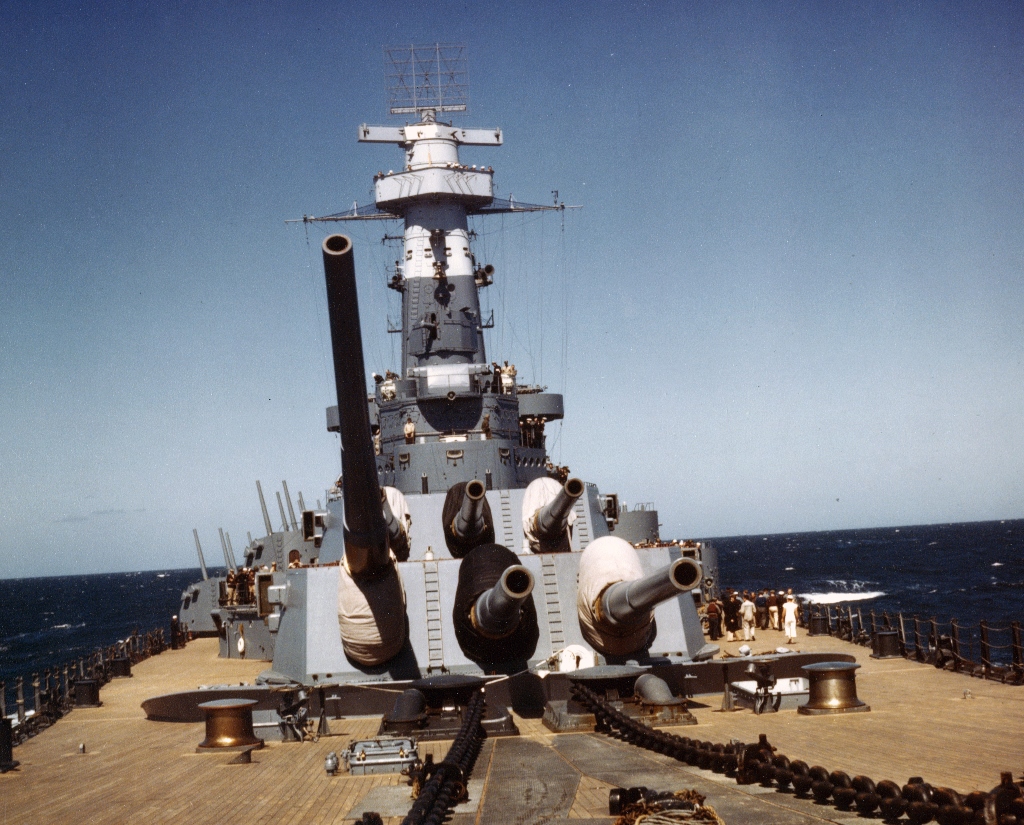
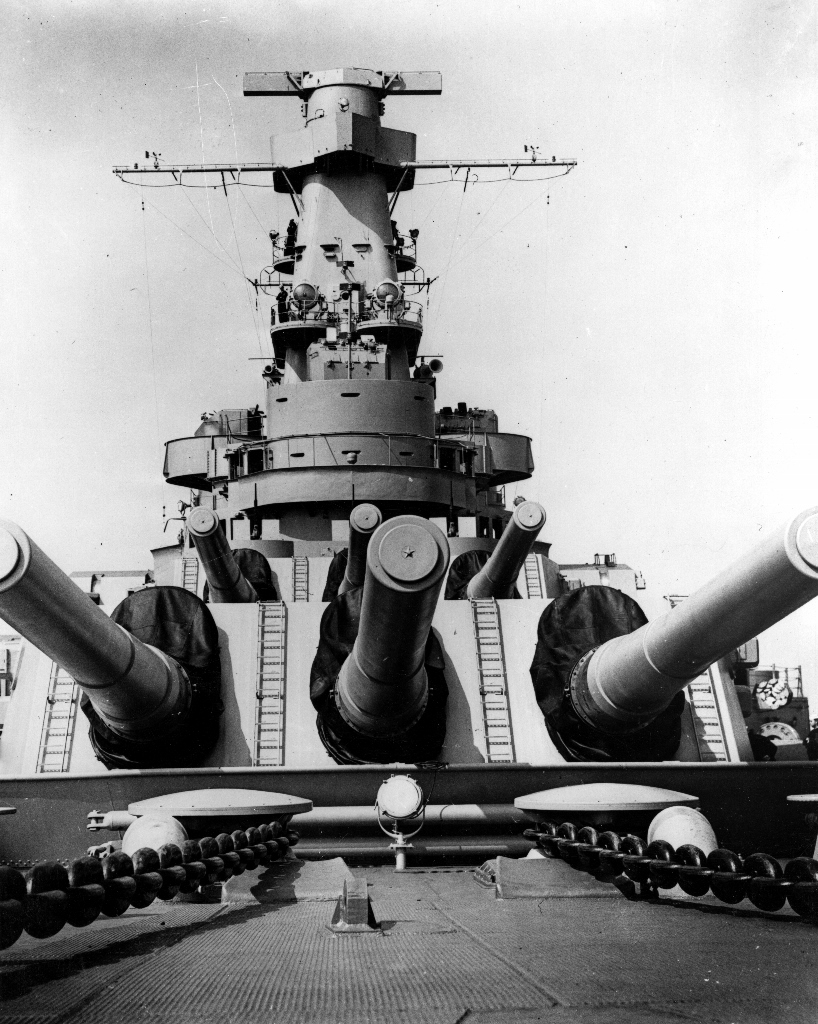
An improved weapon when compared to the older 16"/45 (40.6 cm) gun used on the Colorado class battleships, this weapon was to a simpler, lighter design. A major difference was that the mountings for these guns were specifically designed to handle the 2,700 lbs. (1,224.7 kg) AP Mark 8 projectile. This gun had a slight advantage over the 16"/50 (40.6 cm) Mark 7 in terms of deck armor penetration due to its lower muzzle velocity.
During the Battle off Casablanca in November 1942, USS Massachusetts (BB-59) put two AP rounds through deck armor of the French battleship Jean Bart and temporarily silenced her only operational main battery turret with another AP round. During the Battle of Guadalcanal in the same month, USS Washington (BB-56) sank the small Japanese battleship Kirishima with at least nine direct AP hits.
On 9 August 1945, USS Indiana (BB-58), fired the last Battleship salvo of World War II during a bombardment of the Kamaishi steel mill located on the east coast of northern Honshu. See photograph below.
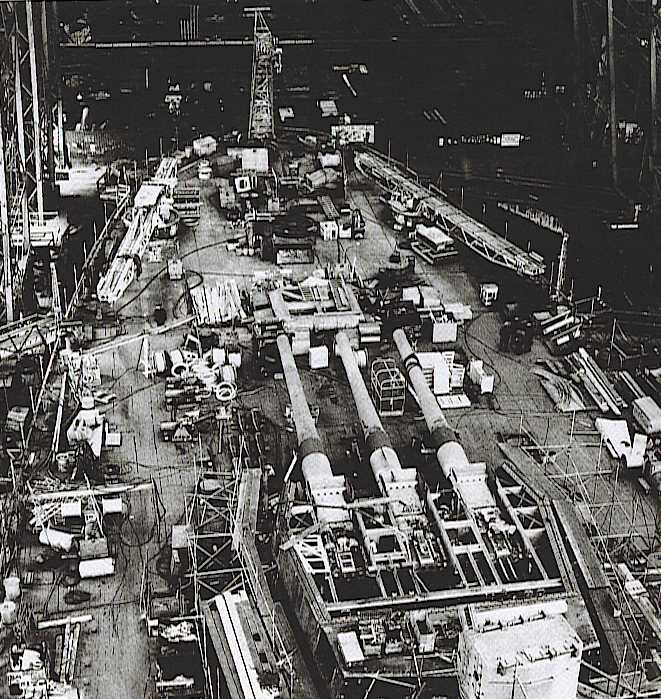
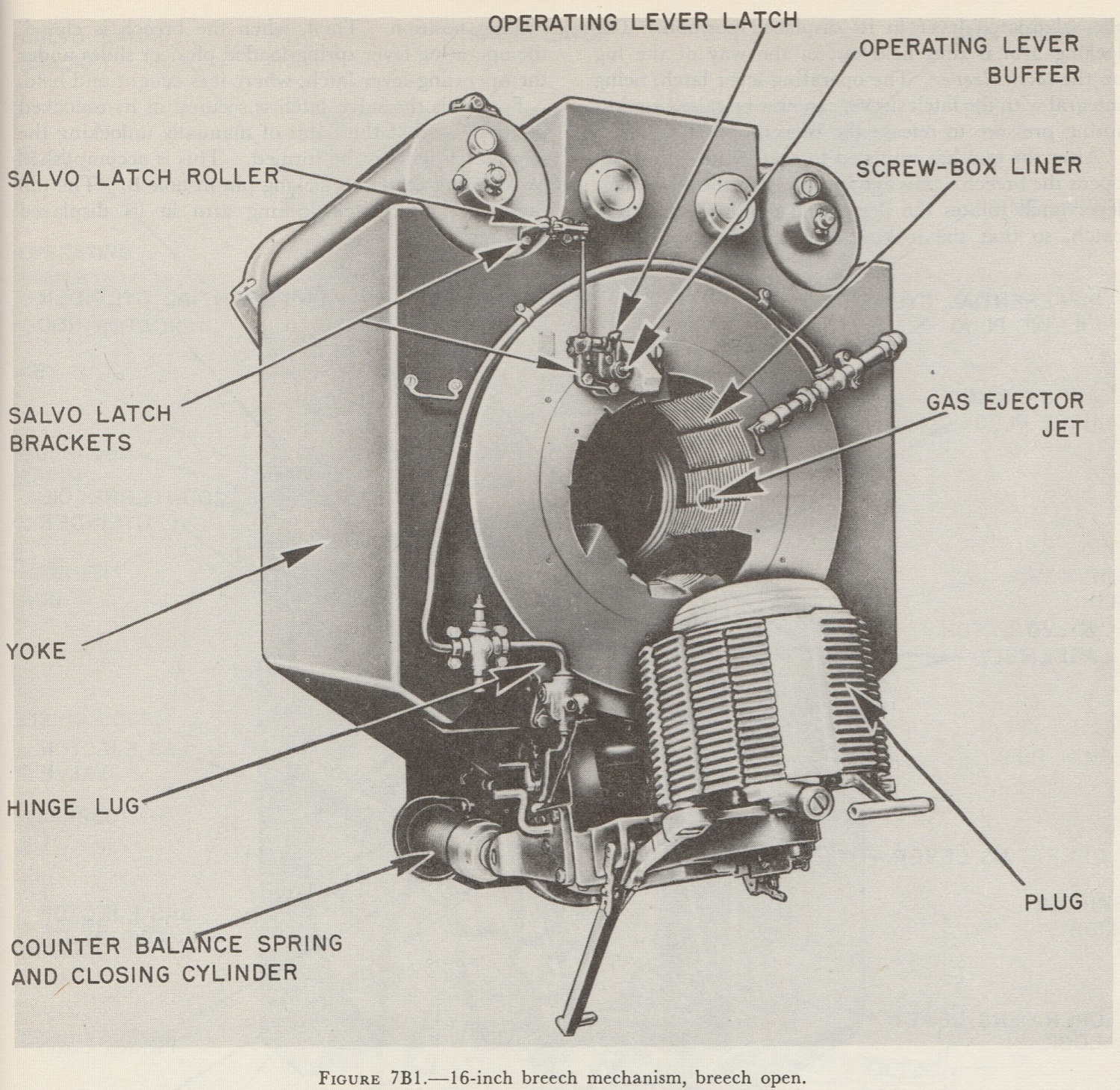
Constructed of liner, A tube, jacket, three hoops, two locking rings, liner-locking ring, yoke ring and screw box liner. Some components were autofretted. Used a Welin breech block which opened downwards. As typical of USN weapons, the bore was chromium plated. Mod 1 was similar except that there were tapped holes in the breech end for securing the hinge lug to the gun. Mod 2 had a set of adapter sleeves to allow it to be used for regunning the Colorado class, but it is doubtful if any of these guns were actually in service aboard those ships. About 120 guns of all mods were manufactured, with most being Mod 1.
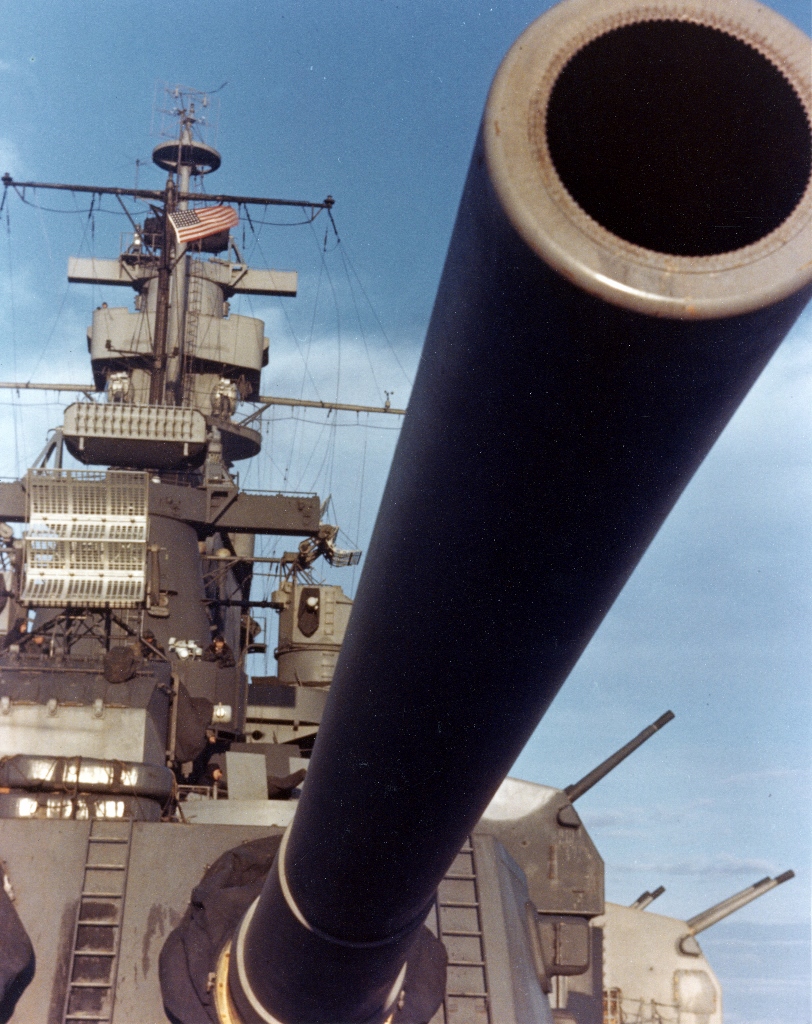
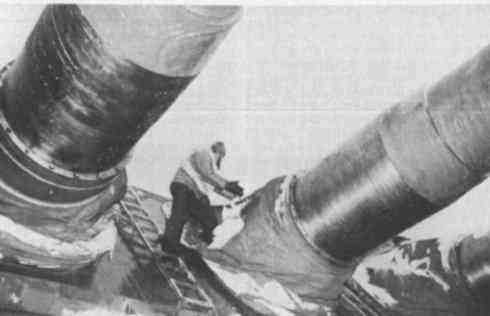
One gun formerly used on USS South Dakota (BB-57) was converted to a 24" (60.96 cm) test gun by removing the liner, cutting the overall barrel length down to 492 inches (12.5 m) and then boring out the inside diameter to 24 inches (60.96 cm). The finished gun was part of the Atlas missile development program and was used to fire 5,000 lbs. (2,268 kg) projectiles at a muzzle velocity of 1,300 fps (396 mps) or 100 lbs. (45.4 kg) projectiles at a muzzle velocity of 3,600 fps (1,097 mps). See photograph below.
| Designation | 16"/45 (40.6 cm) Mark 6 |
|---|---|
| Ship Class Used On | North Carolina (BB-55) and South Dakota (BB-57) classes |
| Date Of Design | 1936 |
| Date In Service | 1941 |
| Gun Weight | 192,310 lbs. (97,231 kg) (without breech) |
| Gun Length oa | 736.0 in (18.694 m) |
| Bore Length | 720.0 in (18.288 m) |
| Rifling Length | 616.9 in (15.668 m) |
| Grooves | 96 |
| Lands | N/A |
| Twist | Twist varied in individual guns of Mod 0, with some having a uniform RH 1 in 25 and
others having increasing RH 1 in 50 to 1 in 32 at the muzzle.
Twist for Mod 1 and Mod 2 guns were all uniform RH 1 in 25. |
| Chamber Volume | 23,195 in3 (380.1 dm3) |
| Rate Of Fire | 2 rounds per minute |
- The primer cartridge can be fired either electrically or by percussion. The cartridge is automatically ejected when the breech opens after firing. In the case of a misfire, the cartridge can be manually removed and replaced without opening the breech.
- The bore was chromium plated for a distance of 625 inches (15.875 m) from the muzzle.
- At 0704 local time on 8 November 1942, USS Massachusetts (BB-59) fired the first US 16 inch (40.6 cm) warshot of World War II. In sixteen minutes she fired nine main battery salvos, scoring five hits on the incomplete French battleship Jean Bart. Heavily damaged, Jean Bart was silenced for the rest of the day. In addition, Massachusetts during this exchange sank four freighters and a floating dry-dock. Between 1000 and 1030 on the same day, Massachusetts, supported by cruisers and destroyers, battled French forces and shared in the sinking of the French destroyer Fougueux and damaged the destroyer Malin. In return, Massachusetts received a 194 mm (7.64") hit from the El Hank shore battery. Massachusetts fired 59.2% of her outfit in four hours of fighting (0704 to 1104) and then fired an additional 8% during the rest of the day. During the entire action off Casablanca, USS Massachusetts in 134 salvos fired a total of 786 rounds out of a possible 800, an output of 98%. During this engagement, she reported that most salvos had a dispersion of about 2 mils in deflection and about 200 to 300 yards (183 to 274 m) in range. All of these shots were with AP projectiles, as the ship had not yet received any HC projectiles.
- During her 15 November 1942 battle with the Japanese battleship Kirishima, USS Washington (BB-56) opened fire at a gun range of 18,500 yards (16,900 m) using radar ranges and optical train and hits were definitely obtained by the third salvo. In the first part of the battle, Washington fired 42 rounds in approximately 3 minutes (precise time not available) or 1.56 rpmpg. During the second phase Washington fired 75 rounds in 5 minutes 24 seconds, or 1.54 rpmpg. Washington fired a total of 117 out of a possible 131 shells, or 89%. Of the 14 missed salvos, the most notable was the center gun of turret 3 which missed five salvos due to a ball check valve being jarred loose by the firing shock, causing a loss of hydraulic pressure for that gun. This loss of pressure prevented the pointer from matching up in the load position. One other gun had a misfire which caused it to miss two salvos. The other failures were primarily "error in drill" related.
- During the 15 November 1942 battle with Japanese forces, USS South Dakota (BB-57) fired a total of 115 rounds in 23 salvos at ranges between 5,000 and 18,000 yards (4,600 and 16,500 m). Nine of these salvos were only from Turret III. Two of her guns in Turret II had been damaged by a bomb hit during the earlier Santa Cruz battle and were not used during the Guadalcanal battle. Almost all of these shots were aimed at Japanese destroyers with the exception of one broadside aimed at either Nagara or Sendai.
| Type | Bag |
|---|---|
| Projectile Types and Weights 1a | AP Mark 8 Mods 0 to 8 - 2,700 lbs. (1,225 kg)
HC Mark 13 Mods 0 to 6 - 1,900 lbs. (862 kg) HC Mark 14 Mod 0 - 1,900 lbs. (862 kg) |
| Bursting Charge | AP Mark 8 - 40.9 lbs. (18.55 kg)
HC Mark 13 - 153.6 lbs. (69.67 kg) HC Mark 14 - 153.6 lbs. (69.67 kg) |
| Projectile Length | AP Mark 8 - 72.0 in (182.9 cm)
HC Mark 13 - 64.0 in (162.6 cm) HC Mark 14 - 64.0 in (162.6 cm) |
| Propellant Charge 2a | Full Charge - 535 lbs. (242.7 kg) D846 SPD
Reduced Charge - 295 lbs. (133.8 kg) D846 SPD or SPDN
|
| Muzzle Velocity | Full Charge - New Gun
AP - 2,300 fps (701 mps) HC - 2,635 fps (803 mps) Full Charge - Average Gun
Reduced Charge - New Gun
|
| Working Pressure | 18.0 tons/in2 (2,835 kg/cm2) |
| Approximate Barrel Life 3a | 395 rounds |
| Ammunition stowage per gun 4a | about 148 rounds |
- ^For additional projectile data on the AP Mark 8, the HC Mark 13 and the HC Mark 14, see the 16"/50 (40.6 cm) Mark 7 data page.
- ^The propellant was in six bags for both full and reduced charges. Bags were transferred from hoist to loading tray three bags at a time and then all six bags were rammed into the breech with a single stroke.
- ^HC rounds at 2,525 fps (770 mps) were 0.74 ESR and at 2,000 fps (610 mps) were 0.09 ESR. The Target rounds at 1,800 fps (549 mps) were 0.08 ESR, but it is noted that this gun could fire 2,860 Target rounds before exceeding liner life.
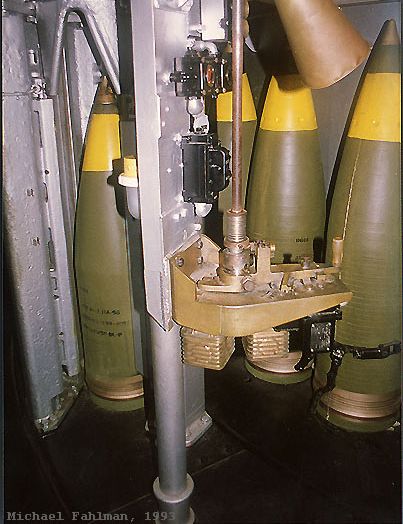
- ^Projectile Stowage for both USS North Carolina (BB-55) and USS South Dakota (BB-57) classes from OP 755:
Projectile Stowage from OP 755 "16-Inch Triple Gun Turrets BB 55-60" Location Projectile Stowage Turret I Projectile Stowage Turret II Projectile Stowage Turret III Upper Projectile Flat Outer Ring 130 130 130 Lower Projectile Flat Outer Ring 130 130 130 Each of the two Inner Rings 72 72 72 Fixed Stowage, Third Level N/A 121 N/A Total 404 525 404 Grand Total 1,333
There were also 9 drill projectiles per turret for a total of 27.OP 755 was first issued in 1941 and updated in October 1944.
As was typical of US designs, the higher position of Turret II allowed significantly more projectile stowage compared to the other two mountings.
- The AP Mark 8 had a nominal 1.5 lbs. (0.68 kg) dye bag but this was allowed to be as large as 3.0 lbs. (1.36 kg) to bring underweight projectiles up to weight. Dye colors were assigned as follows in 1945:
USS North Carolina - Green
USS Washington - Orange
USS South Dakota - Blue
USS Indiana - Red
USS Massachusetts - Green
USS Alabama - No Dye - Bourrelet diameter was 15.977 inches (40.06 cm).
| Elevation | Range | Angle of Fall | Time of Flight | Striking Velocity | Maximum Ordinate |
|---|---|---|---|---|---|
| 2.79 degrees | 5,000 yards (4,572 m) | 2.93 degrees | 6.83 seconds | 2,090 fps (637 mps) | 187 ft (57 m) |
| 5.99 degrees | 10,000 yards (9,140 m) | 6.80 degrees | 14.45 seconds | 1,900 fps (579 mps) | 839 ft (256 m) |
| 9.73 degrees | 15,000 yards (13,716 m) | 11.72 degrees | 22.94 seconds | 1,733 fps (528 mps) | 2,115 ft (645 m) |
| 14.16 degrees | 20,000 yards (18,290 m) | 17.93 degrees | 32.55 seconds | 1,604 fps (489 mps) | 4,260 ft (1,298 m) |
| 19.50 degrees | 25,000 yards (22,860 m) | 25.38 degrees | 43.61 seconds | 1,520 fps (463 mps) | 7,670 ft (234 m) |
| 26.23 degrees | 30,000 yards (27,430 m) | 34.07 degrees | 56.64 seconds | 1,490 fps (454 mps) | 12,970 ft (3,953 m) |
| 36.18 degrees | 35,000 yards (32,000 m) | 44.88 degrees | 74.42 seconds | 1,528 fps (466 mps) | 22,380 ft (6,821 m) |
| 36.08 degrees | 36,800 yards (33,650 m) | 51.85 degrees | 86.72 seconds | 1,588 fps (484 mps) | N/A |
| 45.37 degrees | 36,900 yards (33,741 m) | 53.10 degrees | 89.16 seconds | 1,600 fps (488 mps) | 32,070 ft (9,775 m) |
- ^Values for AP Mark 8 from BuOrd OP 757.
- Range with the originally planned 2,240 lbs. (1,016 kg) AP Mark 5 was 40,200 yards (36,760 m) at a muzzle velocity of 2,520 fps (768 mps).
| Elevation | Range | Angle of Fall | Time of Flight | Striking Velocity | Maximum Ordinate |
|---|---|---|---|---|---|
| 1.27 degrees | 4,000 yards (3,658 m) | 1.82 degrees | 4.78 seconds | 2,387 fps (728 mps) | 92 ft (28 m) |
| 4.88 degrees | 10,000 yards (9,140 m) | 5.63 degrees | 12.99 seconds | 2,034 fps (620 mps) | 679 ft (207 m) |
| 7.34 degrees | 14,000 yards (12,802 m) | 9.23 degrees | 19.31 seconds | 1,824 fps (556 mps) | 1,500 ft (457 m) |
| 11.90 degrees | 20,000 yards (18,290 m) | 16.55 degrees | 30.36 seconds | 1,571 fps (479 mps) | 3,705 ft (1,129 m) |
| 15.65 degrees | 24,000 yards (21,946 m) | 22.78 degrees | 38.91 seconds | 1,457 fps (444 mps) | 6,090 ft (1,856 m) |
| 22.61 degrees | 30,000 yards (27,430 m) | 33.68 degrees | 53.82 seconds | 1,375 fps (419 mps) | 11,670 ft (3,557 m) |
| 28.49 degrees | 34,000 yards (31,090 m) | 41.38 degrees | 65.64 seconds | 1,380 fps (421 mps) | 17,360 ft (5,291 m) | 43.65 degrees | 40,000 yards (36,576 m) | 55.60 degrees | 93.20 seconds | 1,516 fps (462 mps) | 26,180 ft (7,980 m) |
| 45.00 degrees | 40,180 yards (36,741 m) | 56.60 degrees | 95.40 seconds | 1,531 fps (467 mps) | N/A |
- ^Values for HC Mark 13 from BuOrd OP 1188.
| Range | Side Armor | Deck Armor | Striking Velocity | Angle of Fall |
|---|---|---|---|---|
| 0 yards (0 m) | 29.74" (755 mm) | --- | 2,300 fps (701 mps) | 0.0 |
| 5,000 yards (4,572 m) | 26.60" (676 mm) | 0.76" (19 mm) | 2,090 fps (637 mps) | 3.0 |
| 10,000 yards (9,144 m) | 23.51" (597 mm) | 1.87" (28 mm) | 1,900 fps (579 mps) | 6.8 |
| 15,000 yards (13,716 m) | 20.47" (520 mm) | 3.04" (77 mm) | 1,743 fps (529 mps) | 11.7 |
| 20,000 yards (18,288 m) | 17.62" (448 mm) | 4.29" (109 mm) | 1,604 fps (489 mps) | 17.9 |
| 25,000 yards (22,860 m) | 15.05" (382 mm) | 5.76" (146 mm) | 1,521 fps (463 mps) | 25.4 |
| 30,000 yards (27,432 m) | 12.77" (324 mm) | 7.62" (194 mm) | 1,490 fps (454 mps) | 34.1 |
| 35,000 yards (32,004 m) | 10.49" (266 mm) | 10.57" (268 mm) | 1,531 fps (488 mps) | 45.2 |
- The above information is from "Battleships: United States Battleships 1935-1992" for a muzzle velocity of 2,300 fps (701 mps) and is based upon the USN Empirical Formula for Armor Penetration.
- Side Armor penetration with the originally planned AP Mark 5 was 29.68" (754 mm) at the muzzle, 16.24" (412 mm) at 20,000 yards (18,288 m) and 10.02" (210 mm) at 35,000 yards (32,004 m). Information is from "Battleships: United States Battleships 1935-1992" for a muzzle velocity of 2,520 fps (768 mps).
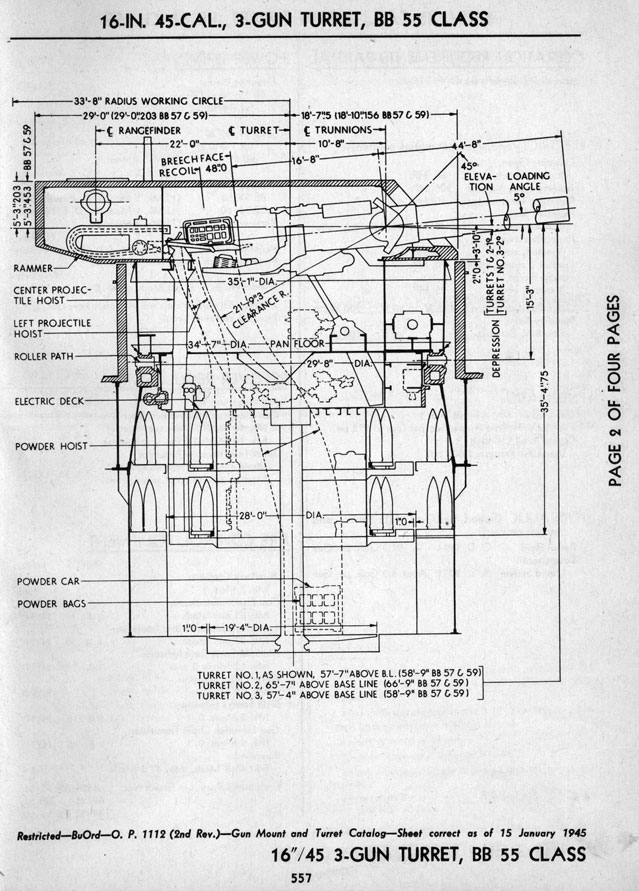
| Designation | Three-gun Turrets 1e 2e North Carolina (3) and South Dakota (3) |
|---|---|
| Weight | 1,403 - 1,437 tons (1,426 - 1,460 mt) |
| Elevation | Turrets I and III: -2 / +45 degrees
Turret II: 0 / +45 degrees |
| Rate of Elevation | 12 degrees per second |
| Train 3e | -150 / +150 degrees |
| Rate of Train | 4 degrees per second |
| Gun Recoil | 48 in (1.219m) |
| Loading Angle | +5 degrees |
- ^These three-gun mountings had individually sleeved guns which were spaced further apart than in the previous 14" (35.6 cm) three-gun mounts. They also used delay coils, which delayed the firing of the guns by about 0.060 seconds (60 milliseconds). The firing order was left, right, center. These changes gave this weapon considerably improved dispersion characteristics when compared with the older 14" (35.6 cm) triple and three-gun mounts. Turrets were essentially the same between the two classes with the South Dakota (BB-57) class having slightly thicker armor protection on most surfaces.
- ^These mountings do not have a working chamber and both shell and propellant hoists are single stage types running directly up to the gunhouse. Effectively, the powder handling room at the bottom of the stalk acts as a working chamber as the powder circle compartment outside of it forms a double-wall isolation between the hoists and the propellant magazines.
- ^Training was by a 300 hp electric motor driving hydraulic gear. Each gun had a 60 hp motor for elevation, a 60 hp motor for ramming, a 60 hp motor for shell hoist and a 75 hp motor for power hoist. Each of the two shell rings used a 40 hp motor.
- The gun axes were 117 in (297 cm) apart.
- Gun crew was two officers and about 90 crewmen per turret.
- As was typical of US designs of this period, guns could be removed and replaced without dismantling the gunhouse.
- Armor thickness for the North Carolina class (BB-55) as given in "Battleships: United States Battleships, 1935 - 1992" by W.H. Garzke, Jr. and R.O. Dulin, Jr.:
Face: 16.0 in (40.6 cm) Class B armor over 2.5 in (6.4 cm) STS
Sides: 9.8 in (24.9 cm) Class A armor over 0.75 in (1.9 cm) STS
Rear: 11.8 in (30.0 cm) Class A armor over 0.75 in (1.9 cm) STS
Roof: 7.0 in (17.8 cm) Class A armor over 0.75 in (1.9 cm) STSArmor thickness for the South Dakota class (BB-57) as given in "Battleships: United States Battleships, 1935 - 1992" by W.H. Garzke, Jr. and R.O. Dulin, Jr.:
Face: 18.0 in (45.7 cm) Class B armor over 2.5 in (6.4 cm) STS
Sides: 9.5 in (24.1 cm) Class A armor over 0.75 in (1.9 cm) STS
Rear: 12.0 in (30.5 cm) Class A armor over 0.75 in (1.9 cm) STS
Roof: 7.25 in (18.4 cm) Class A armor over 0.75 in (1.9 cm) STS
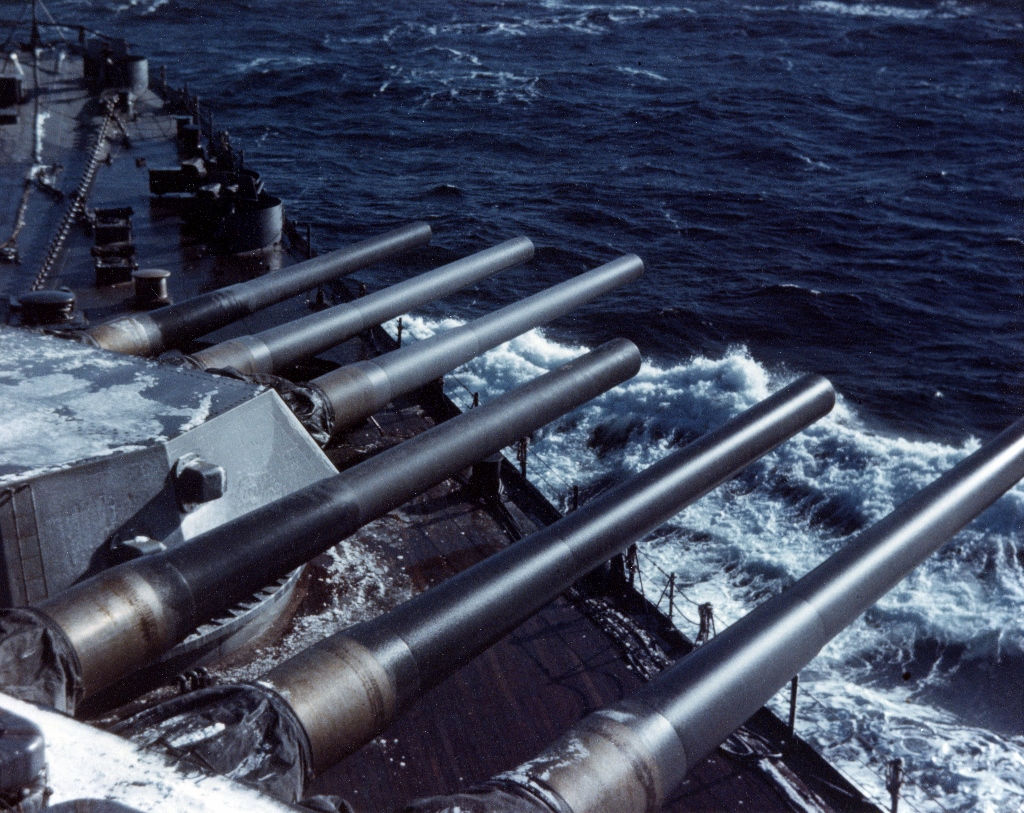
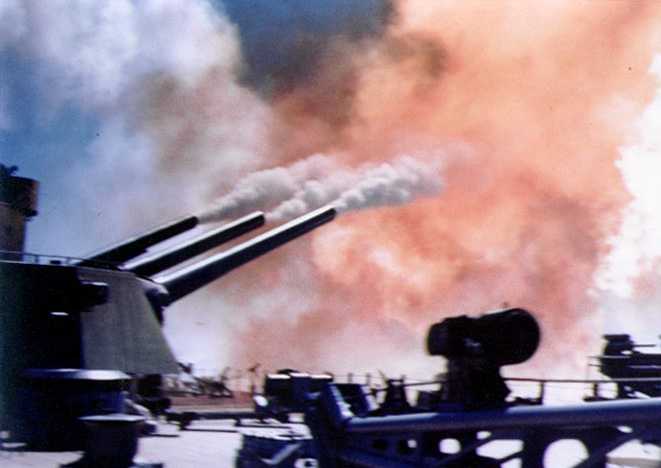
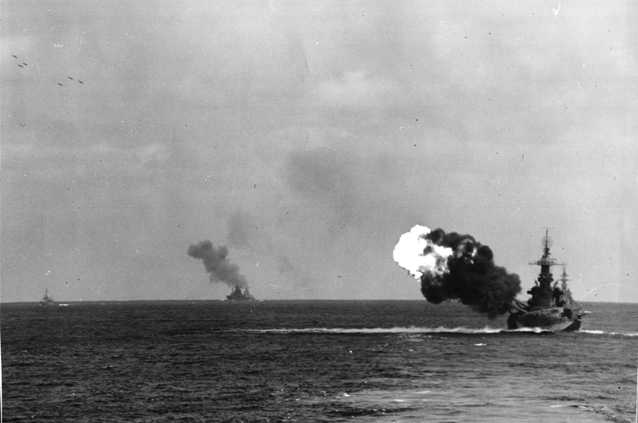
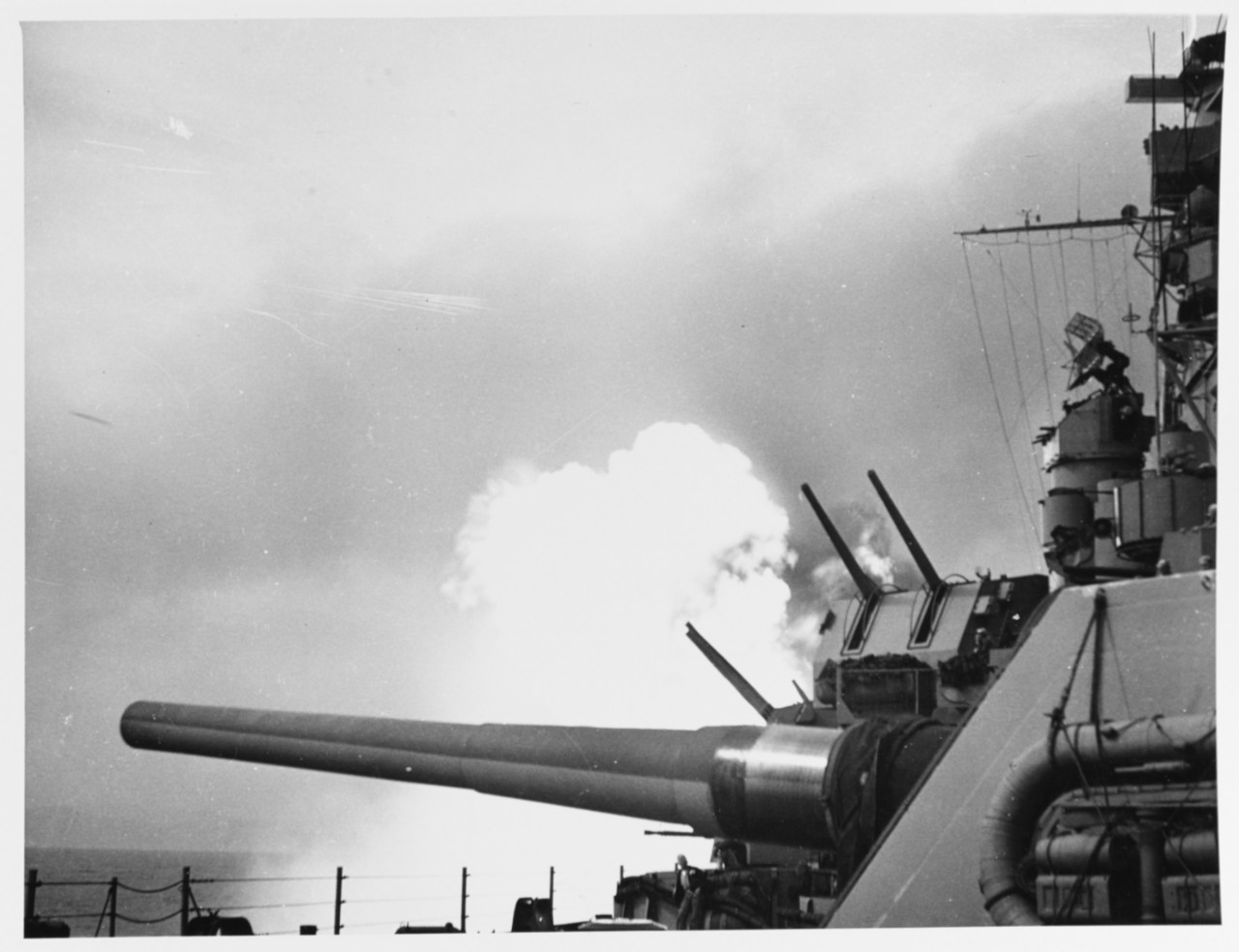
"Bombarding Kamaishi, Honshu, Japan, with her forward 16" guns, 9 August 1945. This was the last salvo of the bombardment. Note 16" projectile in air at left."
As well as being the last salvo of the bombardment, this was also the last 16" (40.6 cm) warshot of World War II. Photograph was taken by Photographer’s Mate 2nd Class Frank P. Fish. NHHC photograph # 80-G-339340.

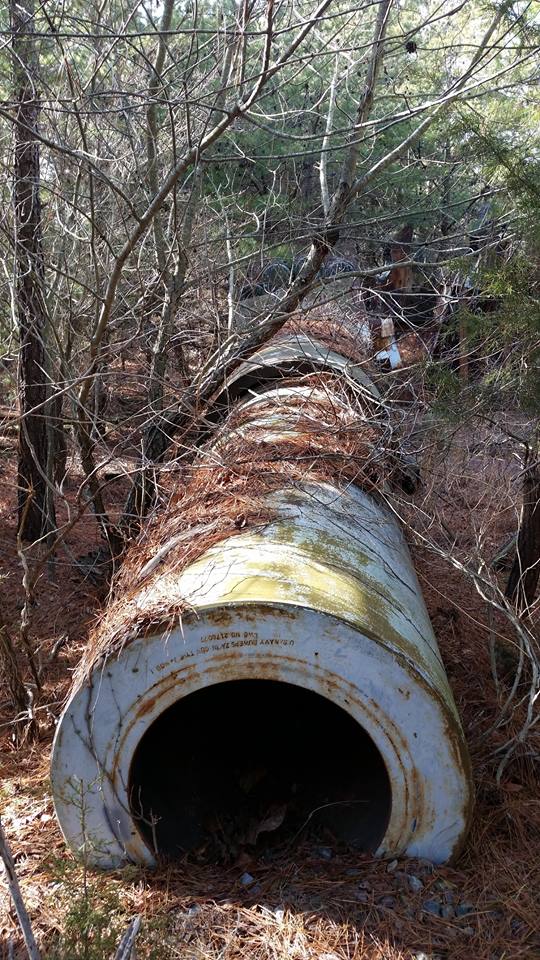
U.S. NAVY BUWEAPS 24 IN GUN TYPE A MOD 1
DWG NO 2176077
Photograph courtesy of Rich W. and used here by his kind permission.
John Campbell
- "Naval Weapons of World War Two"
Friedman, Norman
- "US Battleships: An Illustrated Design History"
- "US Naval Weapons: Every gun, missile, mine and torpedo used by the US Navy from 1883 to the present day"
Garzke, Jr., William H. and Dulin, Jr., Robert O.
- "Battleships: United States Battleships, 1935 - 1992"
Herder, Brian Lane
- "The Naval Siege of Japan 1945: War Plan Orange Triumphant"
O'Hara, Vincent P.
- "The U.S. Navy Against the Axis: Surface Combat 1941-1945"
---
Love, R.L. - Letter to the Editor
- "Alnavco Log" Volume 7 Number 3, September 1972
---
Bureau of Ordnance (BuOrd), Department of the Navy
- "USS Massachusetts 1945 Gunnery Doctrine"
- "16-Inch Triple Gun Turrets (45 Cal.) For Battleships 55 to 60 Incl." - Ordnance Pamphlet No. 755 - December 1941
- "Range Tables for 16"/45 caliber gun, Mark VI, Rifling 1/25, 2700lb Projectile, 2300 F.S." - Ordnance Pamphlet No. 757 - October 1940
- "Abridged Range Tables for U.S. Naval Guns" - Ordnance Pamphlet No. 1188 - 13 June 1944
- "U.S. Explosive Ordnance" - Ordnance Pamphlet No. 1664 - 28 May 1947
Naval Historical Center, Department of the Navy
Reilly, Jr., John C., Editor
- "Operational Experience of Fast Battleships: World War II, Korea and Vietnam" - 1989
---
Gene Slover's Navy Pages
---
Special help by Keith Allen, Brad Fischer, Leo Fischer, Nathan Okun, Robert Lundgren and Ed Jackson
22 October 2008 - Benchmark
30 December 2009 - Fixed typographical error, added information on USS Massachusetts at Casablanca
24 August 2014 - Added turret armor note
22 May 2015 - Redid photograph of USS North Carolina and mentioned 24 inch gun photograph
08 June 2015 - Redid photographs of USS Indiana and USS Alabama, added photograph of 24 inch gun
23 June 2016 - Converted to HTML 5 format
19 January 2018 - Reorganized notes
20 December 2018 - Added turret sketch
21 April 2019 - Added projectile storage information
03 August 2020 - Added note regarding gun replacement
25 October 2020 - Added comment and photograph regarding USS Indiana at Kamaishi
10 November 2020 - Added number of shots fired by USS South Dakota during the Guadalcanal Battle
21 November 2021 - Corrected typographical errors
23 March 2023 - Added Time of Flight / Maximum Ordinate Table
23 June 2023 - Added sketch of Smith-Asbury breech mechanism
04 August 2023 - Revised range tables
28 July 2024 - Added note regarding shell and propellant hoists
19 January 2026 - Added D846 for propellant
12 September 2026 - Added barrel blueprint and reorganized Sources section