
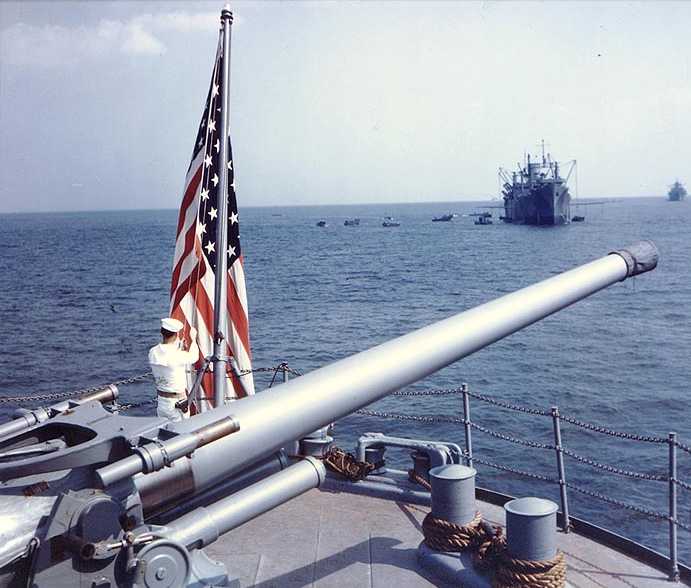
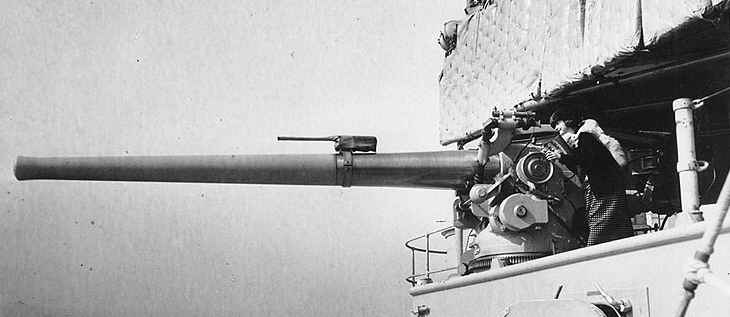
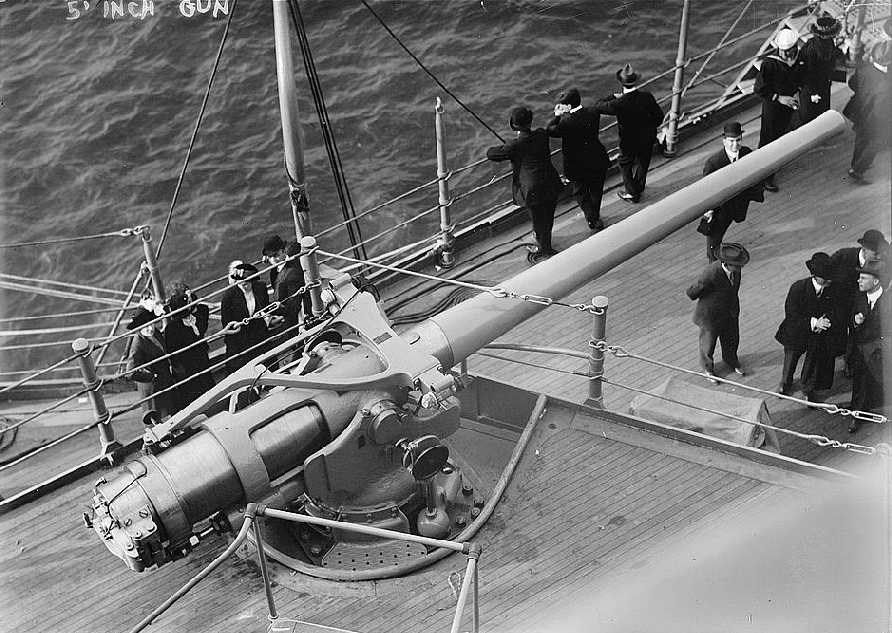
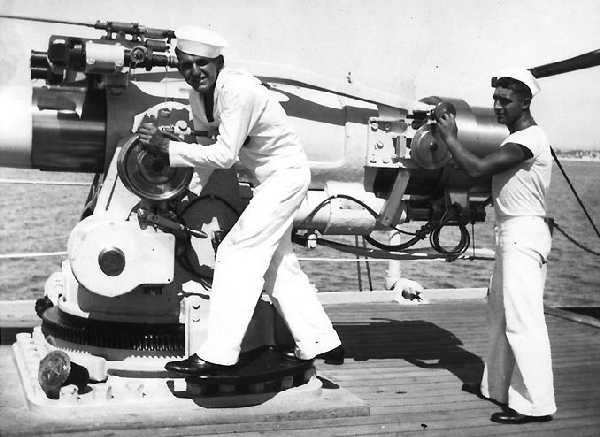
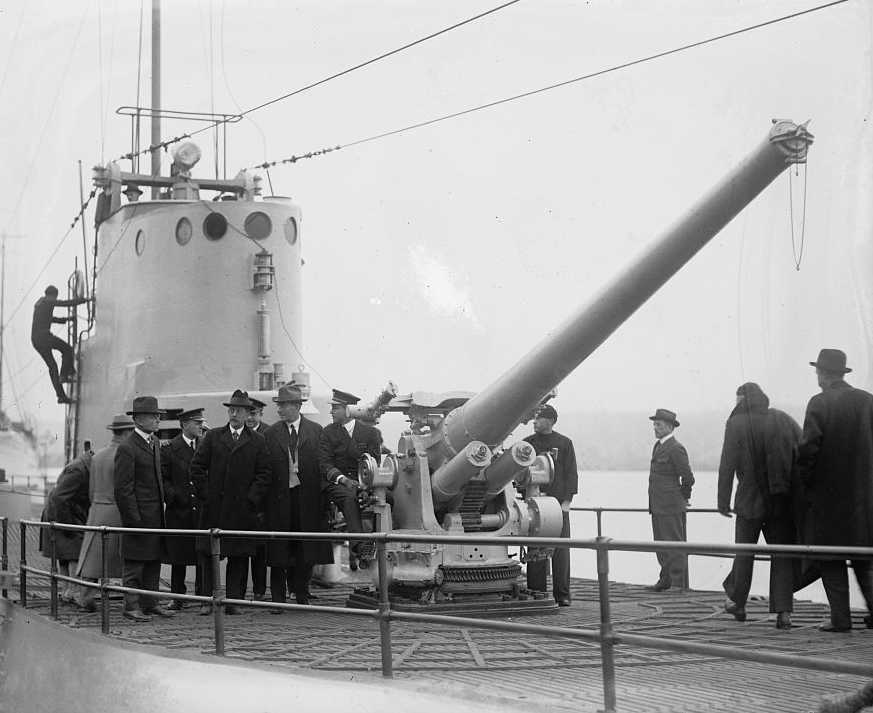
First introduced as anti-torpedo boat guns in the battleships of the Florida (B-30) and Wyoming (B-32) classes. Later versions were mounted on almost all battleships built in the 1910s and 1920s and fitted to many smaller warships. Most versions fired bag ammunition, with the exception of the Mark 9 which was a "wet-gun" for submarine use and fired semi-fixed (separate) ammunition.
These guns were also used as coastal artillery, most notably at Wake Island, where they are credited with sinking the Japanese destroyer IJN Hayate.
The US Navy was proud of the performance of this gun, as it had both a high muzzle velocity and good accuracy, important features for an anti-destroyer weapon on capital ships. As a result of its high muzzle velocity, the danger space for this gun was quite large, actually longer than the range to the target for ranges less than 3,000 yards (2,740 m). This high performance did result in a short barrel life.
In the late 1930s these 5"/51 (12.7 cm) SP guns and their cousins, the 5"/25 (12.7 cm) AA guns, were both replaced on new construction by the versatile 5"/38 (12.7 cm) Mark 12.
The British obtained three guns from Bethlehem Steel during World War I and employed them in the coastal defenses at Scapa Flow. In 1918 a further 150 guns of an improved pattern were ordered to arm DAMS, but this order was cancelled at the end of the war. These guns were designated as 5"/51 (12.7 cm) BL Mark VI and VII, respectively. During World War II, 22 Mark 8 Mod 7 guns were supplied with the ten US Coast Guard Cutters transferred to Britain as a part of Lend-Lease. Most of these guns were later replaced with British 4"/45 (10.2 cm) QF Mark V and other British AA weapons. Some of the 5"/51 (12.7 cm) guns were then sent to New Zealand where they were used in coastal defenses.
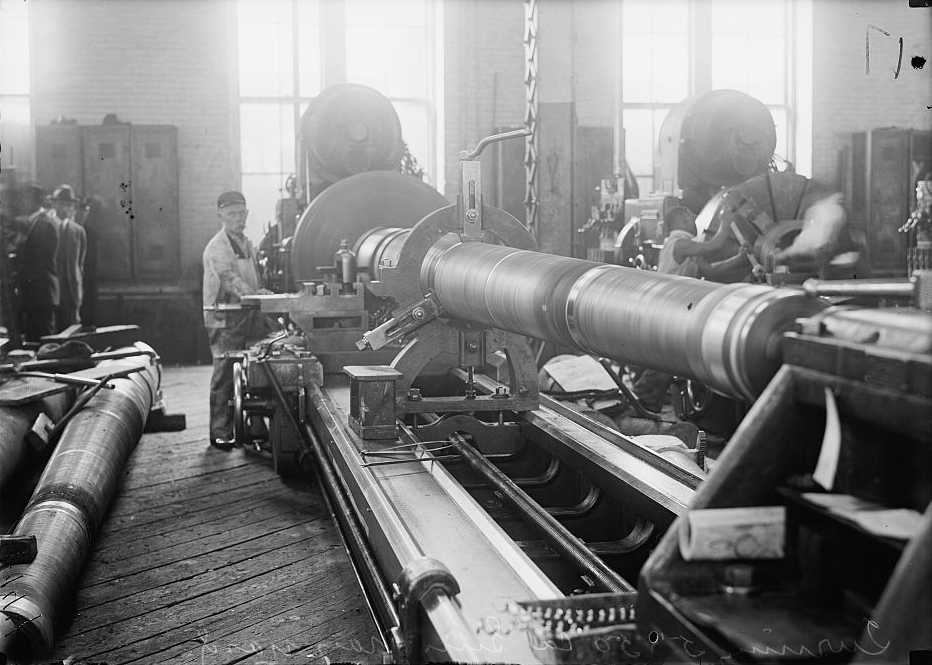
The construction of the Mark 7 was similar to the previous 5"/50 (12.7 cm) Mark 6 and consisted of A tube, jacket, hoop, locking ring and screw box liner. Some early Mark 7 guns were completed as case (semi-fixed) ammunition guns but were later converted to bag guns. As a bag gun, they generally used a Welin breech block with a side-swing Smith-Asbury mechanism. The Mark 8 gun used steel for some components and the chamber was slightly different, being constructed of tapered liner, A tube and full length jacket with a hoop and locking ring. Used a breech bush and a liner locking bush with Welin breech block with an Asbury mechanism. The Mark 9 was intended for submarines and was similar to the Mark 8, but had a different screw box liner, breech and chamber to allow the use of semi-fixed ammunition. Mark 14 was a relined Mark 8 and Mark 15 was the Mark 14 with an enlarged chamber and a chromium plated bore.
The data that follows is specifically for the Mark 15 version unless otherwise noted.
| Designation | 5"/51 (12.7 cm) Marks 7, 8, 9, 14 and 15 |
|---|---|
| Ship Class Used On | Battleships: Florida (B-30), Wyoming (B-32), New York (B-34), Nevada (B-36),
Pennsylvania (B-38), New Mexico (B-40), Tennessee (BB-43) and Colorado (BB-45) classes
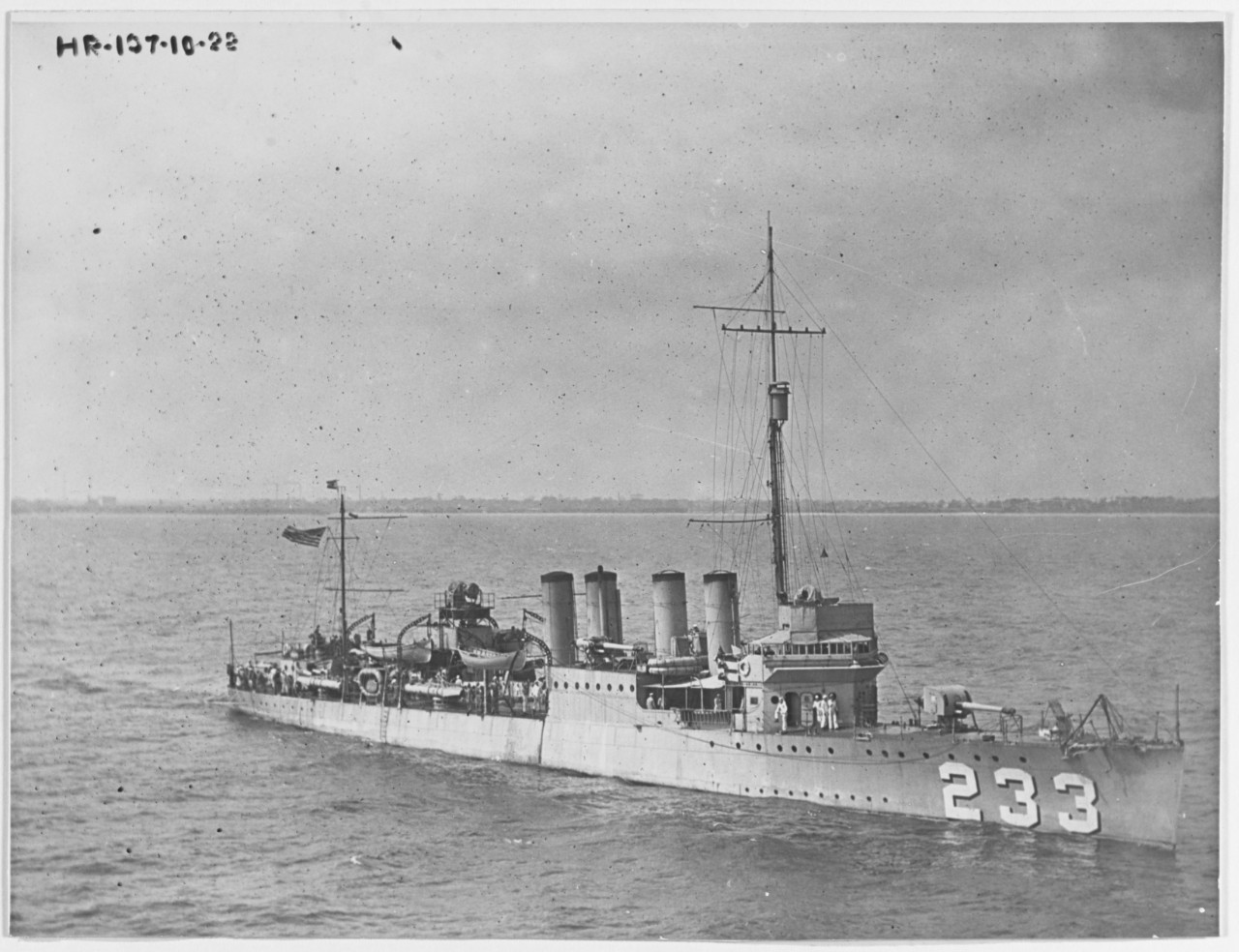
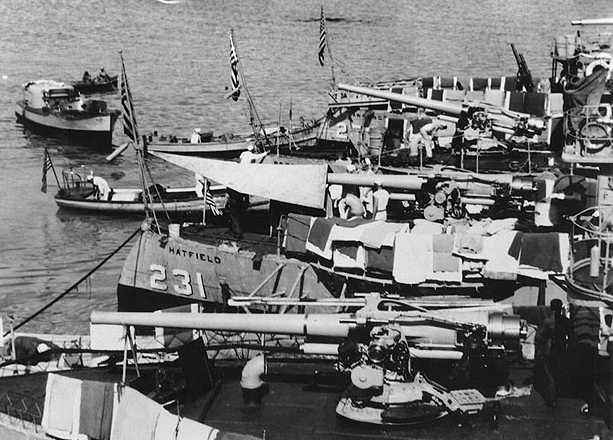
Carriers: Langley (CV-1), Long Island (AVG-1), Bogue (CVE-9), Sangamon (CVE-26) and Charger (CVE-30) classes Cruisers: Olympia (C-6) as rearmed 1 Destroyers 2: Hatfield (D-231), Brooks (D-232), Gilmer (D-233), Fox (D-234) and Kane (D-235) Submarines: Barracuda (SS-163), Bonita (SS-164) and "T" (SS-198) class Plus various Coast Guard cutters, auxiliaries and armed merchant ships |
| Date Of Design | About 1910 |
| Date In Service | 1911 |
| Gun Weight | Mark 8 and Mark 15: 5.05 tons (5.13 mt)
Mark 9: 5.08 tons (5.16 mt) |
| Gun Length oa | 261.25 in (6.636 m) |
| Bore Length | 255 in (6.477 m) |
| Rifling Length | Most guns: 212.1 in (5.387 m)
Mark 9: 214.1 in (5.438 m) |
| Grooves | N/A |
| Lands | N/A |
| Twist | Mark 7 Mods 3 and 4: Increasing RH 0 to 1 in 25 at the muzzle
Mark 7 Mod 2: Uniform RH 1 in 25 Mark 8 Mods 0 - 1: Increasing RH 0 to 1 in 25 at the muzzle Mark 8 Mods 2 - 10: Increasing RH 0 to 1 in 35 at the muzzle Mark 9: Uniform RH 1 in 30 Marks 14 and 15: Uniform RH 1 in 35 |
| Chamber Volume | 1,202 in3 (19.7 dm3) |
| Rate Of Fire | 8 - 9 rounds per minute |
- ^USS Olympia was rearmed twice. She underwent a major refit at Charleston Navy Yard (July–November 1916) where her original main battery of four 8-inch guns was removed, along with their armored barbettes and turrets. In addition, her ten 5"/40 (12.7 cm) guns were also removed. In their place she was rearmed with twelve 4"/50 (10.2 cm) guns. Then between July 1917 and February 1918 she was refitted at the New York Navy Yard with ten 5"/51 (12.7 cm) guns. These weapons replaced the 4" (10.2 cm) guns on the forward and after platforms and in the superstructure, with the exception of the amidships gun positions at frame 47.
- ^All destroyers of the Clemson (D-186) class had strengthened gun foundations which allowed them to mount heavier weapons than the standard single 4"/50 (10.2 cm) gun mounting. However, only the five destroyers listed above plus three others that had twin 4"/50 (10.2 cm) mountings actually carried heavier weapons.
| Type | All except Mark 9: Bag Mark 9: Separate |
|---|---|
| Projectile Types and Weights | AP 1a: 50 lbs. (22.7 kg)
Common Mark 15 Mods 1 through 14 1a: 50 lbs. (22.7 kg) HC Mark 39 Mods 1 and 2: 50.0 lbs. (22.7 kg) AAC Mark 35 Mods 1 through 12 2a 3a: 55.18 lbs. (25.03 kg) VT AA Mark 35 Mods 2 and 4: 55.18 lbs. (25.03 kg) Illum Mark 25 Mod 2: 54.5 lbs. (24.7 kg) |
| Bursting Charge | AP: 1.7 lbs. (0.77 kg) Explosive D
Common Mark 15 Mods 1 through 14: 1.73 lbs. (0.78 kg) Black Powder and TNT HC Mark 39 Mods 1 and 2: 3.65 lbs. (1.66 kg) Explosive D AAC Mark 35 Mods 1 through 12: 7.25 lbs. (3.29 kg) Explosive D, Composition A VT AA Mark 35 Mods 2 and 4: 7.25 lbs. (3.29 kg) Explosive D, Composition A |
| Projectile Length | Common Mark 15 Mods 12 and 14: 17.0 in (43.2 cm)
Mark 39 Mods 1 and 2: 17.0 in (43.2 cm) Mark 35: 20.7 in (52.6 cm) Illum Mark 25: 19.975 in (50.7 cm) |
| Cartridge Case Type, Size and Empty Weight (Mark 9 gun only) | Mark 3: Brass, 127 x 839 mm, 27.38 lbs. (12.4 kg) |
| Propellant Charge 4a 5a | World War I
24.5 lbs. (11.1 kg) SPD World War II
|
| Muzzle Velocity | Full Charge - New Gun
All except AAC: 3,150 fps (960 mps) AAC and AAVT: 2,600 fps (792 mps) Reduced Charge - New Gun
|
| Working Pressure | 17 tons/in2 (2,680 kg/cm2) |
| Approximate Barrel Life | Mark 15: 900 rounds
Others: About 700 rounds |
| Ammunition stowage per gun 6a | Delaware: 240 rounds
New York: 230 rounds Pennsylvania 7a: 230 rounds Others: N/A |
- ^The AAC Mark 35 and Mark 36 projectile bodies could be used with Point Detonating (PD), Mechanical Time (MT) or with proximity (VT) fuzes. When used with PD fuzes, they were considered to be HC rounds. As the VT fuze was larger than the other ones, only certain projectile Mods could use it.
- ^AAC rounds used both nose and base fuzes. The base fuze was an instantaneous contact type while the nose fuze was a Mechanical Time type. A blind plug was used in place of the base fuze for those projectiles using VT nose fuzes.
- ^Semi-fixed and Bag charges used the same weight of propellant in most cases. Reduced charges were used only for bag guns.
- ^Some SPD charges had flashless pellets added which gave them a "reduced" flash.
- ^The New Mexico class (BB-40) had 24 ready rounds per gun which probably implies that all of the other 'Standards' did as well.
- ^Other "Standard" battleships probably had 230 rounds per gun as well.
- Bourrelet diameter was 4.985 inches (12.66 cm).
- During World War II Lt. McNaughton, the secondary battery officer on USS Maryland (BB-46), obtained ten 5"/38 (12.7 cm) AA common projectiles per gun which were all set for 2 seconds fuze time. He computed and painted a table on each gun giving the necessary lead angle based upon the target angle. The gun crews trained for engaging torpedo planes and this training paid off when these guns shot down a Nakajima B5N "Kate" Type 97 torpedo plane on 18 June 1944 during the Saipan invasion.
| Elevation | Range | Angle of Fall | Time of Flight | Striking Velocity | Maximum Ordinate |
|---|---|---|---|---|---|
| 0.30 degrees | 1,000 yards (910 m) | 0.32 degrees | 1.00 seconds | 2,846 fps (867 mps) | 4 feet (1.2 m) |
| 0.64 degrees | 2,000 yards (1,830 m) | 0.73 degrees | 2.10 seconds | 2,568 fps (782 mps) | 18 feet (5.5 m) |
| 1.03 degrees | 3,000 yards (2,740 m) | 1.27 degrees | 3.33 seconds | 2,308 fps (703 mps) | 44 feet (13 m) |
| 1.49 degrees | 4,000 yards (3,660 m) | 1.97 degrees | 4.70 seconds | 2,068 fps (630 mps) | 89 feet (27 m) |
| 2.02 degrees | 5,000 yards (4,570 m) | 2.87 degrees | 6.23 seconds | 1,848 fps (563 mps) | 150 feet (46 m) |
| 2.64 degrees | 6,000 yards (5,490 m) | 4.05 degrees | 7.94 seconds | 1,649 fps (503 mps) | 255 feet (78 m) |
| 4.24 degrees | 8,000 yards (7,320 m) | 7.55 degrees | 12.01 seconds | 1,319 fps (402 mps) | 737 feet (225 m) |
| 6.44 degrees | 10,000 yards (9,140 m) | 12.80 degrees | 17.00 seconds | 1,107 fps (337 mps) | 1,200 feet (366 m) |
| 9.34 degrees | 12,000 yards (10,970 m) | 19.50 degrees | 22.76 seconds | 1,013 fps (309 mps) | 2,208 feet (673 m) |
| 12.93 degrees | 14,000 yards (12,800 m) | 26.95 degrees | 29.16 seconds | 976 fps (297 mps) | 3,717 feet (1,124 m) |
| 17.26 degrees | 16,000 yards (14,630 m) | 34.67 degrees | 36.25 seconds | 969 fps (295 mps) | 5,793 feet (1,766 m) |
| 22.54 degrees | 18,000 yards (16,460 m) | 42.17 degrees | 44.25 seconds | 982 fps (299 mps) | 8,727 feet (2660 m) |
| 24.92 degrees | 18,800 yards (17,190 m) | 45.15 degrees | 47.78 seconds | 994 fps (303 mps) | 10,255 feet (3,126 m) |
| 25.23 degrees | 18,900 yards (17,282 m) | 45.52 degrees | 48.24 seconds | 995 fps (303 mps) | 10,437 feet (3,181 m) |
| Range | Side Armor | Deck Armor |
|---|---|---|
| 3,200 yards (2,930 m) | 4.0" (102 mm) | --- |
| 5,200 yards (4,750 m) | 3.0" (76 mm) | --- |
| 8,000 yards (7,320 m) | 2.0" (51 mm) | --- |
| 19,600 yards (17,920 m) | --- | 1.0" (25 mm) |
These figures are taken from armor penetration curves issued in 1942 as published in "US Naval Weapons."
| Designation | "Dry" Single Mountings 1c: P13 and P15
Battleships 2c: Florida (16), Wyoming (21), New York (21), Nevada (21), Pennsylvania (22), New Mexico (14), Tennessee (14) and Colorado (12) Carriers: Langley (4), Long Island (1), Bogue (2) 3c, Sangamon (2) and Charger (1) Destroyers: Hatfield (3) Coast Guard Cutters: Lake Class (1) "Wet" Single Mountings: Mark 18
Twin Mounting 4c: Mark 14 |
|---|---|
| Weight | P mountings: 10.0 to 11.9 tons (10.2 to 12.1 mt)
Mark 18: 10.7 tons (10.9 mt) |
| Elevation | P13 Early Versions: -10 / +15 degrees
P13 Later Versions: -10 / +20 degrees P15: -15 / +20 degrees Mark 18: -8.5 / +25 degrees |
| Elevation Rate | Manual operation, only
One turn of handwheel = 1.21 degrees |
| Train | about +150 / -150 degrees |
| Train Rate | Manual operation, only
One turn of handwheel = 1.18 degrees |
| Gun recoil | Mark 13: 15 in (38.1 cm)
Mark 15 Mod 1: 30 in (76.2 cm) Mark 15 Mods 2-5: 28.5 in (72.4 cm) Mark 18: 21 in (53.3 cm) |
| Loading Angle | Any |
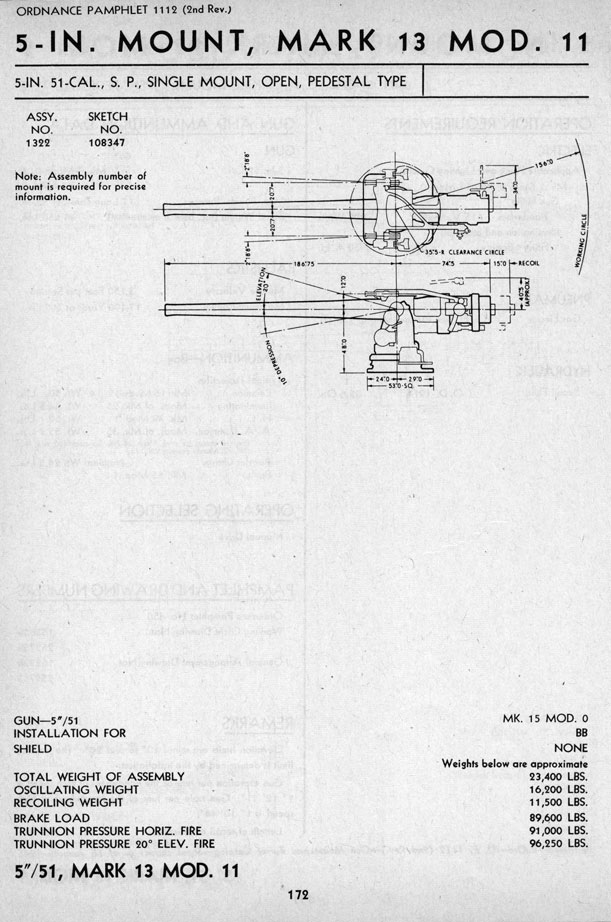
- ^The Mark 13 was primarily used to arm battleships. All battleships had the later mods of the P13 mounting by the start of World War II. The Mark 15 was a long-recoil type used primarily on smaller ships.
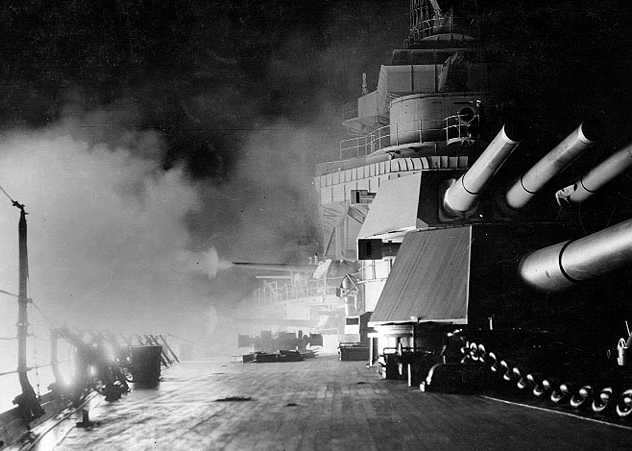
- ^Battleships carried up to twenty-two 5"/51 (12.7 cm) guns as commissioned, although many of these were removed during World War I in order to free up guns to arm Auxiliary vessels. The forward and aft hull casemate guns were the first to go, as these tended to wash out in heavy seas and were thought to endanger the safety of the ship. In regards to this, the Captain of USS Pennsylvania (B-38) expressed the view that the British battleship HMS Audacious - lost to progressive flooding following mine damage - would not have sunk had she not flooded through her after casemate gun ports. During the war, the Wyoming (B-32) and New York (B-34) classes lost five guns, the Nevada class (B-36) lost nine guns and the Pennsylvania class (B-38) lost eight guns. Battleships serving with the British Grand Fleet retained their secondary batteries until after the war, although the Captain of USS Texas (B-35) reported in May 1919 that he considered the hull mounted guns to be of little use and that their crews crowded the ship. The Tennessee (BB-43) class were the first US battleships to have all secondary guns mounted on or above the weather deck as completed. By 1921 the approved ultimate secondary batteries for the "Standards" was twelve 5"/51 (12.7 cm) and eight 3"/50 (7.62 cm) AA guns and the Colorado class (BB-45) was completed with this armament. Some battleships had the number of their 5"/51 (12.7 cm) guns reduced during the 1920s in order to mount 5"/25 (12.7 cm) AA guns. During the 1930s rebuilds of the battle line, "Standard" battleships with hull mounted guns had them removed and resited in the superstructure. By 1941, the battleships Arkansas (BB-33), New York (BB-34) and Texas (BB-35) carried sixteen 5"/51 (12.7 cm) guns, the battleships Nevada (BB-36) through California (BB-44) carried twelve guns and the Colorado class (BB-45) carried ten guns. During the war, the battleships Nevada (BB-36), Pennsylvania (BB-38), Tennessee (BB-43), California (BB-44), Maryland (BB-46) and West Virginia (BB-48) replaced their mixed batteries of 5"/51 (12.7 cm) SP and 5"/25 (12.7 cm) AA guns with a uniform battery of sixteen (8x2) 5"/38 (12.7 cm) DP guns. USS New Mexico (BB-40) had all of her 5"/51 (12.7 cm) guns removed in late 1942 and her light AA armament greatly increased. USS Mississippi (BB-41) had all of her 5"/51 (12.7 cm) guns removed in 1945 in order to allow a total battery of sixteen 5"/25 (12.7 cm) AA guns. USS Idaho (BB-42) replaced her mixed 5" (12.7 cm) batteries in late 1944 with ten 5"/38 (12.7 cm) DP guns in single mounts. Removed guns were reused during World War II on Auxiliaries and in coastal batteries.
- ^During World War II, Escort Carriers of the Bogue class (CVE-9) traded their two 5"/51 (12.7 cm) guns for two 5"/38 guns.
- ^The twin mounting was approved in 1919 and a prototype was under construction later that year. These were to be used to rearm the the older dreadnought battleships of the Florida (B-30) through New York (B-34) classes and some single guns were removed from those ships in preparation for the new mountings. However, trouble with the prototype led to the project being abandoned in November 1919 and by December the removed single guns were being reinstalled.
- Air purging was used after each shot to clear the bore of burning embers.
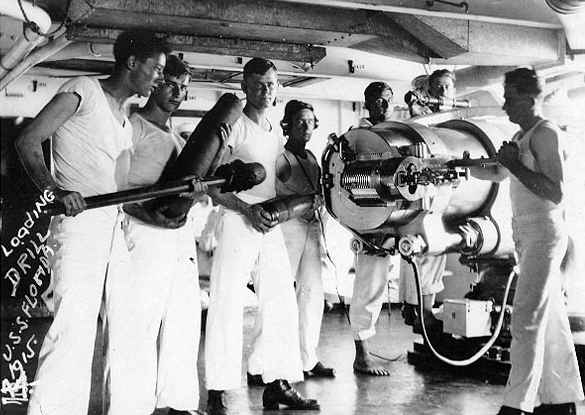
- Gun crew consisted of ten men: Gun Captain, Plugman (Breech Operator), Sightsetter, 1st Shellman, 2nd Shellman, 1st Powderman, Spongeman, Rammerman, Pointer and Trainer.
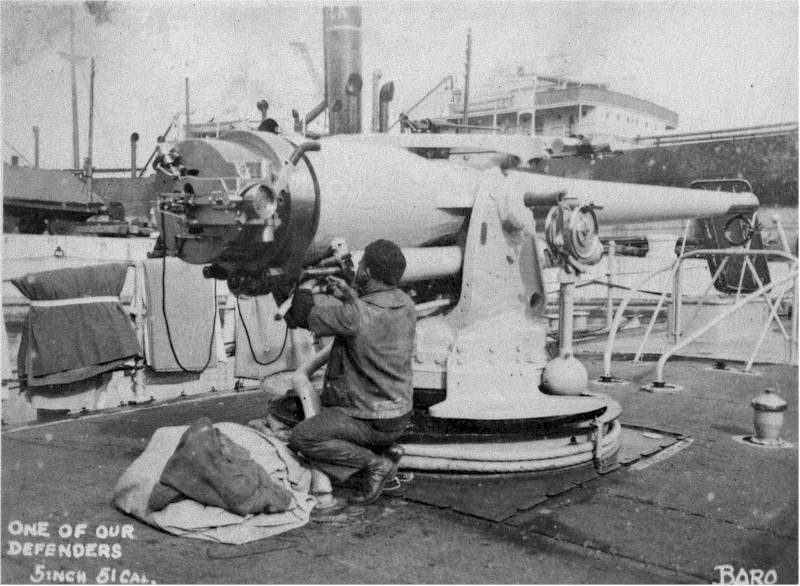
- Most deck mounts on all ship types did not have gun shields, leaving their crews exposed to shrapnel.
Tom Scott videos of Battleship Texas:
- Describing the 5"/51 (12.7 cm) design and how it operated
- Describing the 5"/51 (12.7 cm) trunnions and frictionless bearings
"Naval Weapons of World War Two" and "British Naval Guns 1880-1945 No 14" article in "Warship Volume VIII" both by John Campbell
"US Battleships: An Illustrated Design History" and "US Naval Weapons" both by Norman Friedman
"The Last Big-Gun Naval Battle: The Battle of Surigao Strait" by Howard Sauer
"U.S. Warships of World War II" by Paul H. Silverstone
"Battleships of World War Two" by M.J. Whitley
---
"Range and Ballistic Tables 1935" by Department of Ordnance and Gunnery, U.S. Naval Academy
"U.S. Explosive Ordnance - Ordnance Pamphlet No. 1664 - May 1947" by Bureau of Ordnance (BuOrd), Department of the Navy
---
"United States Naval Guns, Their Marks and Modifications - Ordnance Pamphlet No. 127 - April 1942" at Gene Slover's US Navy Pages
"OP-1112 - Gun Mount and Turret Catalog" on the HNSA Website
---
"DANFS: Olympia I (Cruiser No. 6) 1895–1957" at Naval History and Heritage Command
09 February 2008 - Benchmark
17 January 2009 - Added picture of V-1
25 January 2009 - Added information on British guns, added construction information on the Mark 8
28 September 2009 - Added information concerning use on escort carriers
30 November 2009 - Adjusted description of nose fuzes
12 February 2012 - Updated to latest template
23 February 2013 - Added notes regarding changes to battleship secondaries
12 March 2018 - Converted to HTML 5 format, reorganized notes and added mounting information
11 January 2019 - Added mounting sketch
01 September 2019 - Added photograph of USS Gilmer (DD-233) with shield on bow gun
26 August 2020 - Added notes on guncrew and success against Kate torpedo bomber
25 March 2023 - Added time of flight and maximum ordinate to range table
26 May 2023 - Added links to Battleship Texas (BB-35) and 5"/51 (12.7 cm) gun video
09 August 2023 - Minor changes
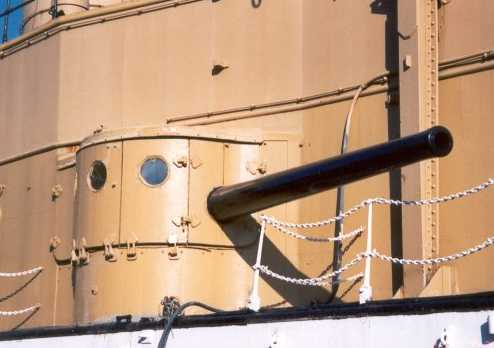
15 October 2024 - Added photograph of gun on USS Olympia (C-6)
18 February 2024 - Added note regarding the regunning of USS Olympia (C-6) and link to her DANFS entry
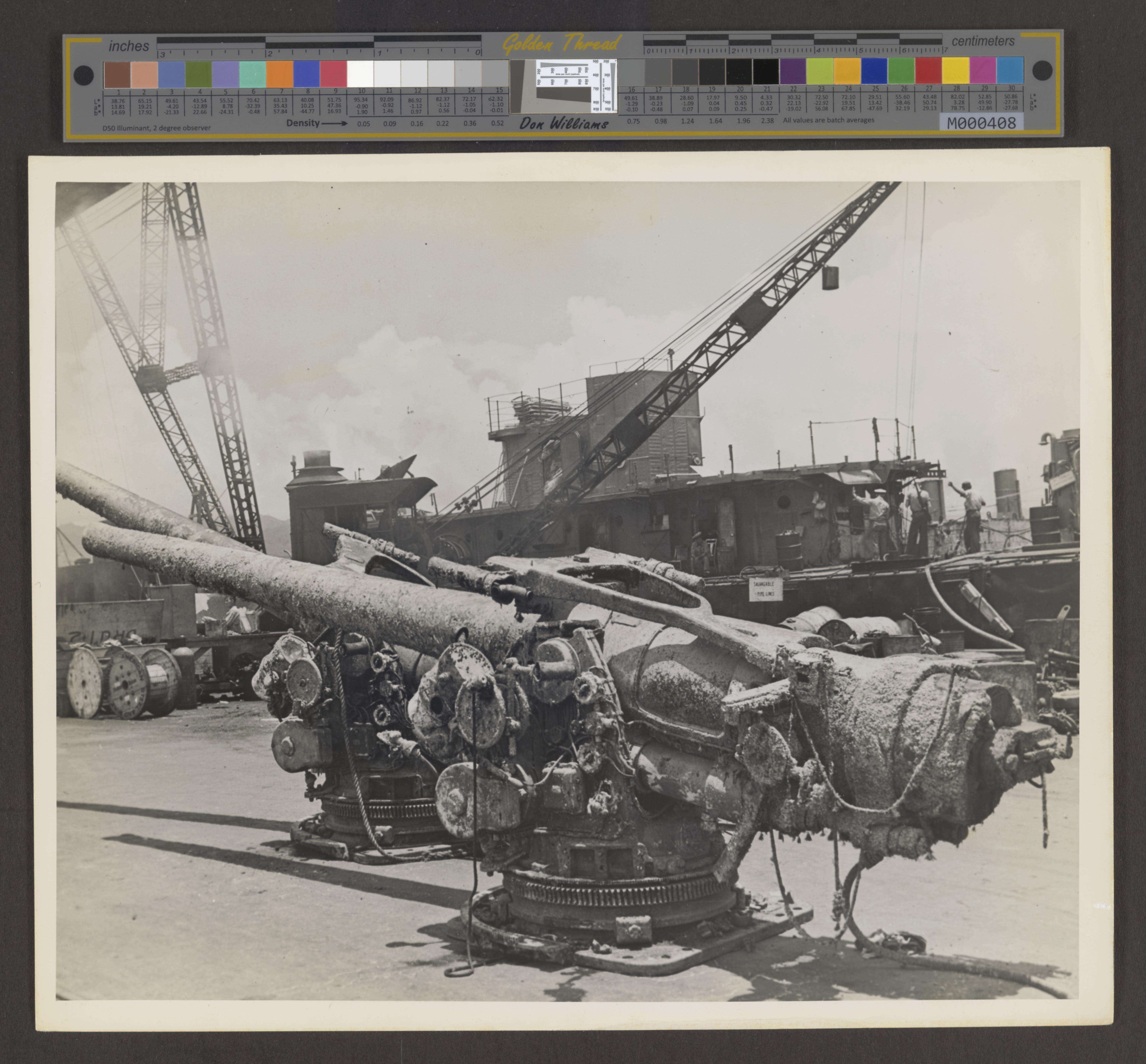
03 May 2025 - Added photograph of guns salvaged from USS Arizona (BB-39)
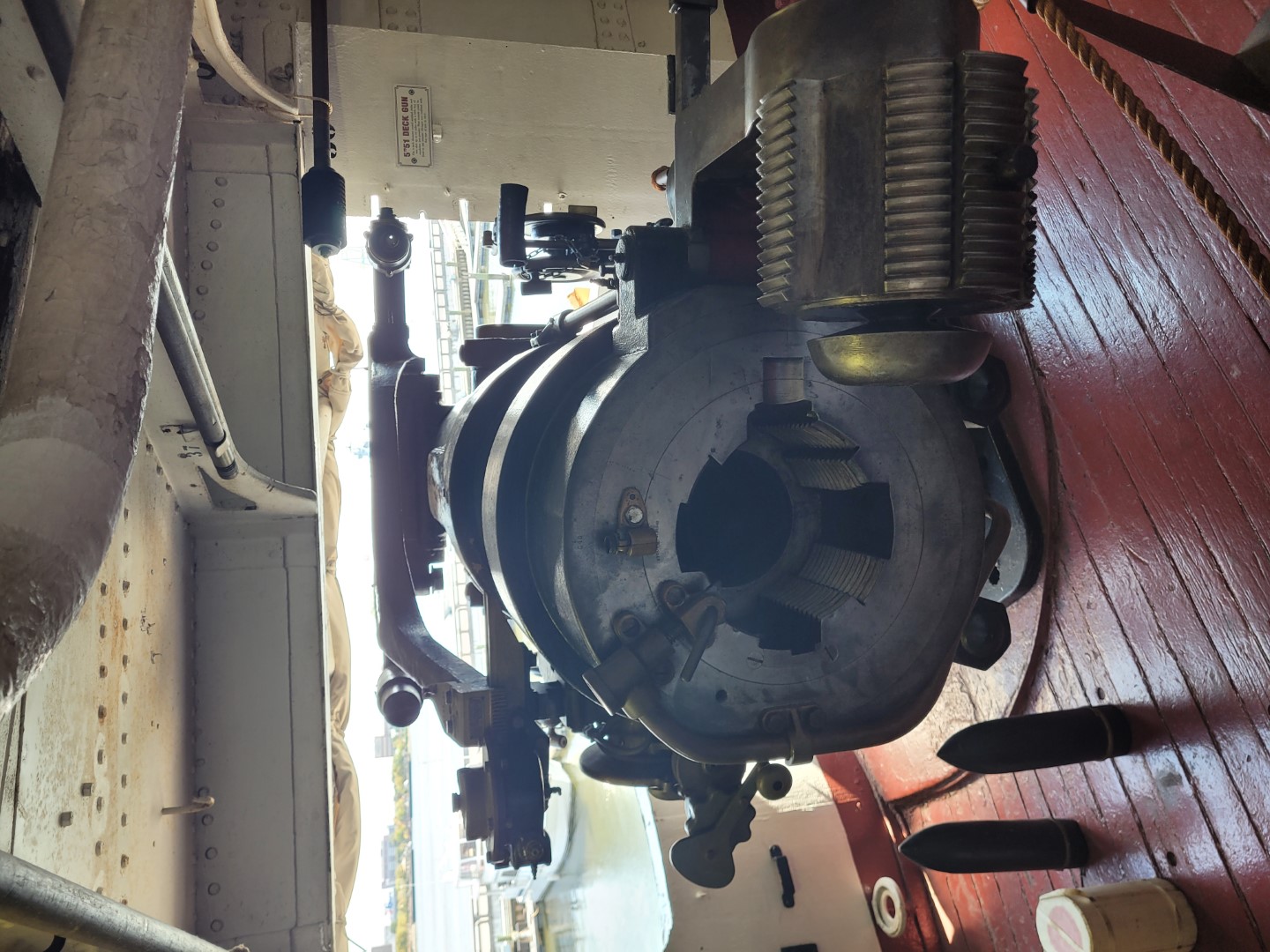
18 September 2025 - Added comment about missing gas check pads on USS Olympia (C-6) gun
05 February 2026 - Minor changes to description section for clarity