
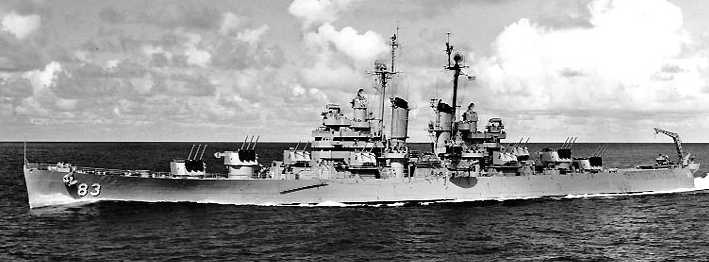
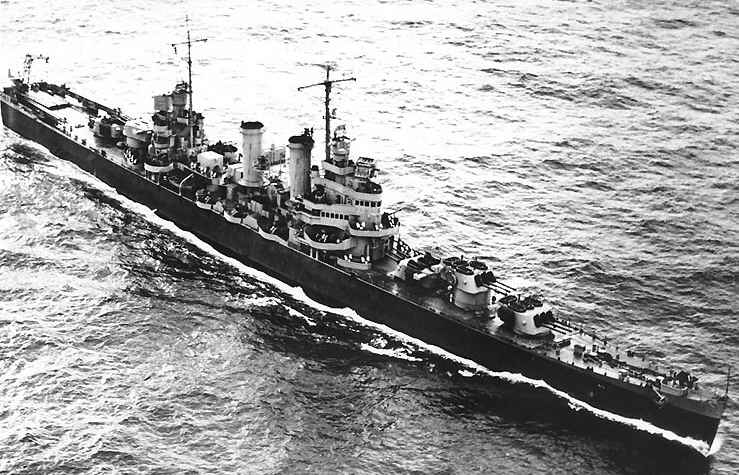
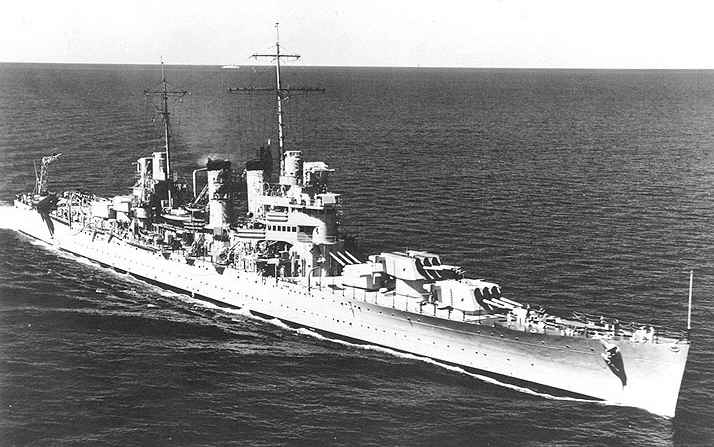
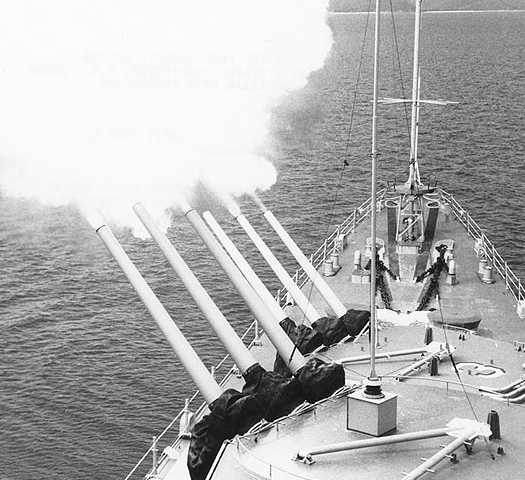
These guns were used to arm the Brooklyn and Cleveland class light cruisers, the latter being the most numerous class of cruisers ever built. Developed from experiments with old 6"/50 (15.2 cm) Mark 8 guns with various modifications to test new ideas, this weapon was to a new design firing separate (semi-fixed) ammunition and was capable of using the "super heavy" AP projectile. These new projectiles had almost double the penetration performance when compared against the older 6"/53 (15.2 cm) AP projectiles used for the Omaha class (CL-4) light cruisers.
Constructed of monobloc autofretted barrel with liner secured to the housing by a bayonet joint. Mark 16 Mod 1 differed from Mod 0 in having a tapered liner. All used a semi-automatic vertical sliding breech block accommodated in the housing. There was a 0.5 in (12.7 mm) ring attachment at the muzzle.
| Designation | 6"/47 (15.2 cm) Mark 16 |
|---|---|
| Ship Class Used On | Brooklyn (CL-40), St. Louis (CL-49), Cleveland (CL-55) and Fargo (CL-106) classes |
| Date Of Design | 1932 |
| Date In Service | 1937 |
| Gun Weight | 6.5 tons (6.6 mt) |
| Gun Length oa | 300 in (7.620 m) |
| Barrel and Bore Length | 282.3 in (7.169 m) |
| Rifling Length | 238.3 in (6.053 m) |
| Grooves | N/A |
| Lands | N/A |
| Twist | Uniform RH 1 in 25 |
| Chamber Volume | 1,470 in3 (24.1 dm3) |
| Rate Of Fire | 8 - 10 rounds per minute 1 2 3 |
- ^Gunnery exercises by USS Savannah (CL-42) and USS Honolulu (CL-48) as described in "U.S. Cruisers: An Illustrated Design History:"
As for the 6-in battery, it fulfilled expectations: Very high volumes of fire (ten rounds or better per gun per minute in some ships) were achieved in experimental firings off Guantanamo Bay in March 1939. The Savannah’s captain reported that the target was "simply smothered." The Honolulu’s wrote that "those who saw this practice said [that] it looked almost like a stream of bullets playing on the targets, which were almost continuously obscured and drenched by water." The rate of fire was reduced only at ranges so great that guns had to be depressed to load. As for the salvo issue, typically a ship fired a "ladder" to find the range, then shifted to rapid fire. The Savannah, for example, fired an opening-up ladder with a 600-yard spread: fourteen shells well short, fourteen (fired within a two-second interval) well over, then full rapid fire by individual guns, 138 shots being fired in one minute. - ^At the maximum elevation of +60 degrees, the rate of fire was about 5 rounds per minute due to the need to lower the guns to +20 degrees for loading.
- ^There was pre-war interest in using these guns in the anti-aircraft mode. In an August 1940 General Board hearing on the design of the Cleveland (CL-55) class, it was proposed modifying their Mark 37 GFCS to add an extra cam to allow gun orders to be generated for the 6"/47 (15.2 cm) guns as well as for the 5"/38 (12.7 cm) guns. As there was not enough room in the gun houses to add fuze setters, the ships were to use pre-set time fuzes. This and other proposals made at this meeting were not carried out as the building delays involved were considered to be unacceptable. Post-war, there was a program to increase the AA potential of the Cleveland class by giving their 6"/47 (15.2 cm) guns a power-operated loading cradle which was designed to allow all-angle loading. A prototype was installed on one gun of USS Mobile (CL-63) for evaluation in June 1950. The project was soon abandoned as the increased top-weight of 21 tons (22 mt) was considered too large a risk from a stability viewpoint. In addition, at this time most of the Cleveland class were either already in or soon would be put into mothballs. A decade later when six of these ships were modified and recommissioned as missile cruisers, interest in gun-oriented AA defense had waned and none of these cruisers were given the new loading gear.
- The exterior of the gun was sprayed with zinc for 25.5 in (64.8 cm) starting 20.25 in (31.4 cm) from the breech end. The bore was chrome plated 0.0005 in (0.013 mm) deep for 246.0 in (6.248 m) from the muzzle.
| Type | Separate |
|---|---|
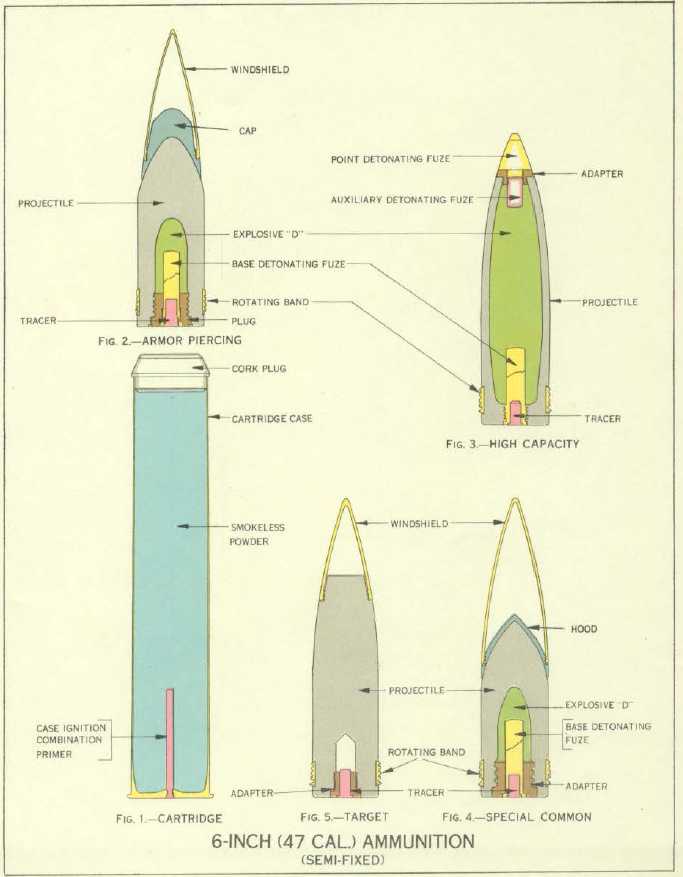
| Projectile Types and Weights | Common Mark 28 Mod 1 1a : 105 lbs. (47.6 kg)
AP Mark 35 Mods 1 to 11 (super heavy): 130 lbs. (59.0 kg)
|
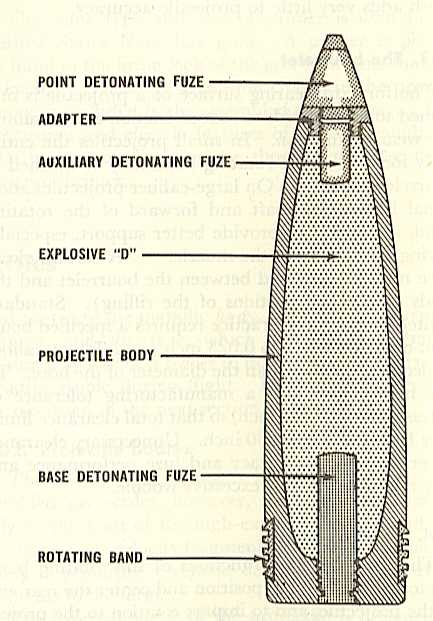
| Bursting Charge | Common Mark 28: 5.72 lbs. (2.6 kg) Explosive D
AP Mark 35: 1.95 lbs. (0.9 kg) Explosive D HC Mark 34: 13.22 lbs. (6.0 kg) Explosive D |
| Projectile Length | All: 27 in (68.6 cm) |
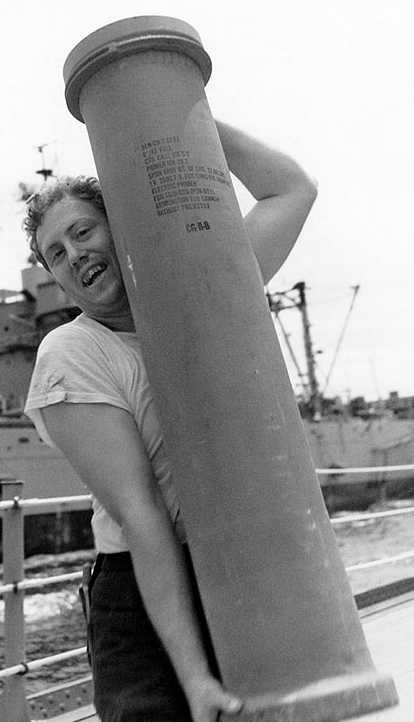
| Cartridge Case Type, Size and Empty Weight 4a 5a | Mark 4: Brass, 152 x 970 mm, 28.2 lbs. (12.8 kg)
Mark 4 Modified: Brass, 152 x 635 mm, N/A |
| Propellant Charge 6a | Common Mark 28
about 34 lbs. (15.4 kg) SPD 1a AP Mark 35 and HC Mark 34
|
| Muzzle Velocity | Full Charge, New Gun
Common Mark 28: 2,800 fps (853 mps) 1a AP Mark 35: 2,500 fps (762 mps) HC Mark 39: 2,665 fps (812 mps) Reduced Charge, New Gun
|
| Working Pressure | 18.5 tons/in2 (2,910 kg/cm2) |
| Approximate Barrel Life 7a | 1,050 rounds |
| Ammunition stowage per gun | 200 rounds |
- ^1.11.21.3Prior to the service introduction of the AP Mark 35 and HE Mark 34, the Brooklyn (CL-41) and St. Louis (CL-49) classes carried Common projectiles. These Common projectiles used a heavier propellant charge which gave them a higher muzzle velocity and longer range than the later projectiles.
- ^The HC Mark 34 projectile body could be used with Point Detonating (PD), Mechanical Time (MT) or with proximity (VT) nose fuzes. When used with PD fuzes, they were considered to be HC rounds while those with MT and VT fuzes were considered as AA rounds. All versions used a base contact fuze. A specially cavitized HC Mark 34 projectile was produced to be used with a VT fuze. This projectile was unique in that it was the only VT fuzed projectile of the World War II period that used a base fuze.
- ^3.13.2The different Mod numbers for the Target Mark 36 were to identify different manufacturers. The only difference between the Target Mark 36 and the Target Mark 37 was that the Mark 37 had provision for a dye load. There was also a post-war 105 lbs. (47.6 kg) Target projectile, but details are not available at this time.
- ^The cartridge cases were sealed with cork plugs which extended about 2.5 in (6.4 cm) past the mouth of the case.
- ^Mark 4 was used for Full Charges while the Mark 4 Modified was used for Reduced Charges.
- ^Some SPD charges had flashless pellets added which gave them a "reduced" flash.
- ^The sources listed below differ as to barrel life. I have chosen to use the figures given in "The Naval Institute Guide to World Naval Weapon Systems 1991/92."
- Bourrelet diameter was 5.985 inches (15.2 cm).
- ESR for various shell types:
Shell Muzzle Velocity ESR 130 lbs. (59.0 kg) AP 2,500 fps (762 mps) 1.00 105 lbs. (47.6 kg) HC 2,665 fps (812 mps) 0.71 130 lbs. (59.0 kg) Target 2,050 fps (625 mps) 0.21 105 lbs. (47.6 kg) Target 2,300 fps (701 mps) 0.21
| Elevation | Range | Angle of Fall | Time of Flight | Striking Velocity | Maximum Ordinate |
|---|---|---|---|---|---|
| 3.22 degrees | 6,000 yards (5,490 m) | 4.15 degrees | 8.51 seconds | 1,799 fps (548 mps) | 291 feet (89 m) |
| 6.26 degrees | 10,000 yards (9,140 m) | 9.67 degrees | 16.15 seconds | 1,428 fps (435 mps) | 1,052 feet (321 m) |
| 14.48 degrees | 16,000 yards (14,630 m) | 24.30 degrees | 31.62 seconds | 1,129 fps (344 mps) | 4,120 feet (1,256 m) |
| 22.33 degrees | 20,000 yards (18,290 m) | 36.63 degrees | 44.86 seconds | 1,102 fps (336 mps) | 8,430 feet (2,569 m) |
| 44.40 degrees | 26,000 yards (23,770 m) | 58.12 degrees | 77.27 seconds | 1,209 fps (369 mps) | 24,650 feet (7,513 m) |
| 47.48 degrees | 26,118 yards (23,881 m) | 60.22 degrees | 81.30 seconds | 1,222 fps (372 mps) | 27,190 feet (8,288 m) |
| 50.37 degrees | 26,000 yards (23,774 m) | 62.18 degrees | 84.90 seconds | 1,235 fps (376 mps) | 29,520 feet (8,998 m) |
| 59.37 degrees | 24,000 yards (21,946 m) | 68.13 degrees | 95.10 seconds | 1,272 fps (388 mps) | 36,650 feet (11,171 m) |
- ^Values for AP Mark 35 from BuOrd OP 1188 page 17.
- ^As commissioned, the guns on these cruisers had a maximum elevation of 40 degrees. During the war, this was increased to 60 degrees. See Mount / Turret note below.
| Elevation | Range | Angle of Fall | Time of Flight | Striking Velocity | Maximum Ordinate |
|---|---|---|---|---|---|
| 3.16 degrees | 6,000 yards (5,490 m) | 4.25 degrees | 8.44 seconds | 1,702 fps (519 mps) | 286 feet (87 m) |
| 6.83 degrees | 10,000 yards (9,140 m) | 11.62 degrees | 16.92 seconds | 1,214 fps (370 mps) | 1,457 feet (444 m) |
| 16.17 degrees | 16,000 yards (14,630 m) | 31.27 degrees | 35.18 seconds | 1,015 fps (309 mps) | 5,266 feet (1,605 m) |
| 27.15 degrees | 20,000 yards (18,290 m) | 45.25 degrees | 50.89 seconds | 1,050 fps (320 mps) | 11,175 feet (3,406 m) |
| 34.30 degrees | 22,000 yards (20,117 m) | 52.40 degrees | 61.14 seconds | 1,082 fps (330 mps) | 16,089 feet (4,904 m) |
| 46.60 degrees | 23,483 yards (21,381 m) | 62.43 degrees | 77.85 seconds | 1,112 fps (339 mps) | 25,228 feet (7,689 m) |
| 57.50 degrees | 22,000 yards (20,117 m) | 59.75 degrees | 90.88 seconds | 1,130 fps (344 mps) | 33,673 feet (10,264 m) |
| 60.10 degrees | 21,200 yards (19,385 m) | 71.38 degrees | 93.68 seconds | 1,134 fps (346 mps) | 35,595 feet (10,849 m) |
- ^Values for HC Mark 34 from BuOrd OP 1188 page 21.
| Elevation | Range | Angle of Fall | Time of Flight | Striking Velocity | Maximum Ordinate |
|---|---|---|---|---|---|
| 2.79 degrees | 6,000 yards (5,490 m) | 3.63 degrees | 7.87 seconds | 1,882 fps (574 mps) | 249 feet (759 m) |
| 5.72 degrees | 10,000 yards (9,140 m) | 8.88 degrees | 15.16 seconds | 1,447 fps (441 mps) | 935 feet (285 m) |
| 12.86 degrees | 16,000 yards (14,630 m) | 23.57 degrees | 30.25 seconds | 1,106 fps (337 mps) | 3,810 feet (1,161 m) |
| 20.33 degrees | 20,000 yards (18,290 m) | 36.52 degrees | 43.44 seconds | 1,072 fps (327 mps) | 7,990 feet (2,435 m) |
| 24.97 degrees | 22,000 yards (20,120 m) | 42.75 degrees | 51.00 seconds | 1,083 fps (330 mps) | 11,090 feet 3,380 m) |
| 46.60 degrees | 27,520 yards (25,160 m) | 63.20 degrees | 86.80 seconds | 1,210 fps (369 mps) | 30,900 feet (9,418 m) |
| 57.78 degrees | 26,000 yards (23,770 m) | 68.72 degrees | 98.20 seconds | 1,251 fps (381 mps) | 39,100 feet (11,918 m) |
| 60.00 degrees | 25,100 yards (22,950 m) | 69.93 degrees | 100.2 seconds | 1,258 fps (383 mps) | 41,000 feet (12,497 m) |
- ^Values for Common Mark 28 from BuOrd OP 1188 page 18.
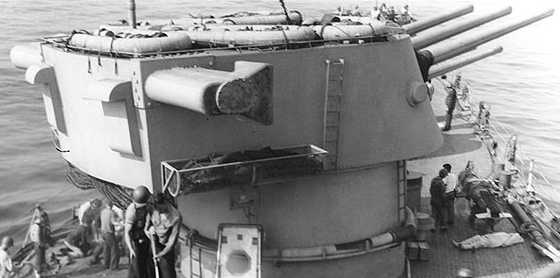
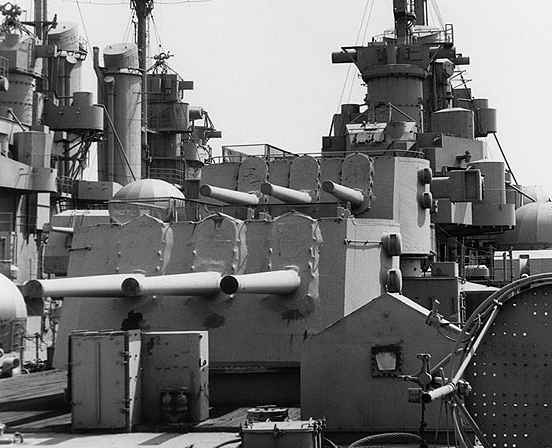
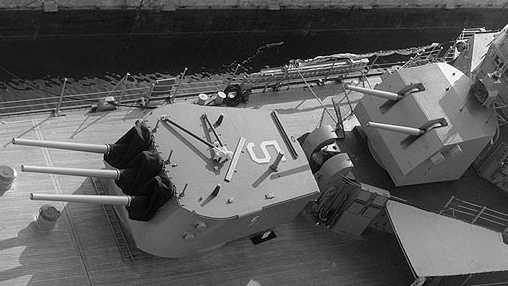
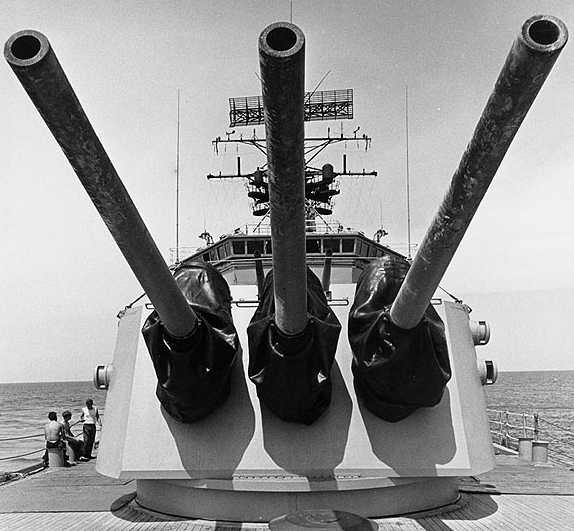
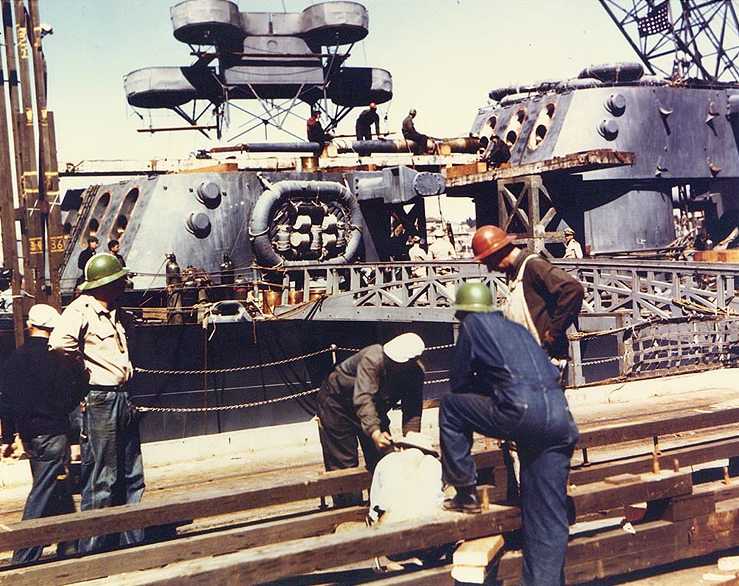
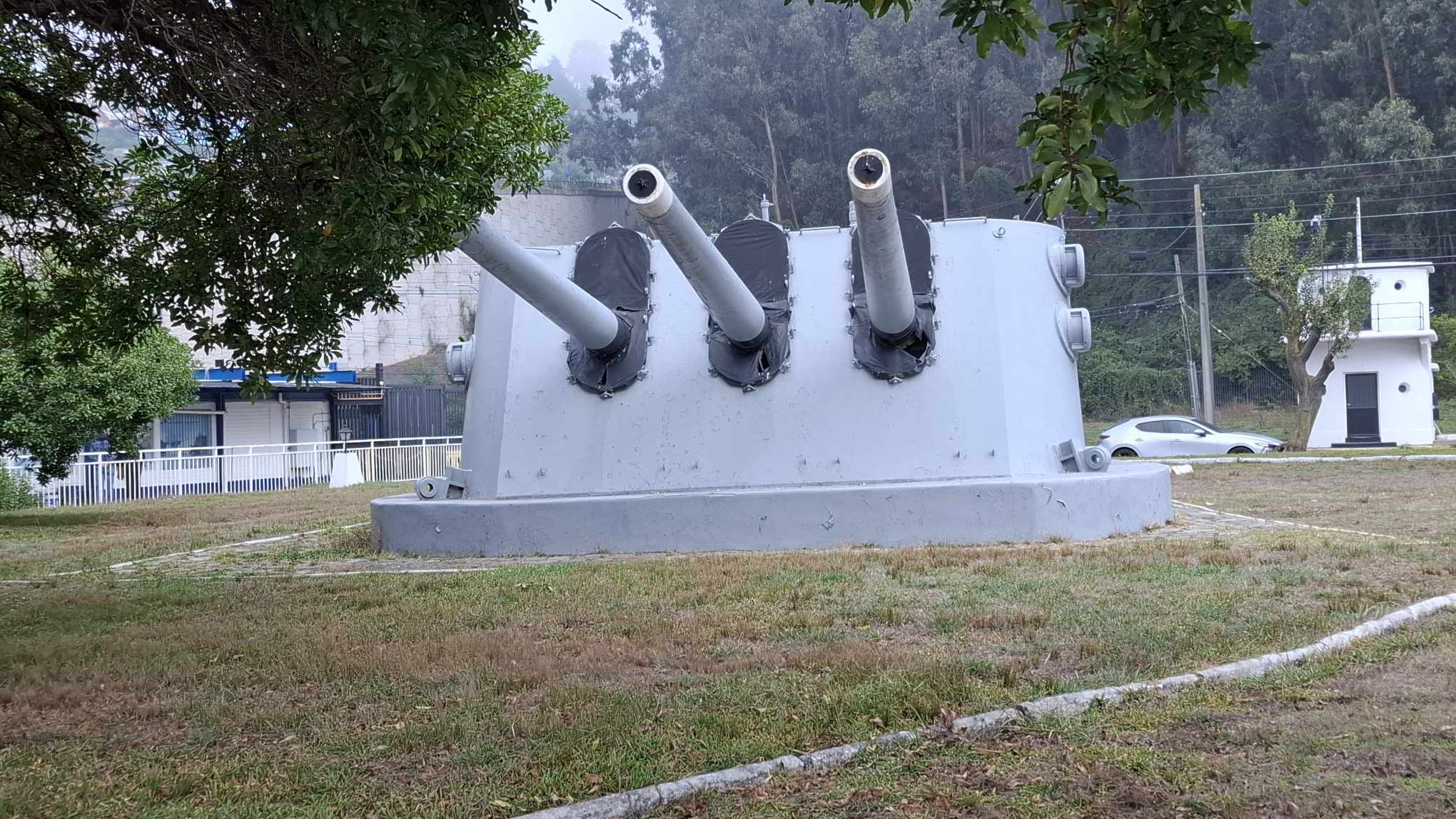
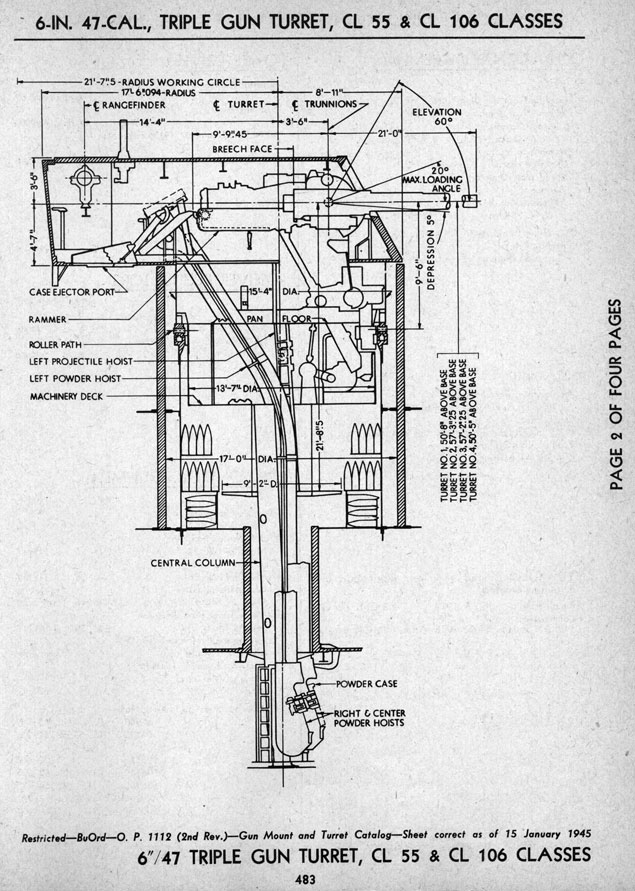
| Designation | Triple Turrets 1e 2e Brooklyn (5), St. Louis 3e (5), Cleveland (4) and Fargo 4e (4) |
|---|---|
| Weight | Brooklyn and St. Louis classes: 154 to 167 tons (156 to 170 mt)
Cleveland and Fargo classes 5e: 165 to 173 tons (168 to 176 mt) |
| Elevation | -5 / +40 degrees as designed, later modified to +60 degrees 6e |
| Elevation Rate | Brooklyn and St. Louis classes: 10 degrees per second
Cleveland and Fargo classes: 11 degrees per second |
| Train | about +150 / -150 degrees |
| Train Rate | All: 10 degrees per second |
| Gun recoil | 21 in (53 cm) |
| Loading angle | -5 to 20 degrees |
- ^Compared to the Brooklyn and St. Louis classes, the Cleveland and Fargo classes traded one 6" (15.2 cm) turret for better fire control equipment and for a better secondary battery - eight 5"/25 (12.7 cm) guns (Brooklyn) or eight 5"/38 (12.7 cm) guns (St. Louis) vs. twelve 5"/38 (12.7 cm) guns (Cleveland and Fargo).
- ^The Cleveland and Fargo classes had a slightly heavier and larger turret with more protection than the ones used for the Brooklyn and St. Louis classes.
- ^The St. Louis class differed from the Brooklyn class by having four twin 5"/38 mounts rather than eight single 5"/25 mounts.
- ^The Fargo class differed from the Cleveland class by having a single funnel and a more compact superstructure which gave their AA weapons better sky arcs.
- ^Weight differences within a class were due primarily to the rangefinders, which were installed only on the first four turrets of the Brooklyn and St. Louis classes and only on the first three turrets of the Cleveland and Fargo classes. Late during World War II some Cleveland class cruisers had the rangefinders removed from Turret I as a weight saving measure.
- ^Prior to 1943, all ships had a maximum elevation of +40 degrees. After that time, new ships and those undergoing refits were modified to increase elevation to +60 degrees. The modifications to increase gun elevation were relatively modest. The gun mountings had already been built for +60 degree elevation but the gun shields were cut to only +41 degrees. The changes were thus primarily increasing the size of the gun ports to allow higher elevations. USS Boise (CL-47) and some early Cleveland (CL-55) class ships were not modified to increase gun elevation until 1945.
- These mountings did not have the guns individually sleeved. RPC was installed on all ships either as built or during refits.
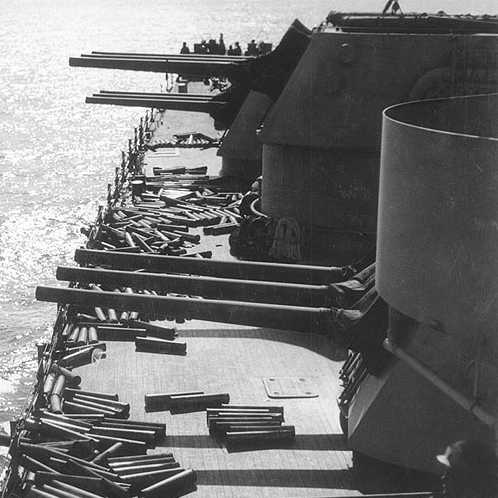
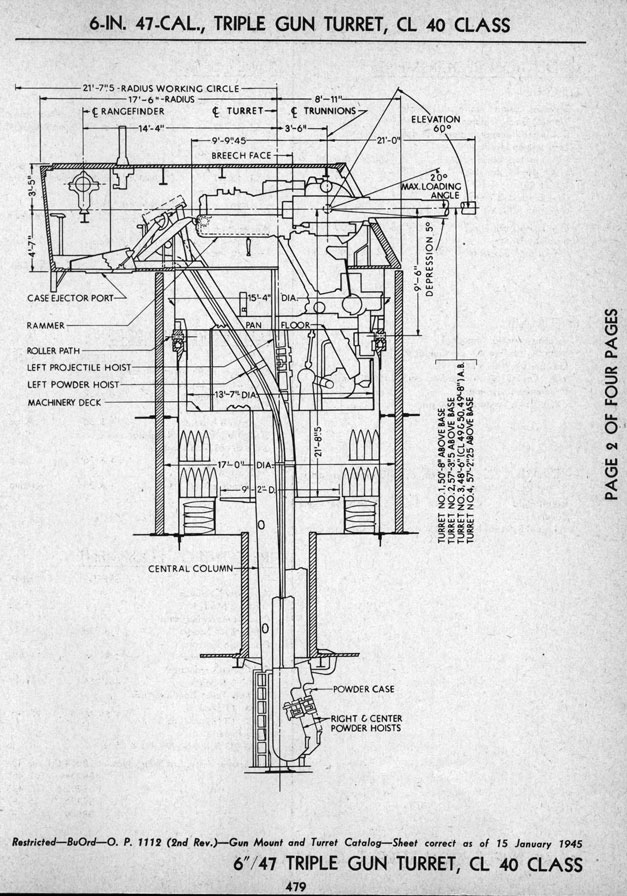
- Each gun was supplied by its own projectile and cartridge hoists which ran directly to the gunhouse. The cartridge hoist was an endless conveyor type with open flights rather than powder cars. Projectiles were delivered vertically to the side of the gun while cartridges were delivered to the rear of the gun. Both were placed into the loading tray and then rammed together. Cartridge cases were ejected through a port in the rear floor of the turret. Shell stowage was on the fixed structure.
- Each turret required a crew of 3 officers and 52 enlisted men.
- These turrets were powered by electric motors with hydraulic drive gears. Training motors were 50 HP while the elevation motors were 25 HP. Each gun had a 7.5 HP motor which operated both the breech mechanism and the rammer, which was attached to the rear of the slide. The three cartridge and three projectile hoists in each turret were driven by three 15 HP motors in the Brooklyn and St. Louis classes and by three 20 HP motors in the Cleveland and Fargo classes.
- As was typical of US designs of this period, guns could be removed and replaced without dismantling the gunhouse.
- Cleveland class cruisers converted into missile cruisers during the 1950s-60s had both stern turrets and three of their six 5"/38 (12.7 cm) twin mounts removed in order to fit a Terrier or Talos twin missile launcher in their place. Those cruisers converted to flagships (USS Providence class) also had Turret II and two more 5"/38 (12.7 cm) twin mounts removed in order to fit additional staff accommodations. Remaining turrets on all ships had the rangefinders removed.
- Turret armor thickness:
Brooklyn and St. Louis classes:
Face: 6.5 in (16.5 cm)
Sides: 1.25 in (3.8 cm)
Rear: 1.5 in (3.8 cm)
Roof: 2.0 in (5.1 cm)Cleveland and Fargo classes:
Face: 6.5 in (16.5 cm)
Sides: 3.0 in (7.6 cm)
Rear: 1.5 in (3.8 cm)
Roof: 3.0 in (7.6 cm)
"Naval Weapons of World War Two" by John Campbell
"U.S. Cruisers: An Illustrated Design History", "US Naval Weapons" and "The Naval Institute Guide to World Naval Weapon Systems 1991/92" all by Norman Friedman
"Cruisers of World War Two" by M.J. Whitley
---
"Naval Ordnance and Gunnery - 1952" by Department of Ordnance and Gunnery, U.S. Naval Academy
"Ammunition: Instructions for the Naval Service: Ordnance Pamphlet No. 4 - May 1943" by Bureau of Ordnance (BuOrd), Department of the Navy
"Abridged Range Tables for U.S. Naval Guns - Ordnance Pamphlet No. 1188 - 13 June 1944" by Bureau of Ordnance (BuOrd), Department of the Navy
"U.S. Explosive Ordnance - Ordnance Pamphlet No. 1664 - May 1947" by Bureau of Ordnance (BuOrd), Department of the Navy
---
William Maloney - Inside Little Rock gun turrets
Gene Slover's Navy Pages
---
Special help from Leo Fischer and Phil Hays
27 November 2008 - Benchmark
25 December 2010 - Corrected information regarding rangefinders on Cleveland class and added note regarding missile conversions
14 January 2011 - Added data reference, added cutaway sketch
01 May 2012 - Added note regarding gunnery trials for USS Savannah CL-42
06 December 2012 - Added ammunition supply information
16 June 2016 - Converted to HTML 5 format
07 January 2019 - Reorganized notes, added turret sketches
30 May 2020 - Updated to latest template
03 August 2020 - Added note regarding gun replacement
12 February 2021 - Expanded note describing 1939 gunnery exercises, added notes regarding use in anti-aircraft mode
and added gun elevation and armor thickness notes
07 October 2022 - Changed link to point at Wayback Archive
14 December 2022 - Added notes on Common and Target projectiles
10 September 2023 - Revised range tables
21 April 2025 - Added photograph of turret from O'Higgins
30 August 2025 - Updated photograph ID
18 October 2025 - Added range table for Common Mark 28