
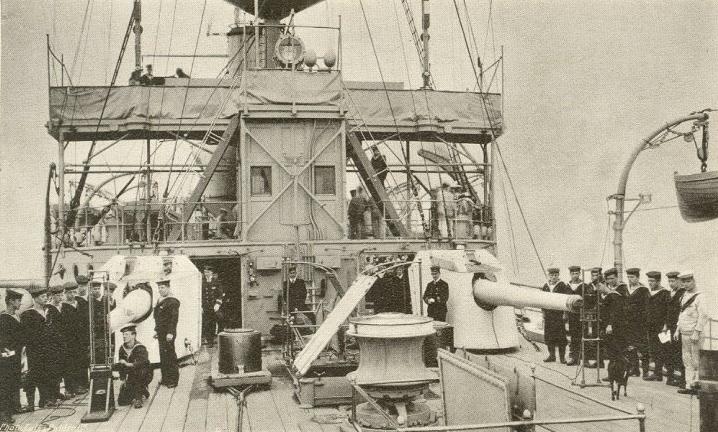
These guns were used on most pre-dreadnoughts and cruisers built between 1890 and 1905. The Mark I and Mark II were only slightly different in construction and are normally listed together in armament lists. Mark III was a trunnioned version of the Mark I.
Mark I was EOC Pattern "Z" and was of built up construction while Mark II was a Woolwich design. The Mark III was known to EOC as "Z1." All used a 3-motion breech mechanism but most were later converted to a single motion breech mechanism. Guns so converted had a "B" added after the Mark number. A total of 137 Mark I, 760 Mark II and 53 Mark III guns were made for Britain. In addition, numerous 6" (15.2 cm) EOC guns of the same or similar designs were made for other countries, including Italy and Japan.
Some British guns were employed as AA weapons during World War I, but this did not prove very successful. 63 Mark II guns were transferred to the Army, where they were bored out and converted to 8" (20.3 cm) howitzers.
Nomenclature note: The 6"/45 (15.2 cm) QF Mark IV designation was given to twelve guns purchased from the USA firm of Bethlehem Steel early in World War I. Eight of these were used in coastal defenses at Scapa Flow and four were used on DAMS. These guns may actually have been the Bethlehem 6"/44 (15.2 cm) Mark 9 or a close relation.
| Designation | 6"/40 (15.2 cm) QF Marks I, III and III |
|---|---|
| Ship Class Used On | Pre-dreadnoughts: Royal Sovereign, Hood, Renown, Majestic and Canopus classes
Armored cruisers: Diadem, Powerful, Royal Arthur and Edgar classes Small cruisers: Blake, Aeolus, Brilliant, Iphigenia, Hermes, Challenger, Arrogant, Eclipse and Astraea classes Rearmed Ships: Trafalgar, Indefatigable, Intrepid, Rainbow and Sirius Added to: Hercules, Immortalité and Narcissus |
| Date Of Design | 1888 |
| Date In Service | 1892 |
| Gun Weight | 6.6 tons (6.7 mt) |
| Gun Length oa | 249.25 in (6.331 m) |
| Bore Length | 240.0 in (6.096 m) |
| Rifling Length | N/A |
| Grooves | N/A |
| Lands | N/A |
| Twist | N/A |
| Chamber Volume | 832 in3 (13.63 dm3) |
| Rate Of Fire | 5 - 7 rounds per minute |
- A Note on Sources: Campbell in "British Naval Guns 1880-1945 No 11" says that these guns were used to rearm HMS Superb. There is some evidence to support this in "British Battleships: 1860 - 1950" by Parkes, but this is contradicted by other information contained in that same work which says that Superb was rearmed with 6 inch (15.2 cm) BL guns. As Superb was refitted between 1887 to 1891, this predates the introduction of the 6"/40 (15.2 cm) on the Royal Sovereign class. For these reasons, I believe that Superb was actually rearmed with 6 inch (15.2 cm) BL guns.
- During World War I these guns were used on most large monitors and many AMCs and DAMS.
- These guns were used as secondaries on the Italian Garibaldi class armored cruisers, with the Argentine cruisers Pueyrredon and Admiral Belgrano using Mark II guns.
| Type | Separate |
|---|---|
| Projectile Types and Weights 1a | CPC: 100 lbs. (45.3 kg)
HE: 100 lbs. (45.3 kg) |
| Bursting Charge | N/A |
| Projectile Length | 26.5 in (67.3 cm) |
| Propellant Charge | 29.75 lbs. (13.49 kg) EXE
13.25 lbs. (6.01 kg) Cord 30 15.94 lbs. (7.23 kg) MD26 |
| Muzzle Velocity | EXE: 1,882 fps (574 mps)
Cord: 2,230 fps (670 mps) MD: 2,243 fps (684 mps) |
| Working Pressure | N/A |
| Approximate Barrel Life | N/A |
| Ammunition stowage per gun | N/A |
- ^Projectiles were 2crh.
| Elevation | Distance |
|---|---|
| 15 degrees | With Cord 30: 10,000 yards (9,140 m) |
| Designation | Single Mounts: CPI 1b and PII
Pre-dreadnoughts: Royal Sovereign (10), Hood (10), Renown (10), Majestic (12) and Canopus (12) Armored cruisers: Diadem (16), Powerful (12), Royal Arthur (12) and Edgar (10) 2b Small cruisers: Blake (10), Aeolus (2), Brilliant (2), Iphigenia (2), Hermes (11), Challenger (11), Arrogant (2), Eclipse (2) and Astraea (2) Rearmed Ships: Trafalgar (6), Indefatigable (2), Intrepid (2), Rainbow (2) and Sirius (2) Italy: Garibaldi (14) |
|---|---|
| Weight | N/A |
| Elevation 3b | CPI:
Deck mountings: -3 / +20 degrees Casemate mountings: -3 / +15 degrees PII:
HA mountings: -3 / +53.5 degrees |
| Elevation Rate | Manual operation, only |
| Train | about -100 / +100 degrees in casemate mountings
about -150 / +150 degrees in open mountings |
| Train Rate | Manual operation, only |
| Gun recoil | N/A |
- ^Mark I guns were used with CPI mountings.
- ^Many cruisers had a secondary battery of 4.7 (12 cm) guns that were later replaced with more 6" (15.2 cm) guns. The Powerful class was given twelve 6" guns and the Arrogant class was given ten guns. The Eclipse class (except for Eclipse herself) was given eleven guns.
- ^A total of four CPI and twelve PII mountings were converted for AA use. The Monitor Roberts was given a Mark I gun in one of these HA mountings in 1916.
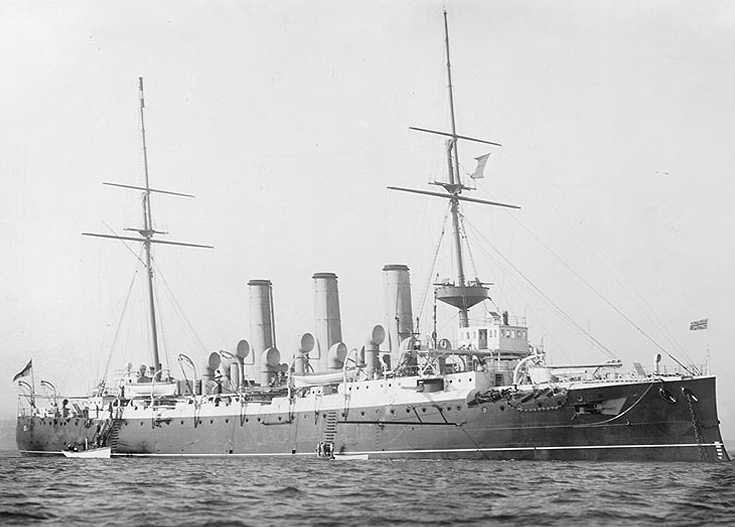
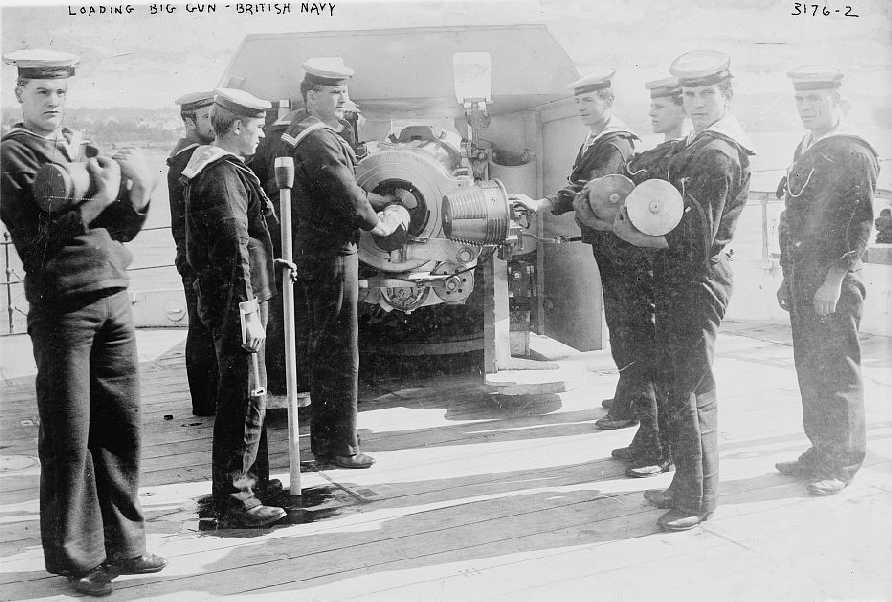
Images at The Vickers Photographic Archive. See photograph 6487.
"Big Gun Monitors: The History of the Design, Construction and Operation of the Royal Navy's Monitors" by Ian Buxton
"Naval Weapons of World War Two" and "British Naval Guns 1880-1945 No 11" article in "Warship Volume VII" both by John Campbell
"British Battleships: 1860 - 1950" by Oscar Parkes
28 December 2008 - Benchmark
10 February 2009 - Added number of mountings information, added HA mounting note
31 December 2009 - Identified gunnery crew as being on HMS Ariadne
29 August 2011 - Added information on Trafalgar class and Superb
28 November 2015 - Changed Vickers Photographic Archive links to point at Wayback Archive
20 November 2024 - Converted to HTML 5 format