
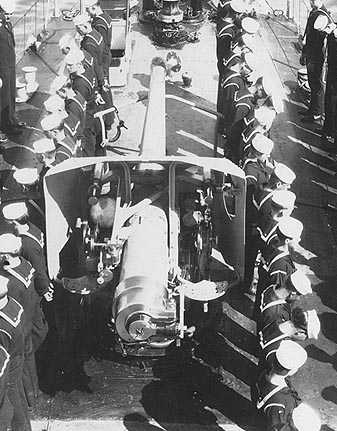
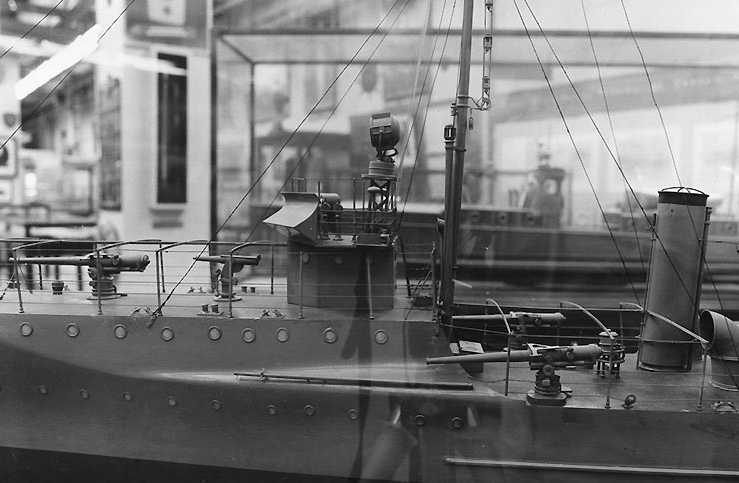
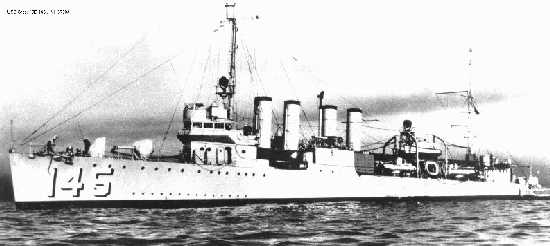
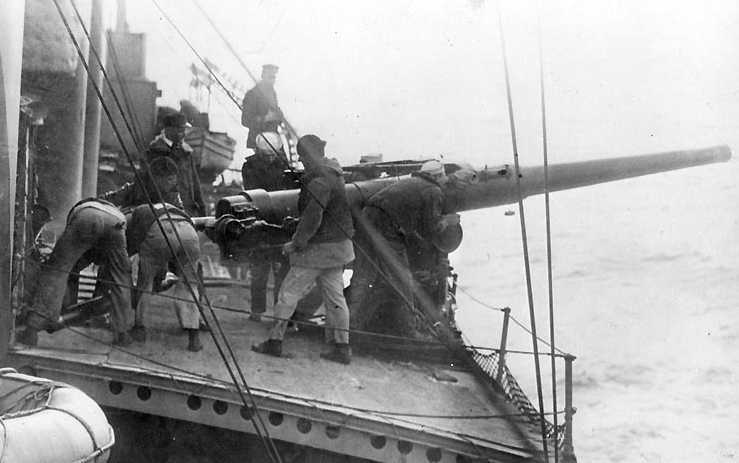
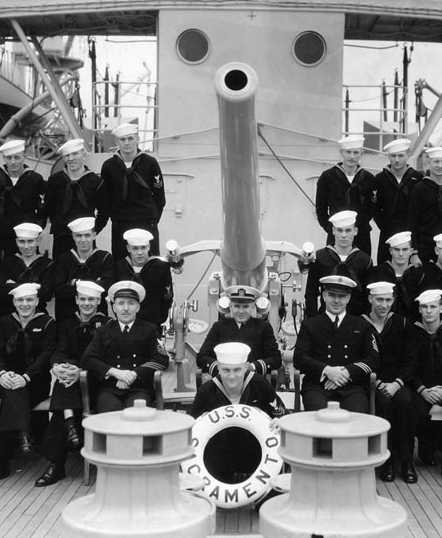
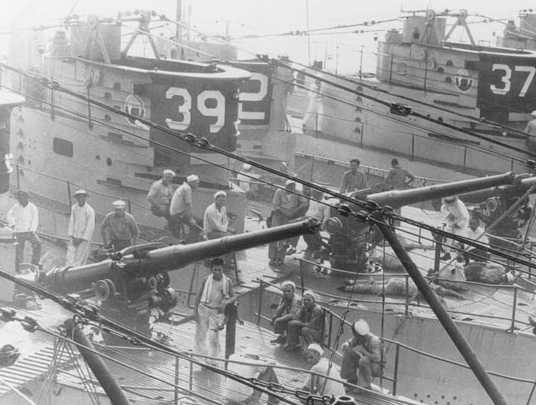
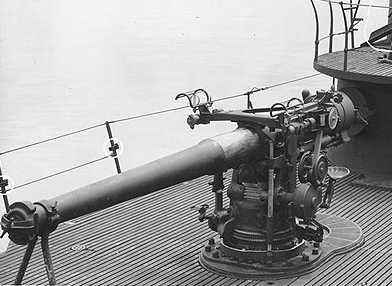
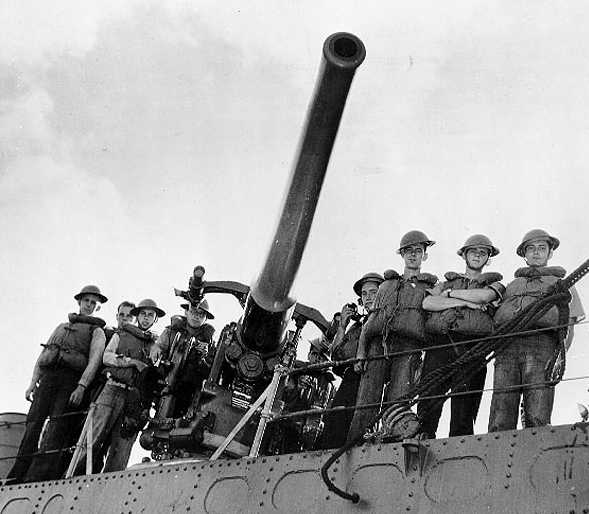
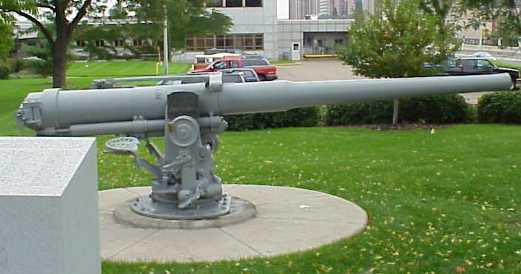
These guns were first used as secondary guns on the Arkansas class monitors and then on nearly all of the "Flush-Deck" destroyers as well as on many submarines. Well-liked on the latter ships, as its light weight made it easy to handle, an important factor on a small ship.
Many individual Mark 9 guns were supplied to the British during World War II as part of Lend-Lease. In addition, these guns armed numerous ex-USN warships transferred to Britain, including destroyers, submarines, escort carriers and DEMS. In total 424 guns were transferred to the UK, mainly Mark 9. The USN also sent 60 guns for Dutch DEMS and 21 guns for Norwegian vessels. By the end of the war, most Lend-Lease destroyers were reduced to only one 4"/50 (10.2 cm) gun and four escort carriers were rearmed with British 4"/45 (10.2 cm) Mark V guns. In British service these USN guns had a poor reputation as they were prone to coppering and steel choke problems. Vickers was asked to provide special liners designed to work with USN ammunition for these guns and for the Mark XVI*, but it was found that this raised the barrel pressure of the latter gun to unacceptable levels.
Mark 7 was constructed of A tube, jacket, hoop locking ring and liner with a screw breech. Mark 8 was a simplified design consisting of a gun tube and jacket. Mark 9 was a light weight design for destroyers and submarines and was originally built with A tube and full length jacket with a muzzle swell and used a Smith-Asbury type side swing breech mechanism with a Welin block. Later mods were of monobloc construction and used chromium plating to increase life. Mark 10 had a vertically sliding breech block and was intended for anti-aircraft use, but this Mark does not appear to have been put into service.
A very similar or identical 4"/50 (10.2 cm) gun was built by Bethlehem Steel for Argentine battleships and destroyers. These were designated as 102 mm/50 Bethlehem Marca 2. Bethlehem Steel had previously built 4"/50 (10.2 cm) guns for the US Navy. When the Argentine battleships were modernized during their 1925-26 rebuilds, all of their 4" (10.2 cm) guns were removed and they were then used to arm other Argentine warships.
The data that follows is specifically for the Mark 9 except where otherwise noted.
| Designation | 4"/50 (10.2 cm) Marks 7, 8, 9 and 10
102 mm/50 Bethlehem Marca 2 |
|---|---|
| Ship Class Used On | Mark 7: Arkansas (BM-7) class
Mark 8: N/A Mark 9:
Argentina 102 mm/50 Bethlehem Marca 2
|
| Date Of Design | Mark 7: 1898
Mark 8: about 1905 Mark 9: about 1910 Mark 10: 1914 |
| Date In Service | Mark 7: 1898
Mark 8: 1906 (?) Mark 9: 1914 Mark 10: Not in service |
| Gun Weight | 2.725 tons (2.769 mt) |
| Gun Length oa | 206.5 in (5.2496 m) |
| Bore Length | 200.0 in (5.080 m) |
| Rifling Length | 165.0 in (4.190 m) |
| Grooves | N/A |
| Lands | N/A |
| Twist | Most Marks and Mods: Increasing RH 0 to 1 in 31.17
Some Mark 9 mods: Increasing RH 0 to 1 in 25 Mark 9 Mod 11: Uniform RH 1 in 25 |
| Chamber Volume | 654.5 in3 (10.73 dm3) |
| Rate Of Fire | 8 - 9 rounds per minute |
- ^USS Olympia (C-6) underwent a major refit at Charleston Navy Yard (July–November 1916) where her original main battery of four 8-inch guns was removed, along with their armored barbettes and turrets. In addition, her ten 5"/40 (12.7 cm) guns were also removed. In their place she was rearmed with twelve 4"/50 (10.2 cm) guns.
| Type | Fixed |
|---|---|
| Weight of Complete Round | 62.4 - 64.75 lbs. (28.3 - 29.4 kg) |
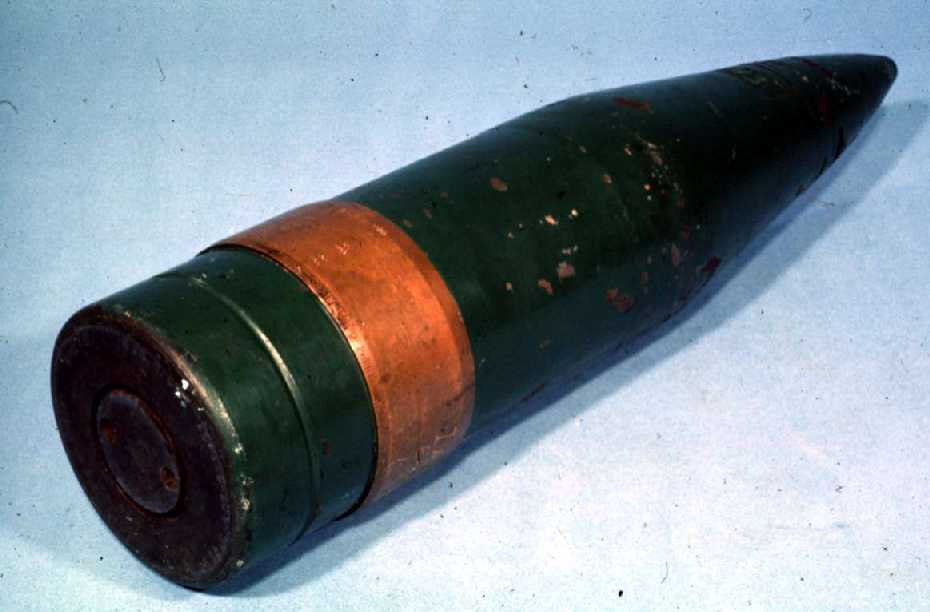
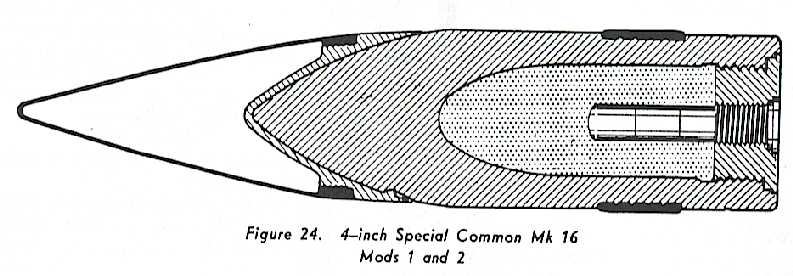
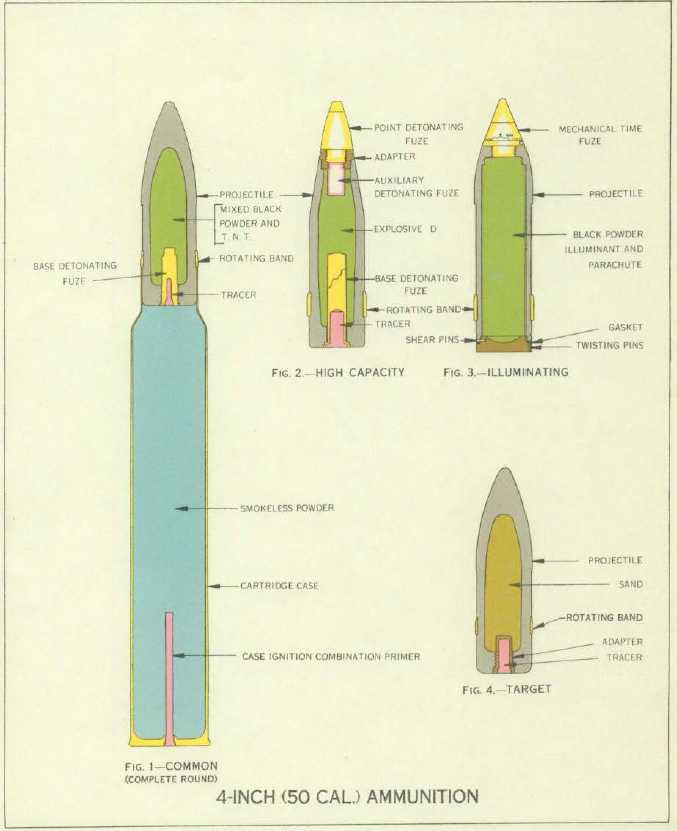
| Projectile Types and Weights | Common Mark 6 Mod 6 1a: 33.0 lbs. (14.97 kg)
S.P. Common 2a Mark 16 Mods 1 and 2: 33.0 lbs. (14.97 kg) H.C. Mark 15 Mod 1: 33.0 lbs. (14.97 kg) EX 2 Mods 0 and 1: 34.0 lbs. (15.4 kg) Illum Mark 14 Mods 1 through 6: 34.66 lbs. (15.72 kg) |
| Bursting Charge | Early Common: 1.1 lbs. (0.5 kg) Black Powder
Common Mark 6 Mod 6: 1.39 lbs. (0.63 kg) Black Powder and TNT S.P. Common Mark 16 Mods 1 and 2: 1.16 lbs. (0.53 kg) Explosive D H.C. Mark 15 Mod 1: 2.71 lbs. (1.23 kg) Explosive D EX 2 Mods 0 and 1: N/A |
| Projectile Length | Common Mark 6 Mod 6: 15.80 in (40.1 cm)
S.P. Common Mark 16 Mods 1 and 2: 17.50 in (44.5 cm) H.C. Mark 15 Mod 1: 18.00 in (45.7 cm) EX 2 Mods 0 and 1: 18.00 in (45.7 cm) Illum Mark 14 Mods 1 through 6: 18.40 in (46.7 cm) |
| Cartridge Case Type, Size and Empty Weight | Mark 2 Mod 0: Brass, 102 x 885 mm, 17.25 lbs. (7.82 kg)
Mark 2 Mod 1: Brass, 102 x 857 mm, 17.00 lbs. (7.71 kg) Mark 2 Mod 3: Brass, 102 x 885 mm, 15.10 lbs. (6.85 kg) Mark 2 Mod 4: Brass, 102 x 857 mm, 14.90 lbs. (6.76 kg) |
| Propellant Charge | 14.5 lbs. (6.5 K) SPD 058
15.0 lbs. (6.8 kg) SPD or SPDN Flashless: 15.0 lbs. (6.8 kg) SPDF |
| Muzzle Velocity | Mark 7: 2,500 fps (762 mps)
Mark 8: 2,800 fps (853 mps) Mark 9: 2,900 fps (884 mps) |
| Working Pressure | 17 tons/in2 (2,680 kg/cm2) |
| Approximate Barrel Life | Non-chrome plated: 400 to 500 rounds
Chrome plated: About 600 rounds |
| Magazine capacity per gun | Destroyers: about 300 rounds
Others: N/A |
- ^Common Mark 6 and Mark 10 rounds were considered obsolete by 1947.
- ^S.P. Common was a "Special Purpose" round having a windscreen and a thin hood and was strengthened to enhance its armor piercing qualities. The EX-2 Mods 0 and 2 were identical to the HC Mark 15 except that they were 1.0 lbs. (0.45 kg) heavier. Approximately 18,000 EX projectiles were manufactured and issued.
- Bourrelet diameter was 3.985 inches (10.12 cm).
- Britain designed a 6crh HE round of 32 lbs. (14.5 kg) using 14.4 lbs. (6.53 kg) NF/S 198-054 propellant. This was to give a range of about 14,200 yards (12,980 m) at a muzzle velocity of 2,760 fps (841 mps) at 20 degrees elevation. It is not thought that this round actually entered service use.
| Elevation | Range | Angle of Fall | Time of Flight | Striking Velocity | Maximum Ordinate |
|---|---|---|---|---|---|
| 0.3 degrees | 1,000 yards (910 m) | 0.4 degrees | 1.1 seconds | 2,590 fps (789 mps) | 5 ft (1.5 m) |
| 0.7 degrees | 2,000 yards (1,830 m) | 0.9 degrees | 2.3 seconds | 2,303 fps (702 mps) | 22 ft (6.7 m) |
| 1.3 degrees | 3,000 yards (2,740 m) | 1.6 degrees | 3.7 seconds | 2,039 fps (621 mps) | 55 ft (16.8 m) |
| 1.8 degrees | 4,000 yards (3,660 m) | 2.5 degrees | 5.3 seconds | 1,799 fps (548 mps) | 112 ft (341 m) |
| 3.4 degrees | 6,000 yards (3,660 m) | 5.5 degrees | 9.1 seconds | 1,799 fps (548 mps) | 335 ft (102 m) |
| 8.6 degrees | 10,000 yards (5,490 m) | 17.1 degrees | 19.7 seconds | 1,398 fps (548 mps) | 1,630 ft (497 m) |
| 12.4 degrees | 12,000 yards (10,970 m) | 24.9 degrees | 26.1 seconds | 966 fps (294 mps) | 2,860 ft (872 m) |
| 19.9 degrees | 15,000 yards (13,720 m) | 37.4 degrees | 37.5 seconds | 942 fps (861 mps) | 5,720 ft (1,743 m) |
| 39.9 degrees | 19,600 yards (17,920 m) | 57.5 degrees | 63.6 seconds | 1,029 fps (313 mps) | 16,575 ft (5,052 m) |
| Range | Side Armor | Deck Armor |
|---|---|---|
| 3,700 yards (3,380 m) | 3.0" (76 mm) | --- |
| 6,300 yards (5,760 m) | 2.0" (51 mm) | --- |
| 18,300 yards (16,730 m) | --- | 1.0" (25 mm) |
These figures are taken from USN armor penetration curves published in 1942 as shown in "US Naval Weapons."
| Designation | |
|---|---|
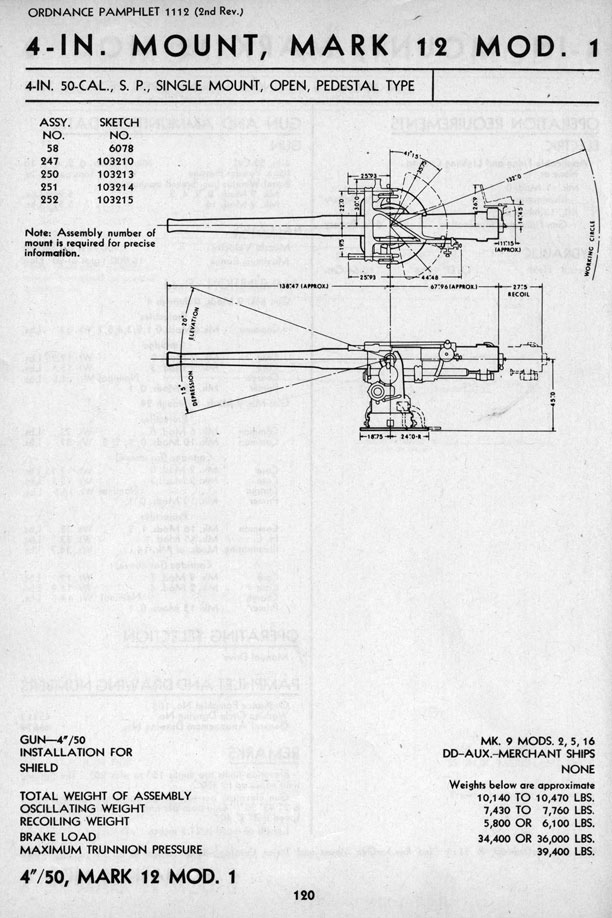
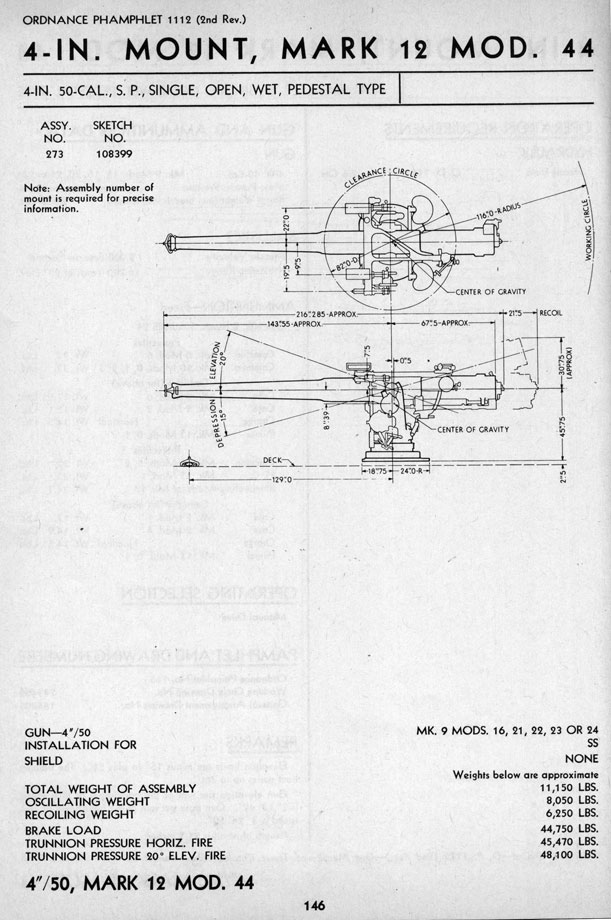
| Weight | Mark 12: 4.53 - 5.63 tons (4.60 - 5.71 mt)
Mark 14: 9.41 tons (9.56 mt) |
| Elevation | -15 / +20 degrees |
| Elevation Rate | Manual operation, only |
| Train | about +150 / -150 degrees |
| Train Rate | Manual operation, only |
| Gun recoil | 27.5 in (70 cm) |
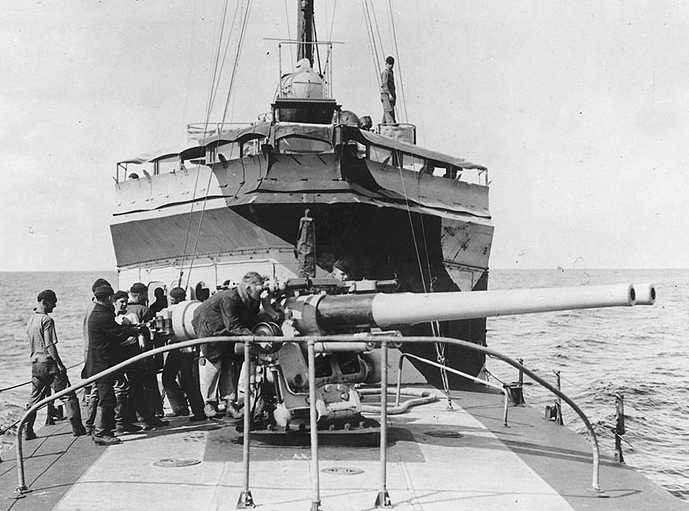
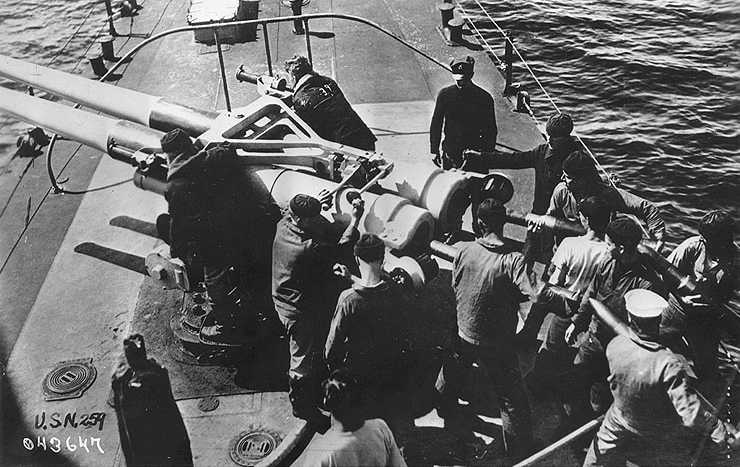
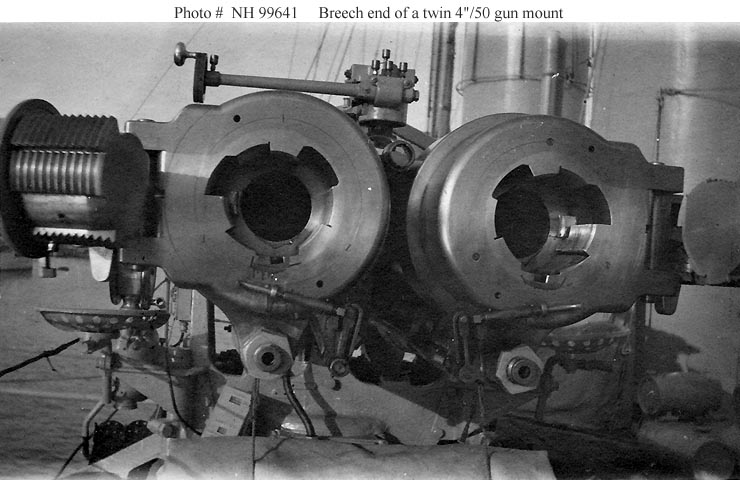
- ^The Clemson (DD-186) class had strengthened gun foundations which allowed them to mount heavier weapons. For this reason, USS Hovey and USS Long were able to use twin 4" (10.2 cm) mounts in place of the single 4" (10.2 cm) mountings used on most other "Flush-deck" destroyers. USS Stockton was apparently used as a test bed for the twin mounting and had a single twin mount on her bow in 1918.
- ^The Gato class (SS-212) submarines were originally equipped with 3"/50 (7.62 cm) guns but had these replaced during the war with the 4"/50 (10.2 cm).
"Naval Weapons of World War Two" by John Campbell
"US Destroyers: An Illustrated Design History" and "US Naval Weapons" both by Norman Friedman
"A Treatise on Rifling of Guns" by Carl F. Jeansén
---
"Naval Ordnance - A Text Book" revised in 1915 by Lt. Cmdr. Roland I. Curtain and Lt. Cmdr. Thomas L. Johnson
"Range and Ballistic Tables 1935" by Department of Ordnance and Gunnery, U.S. Naval Academy
"Ammunition: Instructions for the Naval Service: Ordnance Pamphlet 4 - May 1943" by Department of the Navy
"Abridged Range Tables for U.S. Naval Guns: Ordnance Pamphlet No. 1188, 13 June 1944" by Department of the Navy
"U.S. Explosive Ordnance - Ordnance Pamphlet No. 1664 - May 1947" by Bureau of Ordnance (BuOrd), Department of the Navy
---
Gene Slover's Navy Pages
---
Special help from Leo Fischer and George v. Rauch
15 August 2008 - Benchmark
15 June 2010 - Added picture of HC projectile.
14 January 2011 - Added data reference. Added cutaway sketch.
27 May 2012 - Added information regarding use by other nations
16 January 2019 - Converted to HTML 5 format, reorganized notes and added mounting sketches
01 July 2020 - Formatting changes, fixed mini-sub link to point at Wayback Archives
23 October 2021 - Added photograph of breech end of twin mounting
15 January 2023 - Added to range table
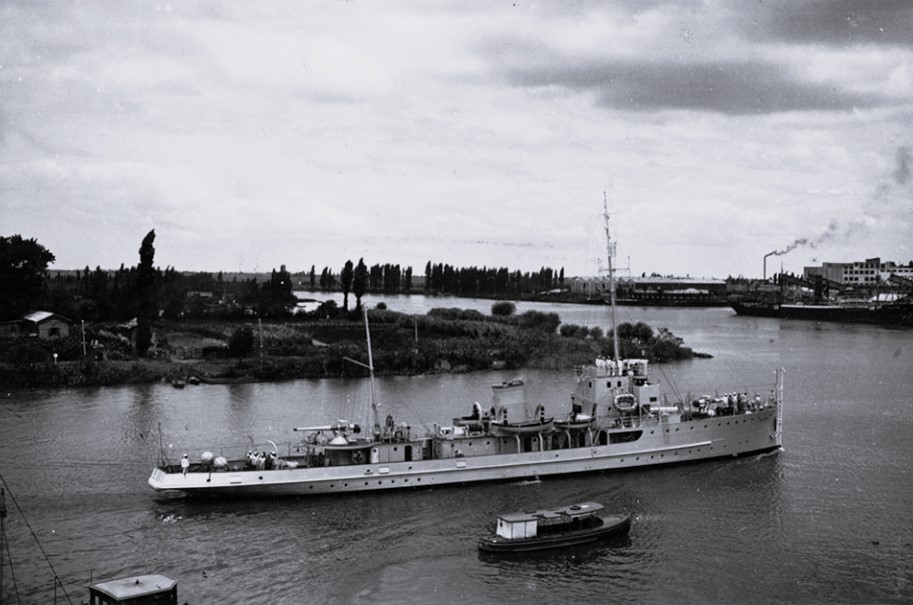
30 June 2023 - Added photograph of USS Sacramento and information to range table
05 August 2023 - Minor changes
29 December 2023 - Added use on Argentine warships
25 March 2024 - Corrected formatting problem
18 February 2025 - Added note about USS Olympia C-6) regunning
31 August 2025 - Added ID to USS Greer (D-145) photograph