
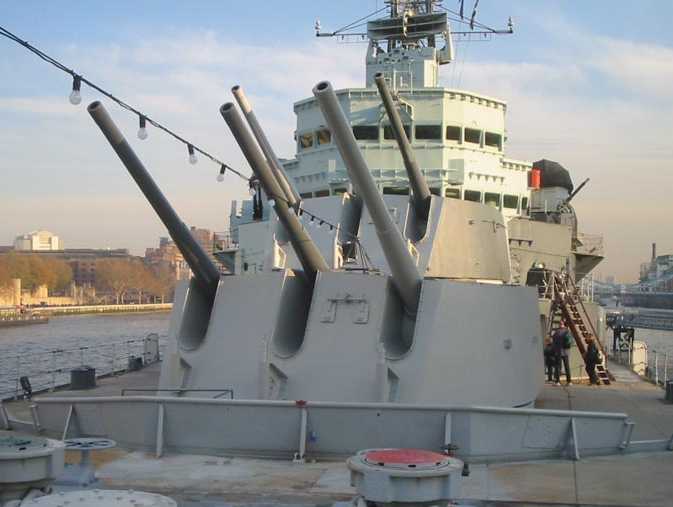
This weapon was developed as a result of the London Cruiser Conference of January 1929 which restricted cruiser gun size to 6" (15.2 cm). A reliable weapon, although somewhat obsolescent in its use of bag ammunition, manual ramming and manually-operated breech mechanism. Mountings had improved ammunition supply compared to earlier cruisers, with power operated hoists and gravity assisted loading trays to increase the rate of fire. These improvements plus the use of enclosed mountings also reduced crew fatigue, meaning that the higher rate of fire could be maintained over a longer period.
Like many contemporary mid-caliber designs, it was originally planned to use this gun in the AA role. However, again like many contemporary designs, the slow rates of train, elevation and firing made it ineffective in that role. For this reason, later mounting designs dropped the high angle requirement, a decision which also reduced their mounting weights.
The early Southampton ("Town") class cruisers experienced dispersion problems with spreads up to 700 yards (640 m) being recorded. It was thought that air currents set up by the wing shells were affecting the flight of the center projectile, even though the center gun was set back to reduce the problems. However, a Professor Hay, who was in charge of the gunnery trials of HMS Newcastle at Shoeburyness in October 1937, theorized that as the cordite charge was much smaller than the chamber, that its burning caused more pressure at the top of the chamber than at the bottom and sides and thus produced an uneven vibration along the gun barrel. Special high speed cameras were mounted in the turret and these showed that some shells were indeed canted at the muzzle which increased the dispersion. As a result, a timing circuit was introduced to delay the firing of the center gun. This increased the shell separation and thus reduced dispersion.
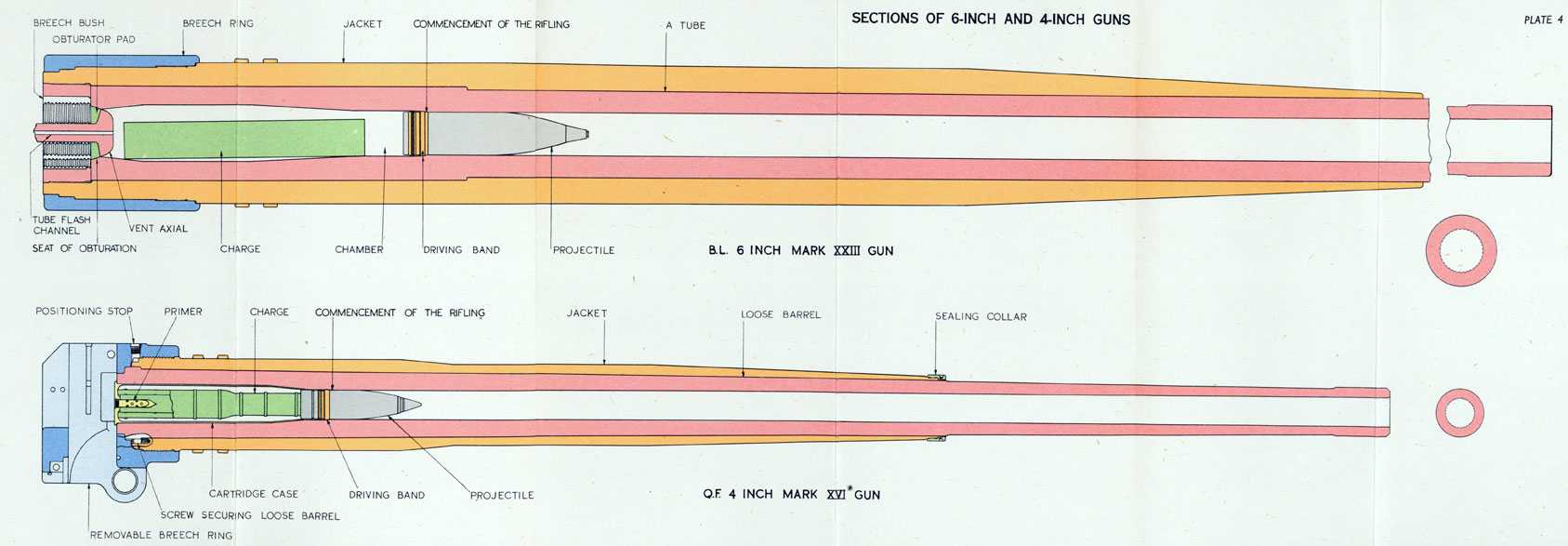
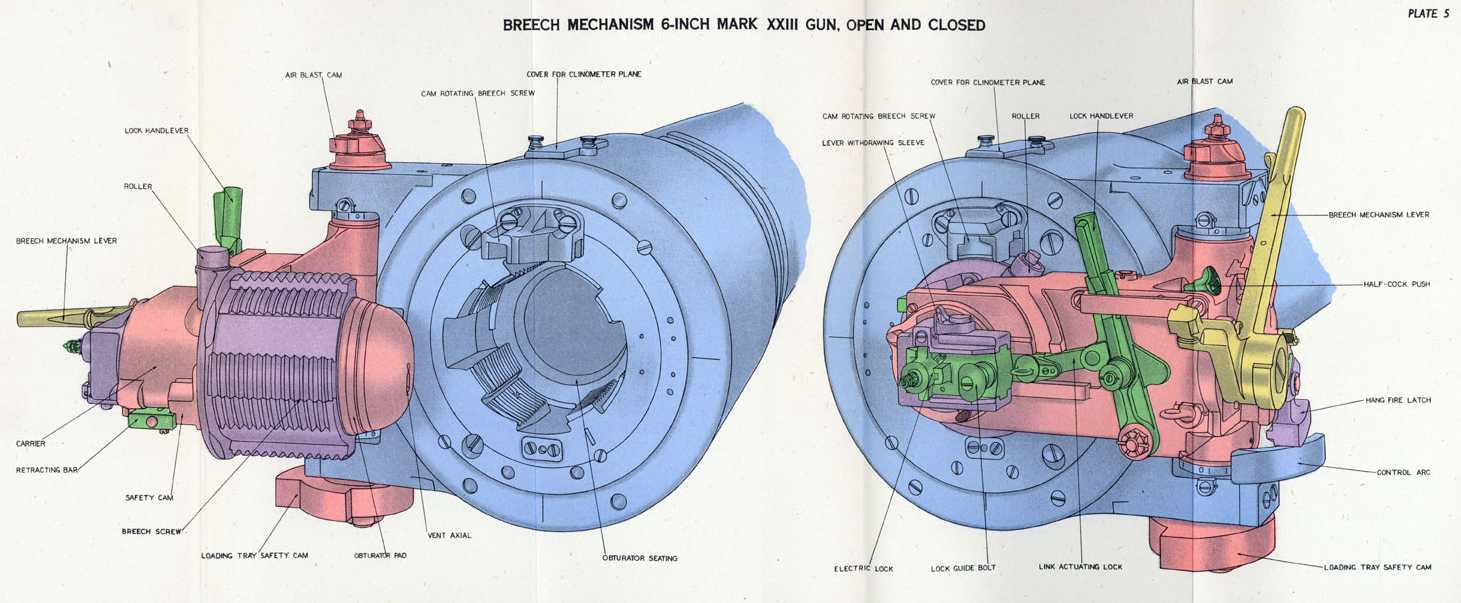
This gun consisted of an A tube, partial jacket, breech ring and breech bush screwed into the jacket and used a Welin breech-block with a hand-operated Asbury mechanism. If relined with a inner tapered A tube, the gun was then designated as Mark XXIII*. A total of 469 guns of all types were manufactured by Elswick, the Royal Gun Factory at Woolwich Arsenal and at William Beardmore & Co. Parkhead Forge works in Glasgow.
Consideration was given to using this weapon as a heavy field gun, but none were ever used in that role.
There was a proposed variation tentatively designated as the Mark XXIV which was for the quadruple mounting originally intended for HMS Edinburgh and HMS Belfast. This gun would have used a power-worked breech mechanism, but it was cancelled along with the quadruple mounting. The Mark XXIV designation was ultimately given to an Army coastal defense gun having the same performance as the Mark VII*, but constructed with a loose barrel. About 140 of these guns were built during World War II.
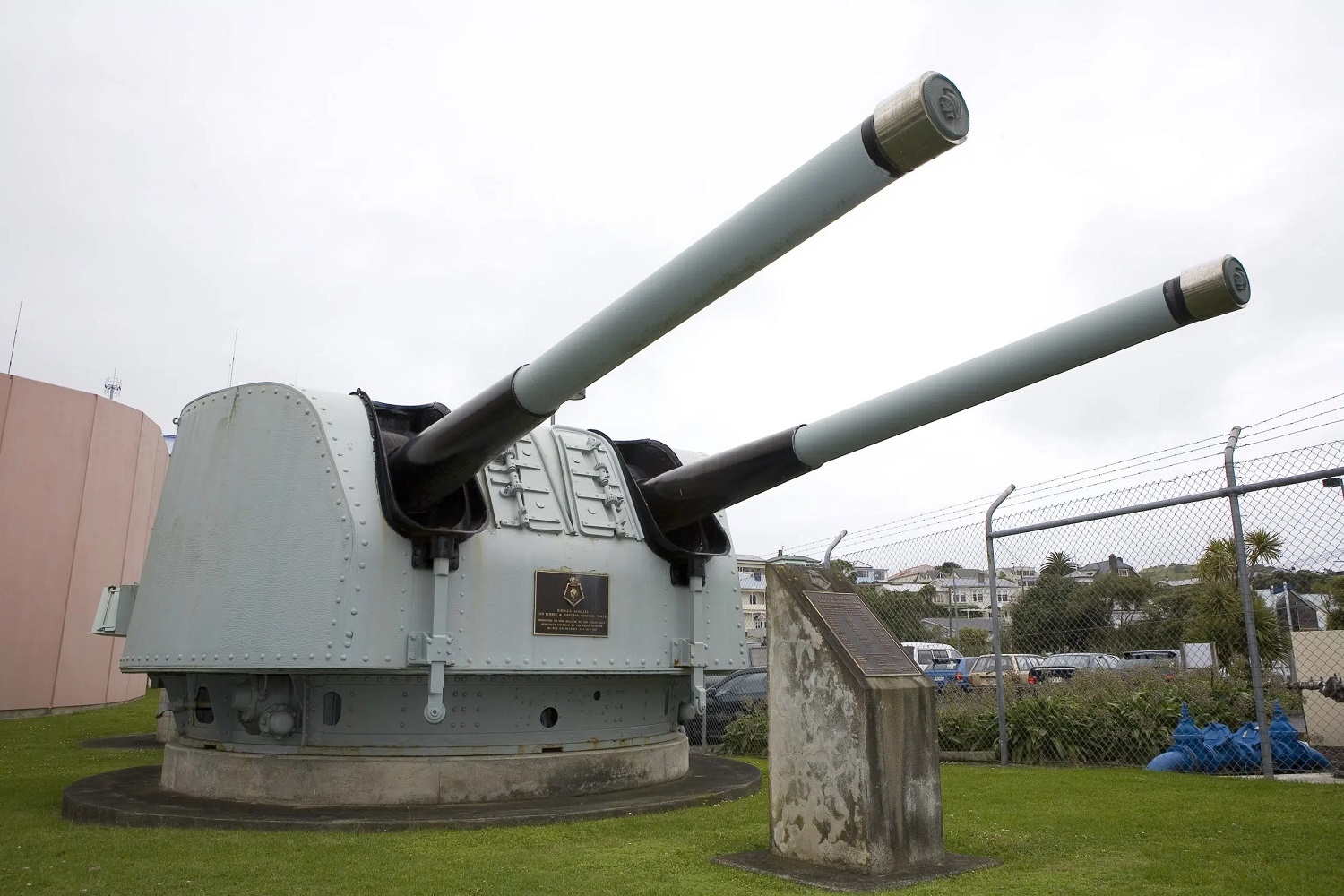
After INS Delhi (formerly HMNZS Achilles) was decommissioned in 1978, her 'Y' turret was removed and given as a gift to the New Zealand government. It is now on display at the entrance of the Devonport Naval Base at Auckland, New Zealand. A second turret from Delhi is preserved at the Indian Army Regiment of Artillery Museum in Nashik. As shown in the adjacent photograph, HMS Belfast is preserved as a museum ship at London, UK.
| Designation | 6"/50 (15.2 cm) BL Mark XXIII |
|---|---|
| Ship Class Used On | Leander, Perth, Arethusa, Southampton ("Town"), Edinburgh ("Modified Town"), Fiji ("Colony"), Ceylon ("Improved Colony")
and Swiftsure classes
Planned for Tiger class Australian Perth class ("Modified Leander") |
| Date Of Design | 1930 |
| Date In Service | 1933 |
| Gun Weight | 6.906 tons (7.017 mt) |
| Gun Length oa | 309.8 in (7.869 m) |
| Bore Length | 309.7 in (7.620 m) |
| Rifling Length | 255.4 in (6.486 m) |
| Grooves | (36) 0.045 in deep x 0.3759 (1.17 x 9.548 mm) |
| Lands | 0.1477 in (3.752 mm) |
| Twist | Uniform RH 1 in 30 |
| Chamber Volume | 1,750 in3 (28.7 dm3) |
| Rate Of Fire | 6 - 8 rounds per minute 1 2 3 |
- ^From "The Twin 6in Mark XXI Turret" by Peter Cannon:
"While nominally capable of eight rounds per minute, a relatively high rate of fire for hand-worked guns, this was achieved in local control with guns laid to loading elevations; the local sight layer pulling the trigger as soon as his two "Gun Ready" lamps illuminated following the 'loading interval,' the bare time it took gun crews to reload the guns. Reality in action was different, particularly under director control. This needed to account for the 'control interval,' the time taken by the director layer to steady his aim (around three seconds on average) as well as the need to depress and elevate the gun to facilitate loading angles while firing at longer ranges. Differing fire control procedures to ascertain line and range needed to be added to spotting corrections, also long time of flight at extreme ranges, change of point of aim, loss of sight of the target, etc., resulting in multiple factors that slowed practical firing rates in action. With all of these in mind, six rounds per minute, relying on a good fire control solution while firing rapid broadsides, was considered the practical rate of fire of the mounting. However, during most actions such opportunities were rare."
- ^"The twin 'Y' turret on HMNZS Achilles is said to have been able to fire at 10 rounds per minute for a few minutes at the Battle of the River Plate before the gun crews tired. The rate of fire was then about six rounds per minute. 'B' turret fired at an average of five rounds per minute during this battle. British Cruisers of World War Two" says that the rate of fire in action for the triple mountings was about five to six rounds per gun per minute. See additional information in the "Mount / Turret" notes below.
- ^As these guns were hand-rammed, firing at high elevations meant that the guns needed considerable time to depress to the loading elevation and then elevate back up into firing position.
| Type | Bag |
|---|---|
| Projectile Types and Weights | CPBC Mark XXVB: 100 lbs. (45.36 kg) (Leander only) 1a HE: 100 lbs. (45.36 kg) (Leander only) 1a CPBC - 112 lbs. (50.8 kg) HE - 112 lbs. (50.8 kg) 2a |
| Bursting Charge | CPBC - 3.75 lbs. (1.7 kg) TNT
HE - about 8 lbs. (3.6 kg) TNT |
| Projectile Length | about 27 in (68.5 cm) |
| Propellant Charge | 30 lbs. (13.6 kg) SC 150 3a 32 lbs. (14.5 kg) NQFP 128 4a |
| Muzzle Velocity 5a | 2,758 fps (841 mps) (new gun) |
| Working Pressure | 20.5 tons/in2 (3,230 kg/cm2) |
| Approximate Barrel Life | 1,100 rounds (one source says 1,020 rounds) |
| Ammunition stowage per gun | 200 rounds 6a |
- ^1.11.2During the design of HMS Leander, the first ship to be equipped with these guns, it was decided to increase the shell weight from 100 lbs. (45.38 kg) to 112 lbs. (50.8 kg). This change came too late for Leander but was incorporated in all subsequent ships. It is noted that the modifications were "relatively minor," but it appears that Leander was never modified to allow her to use the heavier shells.
- ^HE time fuzes were set by hand on the loading trays.
- ^The SC 150 propellant was in a single bag.
- ^An early semi-flashless propellant was introduced in 1942 but this was significantly larger than the SC 150 charges, too large for the existing hoists. As a result, full charges were split into two bags. This complicated supply to the guns but proved effective in combat. In 1945 the semi-flashless NQFP 128 propellant was approved which, although heavier than SC 150, could fit into a single bag.
- ^The Muzzle Velocities given above are for the 112 lbs. (50.8 kg) projectiles using service charges. The 100 lbs. (45.38 kg) projectiles issued to HMS Leander would have had a higher MV with the same charges.
- ^For Treaty compliance purposes, the "Town" class cruisers were rated at a magazine capacity of 150 rounds per gun, but they actually had space for 200 rounds. All other classes, including the "Modified Town" class, were rated at 200 rounds per gun.
- Outfits consisted of CPBC with HE provided for shore bombardment and AA. The outfits per gun were originally made up of 180 rounds of CPBC and 20 rounds of HE along with 31 practice rounds. In 1940 this was changed to 170 rounds of CPBC and 30 rounds of HE, showing the increased threat of air attack. After the end of the war, in 1948 HMS Belfast had an outfit of 1,384 CPC, 960 HE, 474 Practice and 44 Drill for a total of 2,862 projectiles.
- Shells were 5/10crh.
- 'K' devices for coloring shell splashes were introduced during 1942.
| Elevation | Range | Striking Velocity | Time of Flight | Angle of Fall |
|---|---|---|---|---|
| 2.3 degrees | 5,000 yards (4,570 m) | 1,939 fps (591 mps) | 6.6 seconds | 3.0 degrees |
| 6.2 degrees | 10,000 yards (9,140 m) | 1,371 fps (418 mps) | 15.9 seconds | 10.0 degrees |
| 13.1 degrees | 15,000 yards (13,720 m) | 1,098 fps (335 mps) | 29.4 seconds | 23.6 degrees |
| 24.1 degrees | 20,000 yards (18,290 m) | 1,087 fps (331 mps) | 47.2 seconds | 39.9 degrees |
| 41.1 degrees | 24,500 yards (22,400 m) | 1,159 fps (353 mps) | 71.4 seconds | 56.5 degrees |
| 45.0 degrees | 25,480 yards (23,300 m) | --- | --- | --- |
| Range | NC Side Armor | Deck Armor |
|---|---|---|
| 12,500 yards (11,430 m) | 3" (76 mm) | --- |
| 22,000 yards (20,120 m) | --- | 2.0" (51 mm) |
Data from "Nelson to Vanguard: Warship Design and Development 1923-1945."
| Designation | Two-gun Turret
Leander (4) and Arethusa (3): Mark XXI 1b 2b Three-gun Turrets
Four-Gun Turrets
|
|---|---|
| Weight 9b | Mark XXI: 91 tons (92 mt)
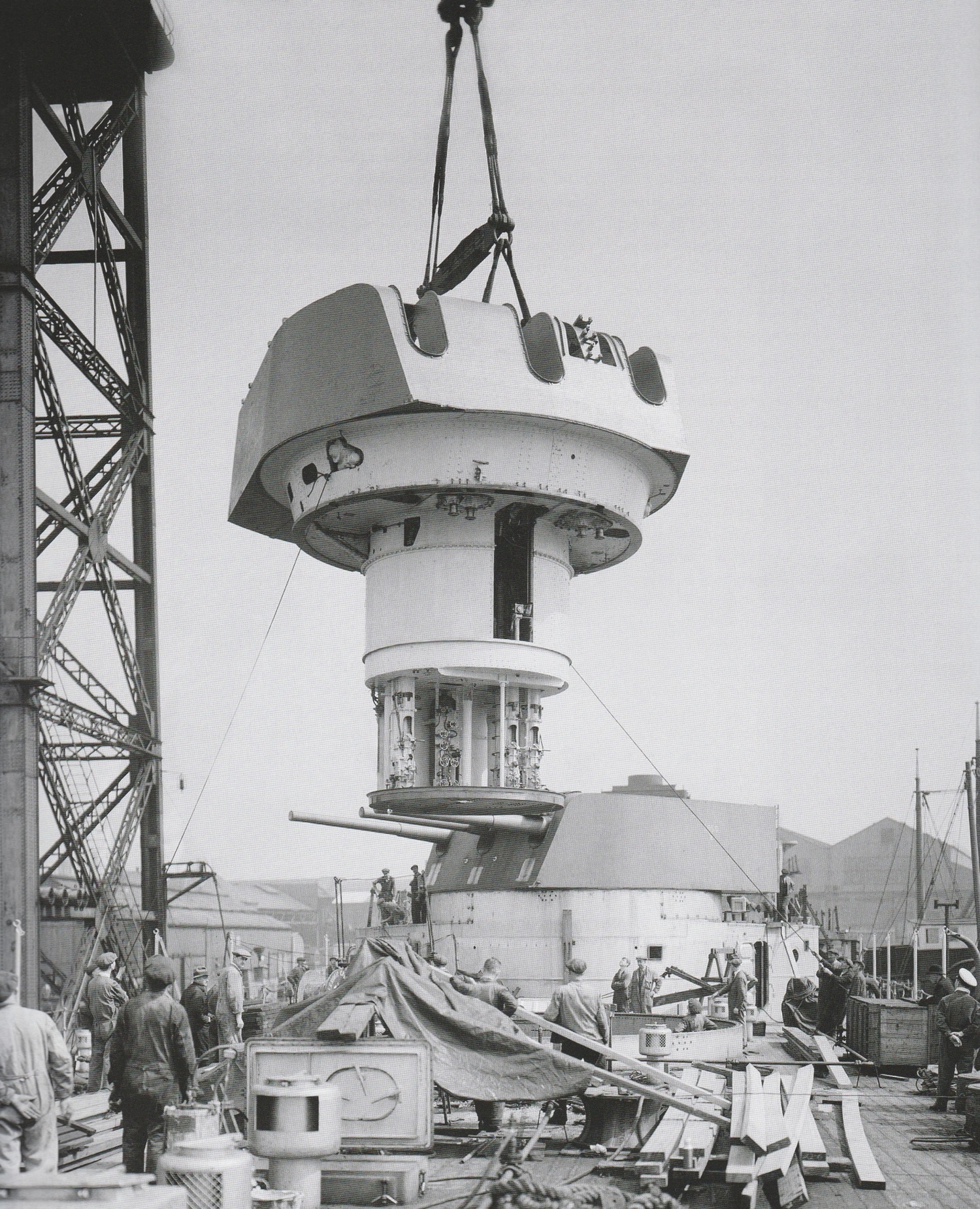
Southampton Mark XXII: 146 tons (148 mt) Gloucester Mark XXII: About 182 tons (185 mt) Edinburgh Mark XXIII: 182 tons (185 mt) Ceylon Mark XXIII: 161 tons (163 mt) RP 10 Mark XXIV: 168 tons (169 mt) |
| Elevation | Mark XXI: -5 / +60 degrees
Mark XXII: -5 / +45 degrees Mark XXIII: -5 / +45 degrees RP 10 Mark XXIV: -5 / +60 degrees |
| Elevation Rate | All: 10 degrees per second |
| Train | +120 / -120 degrees |
| Train Rate | All: 5 to 7 degrees per second 10b |
| Gun recoil | 16.5 in (42 cm) |
| Loading Angle | Limits: -5 to +12.5 degrees
Preferred: +5 to +7 degrees |
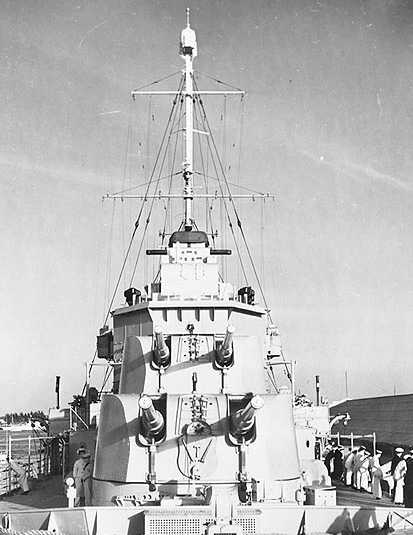
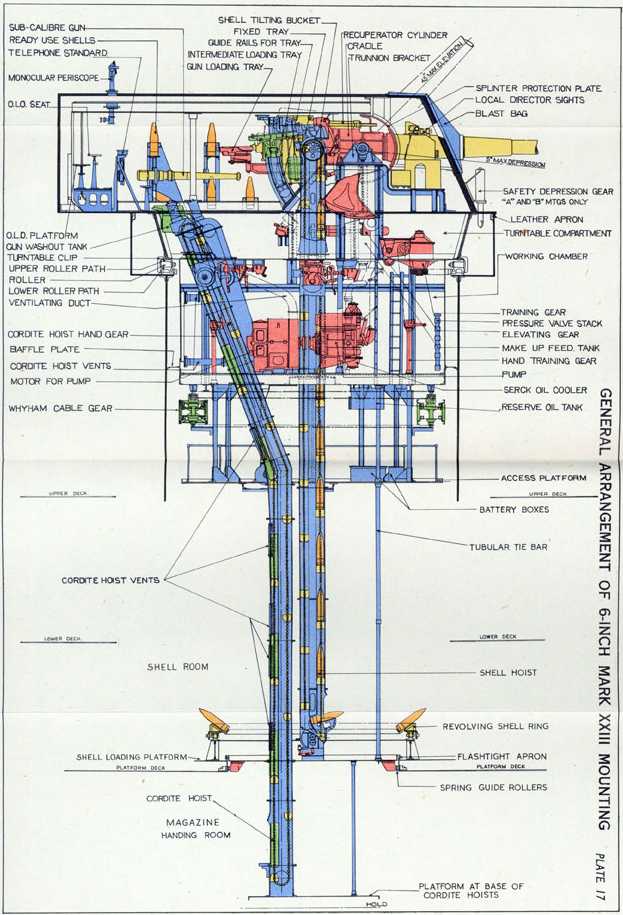
- ^The twin Mark XXI was a "short trunk" design powered by a 65 HP electric motor and hydraulic pump using light mineral oil, located on the revolving structure. The guns were individually sleeved and runout was via compressed air. Elevation was by a swashplate engine driving a worm gear. There were two training engines which were usually operated together as control was better, although training speed was faster when only one was used. Provisions were made to allow manual training. The fore and aft turret groups had a single magazine, with each turret having its own handling room, which was part of the fixed structure. Charges were passed by hand from the magazine through a revolving flashtight scuttle to the cordite handling room. From here, charges were delivered by a single endless chain hoist to each handling room at the rate of 16 per minute for A, B and X mountings. For Y mounting, the handling room was directly above the magazines and the hoist was replaced by two hand ups. Shells were delivered to the handling room by another endless chain hoist at the rate of 16 shells per minute. From the handling room, another endless chain for each gun carried the powder charge to the rear of the gun. Shells were delivered vertically to the gunhouse, where a tilting bucket transferred them to a fixed tray. From here they went to an intermediate tray and then to the loading tray which pivoted on an arm from the cradle. Shells were hand rammed and then charges were placed on the loading tray and hand loaded. Glacis plate had a "rounded" look.
- ^Twin turrets had twenty crewmen in the gun house and there were about forty more crewmen in the magazines, shell rooms. handling room and ammunition lobbies.
- ^The triple Mark XXII was a short trunk design with similar features as the Mark XXI. The electric motors were increased to 103 HP. These ships had a magazine for each turret with a shell room on the same level. A handling room just below the turret was part of the fixed structure. Dual electric powered endless chains delivered 32 charges per minute from the magazine to the handling room. Charges were carried by hand to crewmen in "cordite pockets" attached to the revolving structure where they were passed by hand via hand-ups into the gunhouse. Shells were delivered by dual hoists to the handling room at the rate of 32 rounds per minute. Each gun had its own shell hoist attached to the revolving structure that delivered shells vertically from the handling room up to the gunhouse. Arrangements were similar to those for the twin mounts, with the exception that the center gun had a longer intermediate tray as it was further from its hoist than were the other two guns. Glacis plate had a "rounded" look similar to the Twin Mark XXI turret.
- ^4.14.2The guns in the Mark XXII and Mark XXIII were individually sleeved and had the center gun set back 30 inches (76.2 cm) in order to reduce the interference between shells in flight, give the loading crews more "elbow room" and to better balance the revolving mass. These three-gun mounts had two right-handed guns and one left-handed gun.
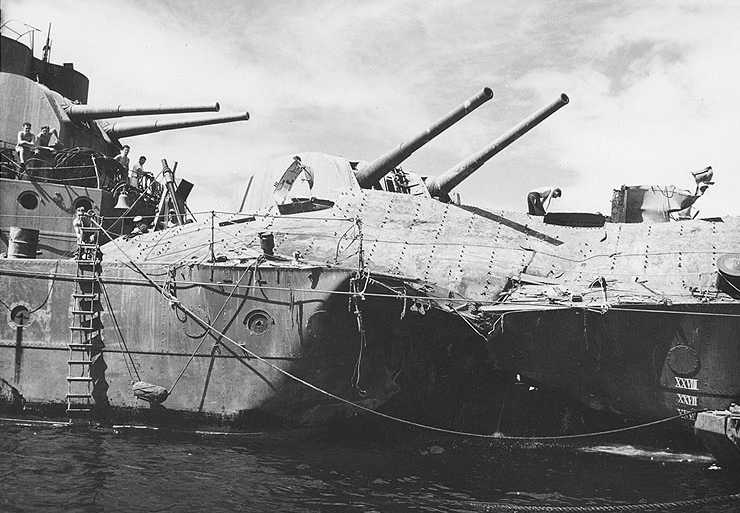
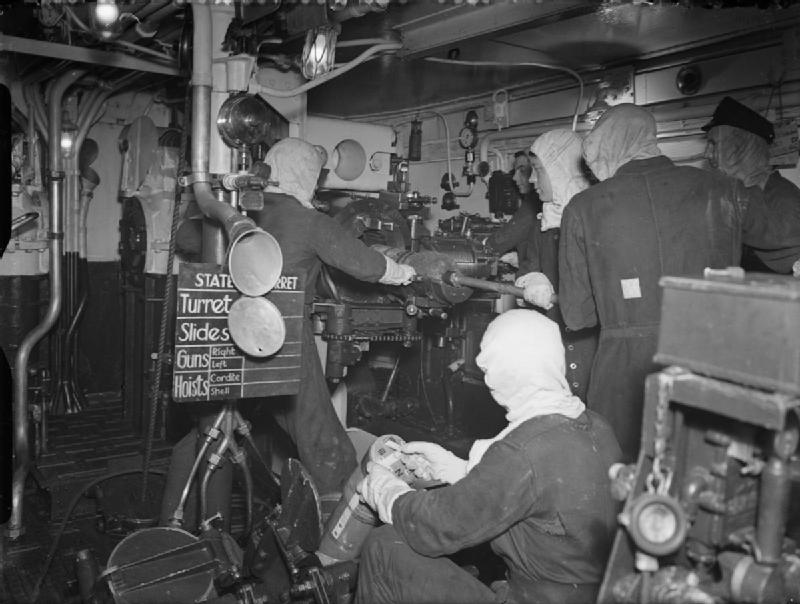
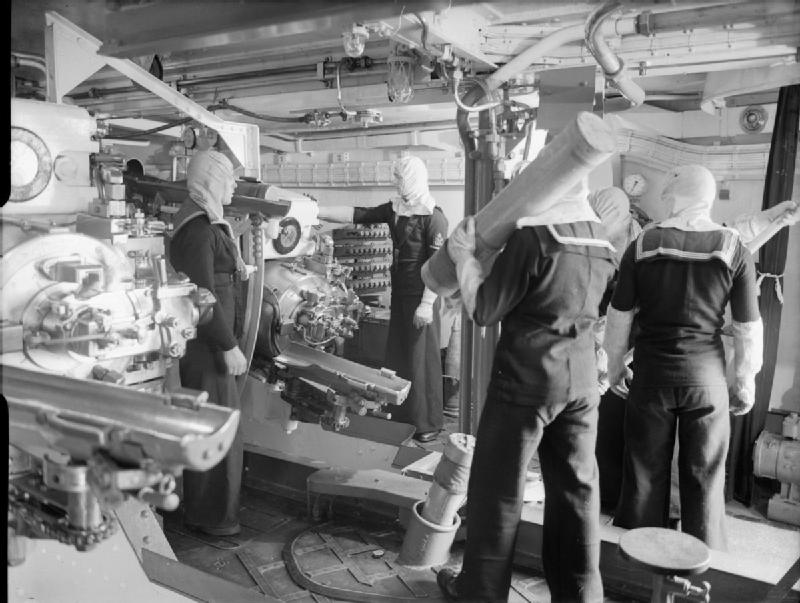
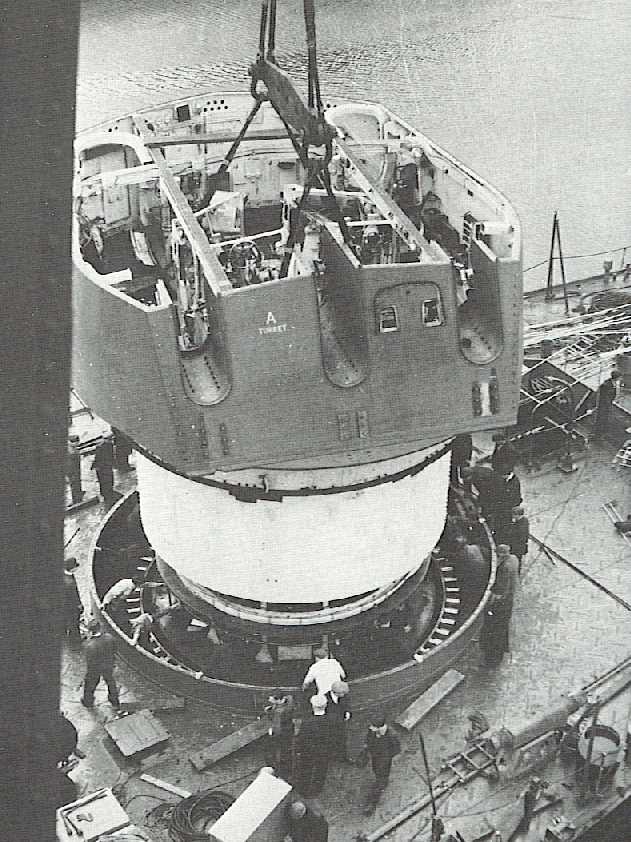
- ^The triple Mark XXIII was powered by a 114 HP motor and had a completely different ammunition supply systems as compared to the earlier Marks. These were "long trunk" designs with each turret having a magazine and a handling room with a shell room located one deck above. Charges were passed via scuttles from the magazines to a handling room where they were loaded onto endless chain hoists. There was one charge hoist per gun and these ran directly from the handling room up to the gunhouse, with the charges being delivered vertically. Each hoist could deliver 10 (Wingate) or 12 (Campbell) charges per minute. In the shell room, shells were passed to an electrically powered and independently-revolving shell ring that could hold up to 56 projectiles stowed inclined with noses upwards and outwards. From here they were passed by hand to the loading trays of the shell hoists. Each gun was provided with its own shell hoist which could supply 10 (Wingate) or 12 (Campbell) shells per minute and which delivered the shells vertically to the gunhouse (both Wingate and Campbell agree that the maximum rate of fire was 8 rounds per minute regardless of which is correct about the rate of ammunition supply). Arrangements for moving projectiles to the breeches were similar to those for the Mark XXII. There was also an auxiliary cordite supply to the rear and left of the center shell hoists and an auxiliary shell hoist on the right hand side to the rear of the right hand shell hoist. Cordite containers were disposed of by pushing them into chutes at the rear of the gunhouse which led outside. Each turret had a crew of 46 men as follows: Captain of Turret (CT), Local Sight Layer (LSL), Turret Trainer (TT), Sightsetter (SS), Telephone Operator (TO), Three Gun Crews (7 men each, consisting of Gun Captain, Breech Worker, Trayworker, two Rammer Men, Cordite Member and Cordite Loader), Shell Room Crew (9 men), Cordite Handling Room Crew (3 men) and Magazine Crew (8 men). In addition, each pair of turrets was allotted one Ordnance Artificer (OA) and two Electrical Mechanics (EM). Glacis plate had a "squared-off" look.
- ^7.17.2The Edinburgh class were originally planned to carry four quadruple mountings. Tests at Shoeburyness in early 1936 with a mockup where all four guns were equally spaced at 42 inches (106.7 cm) apart showed considerable shell interference and collision problems, with the resultant large dispersal patterns. A later design had the guns mounted as two pairs, somewhat similar in concept to the French quad mounts. This design had each pair of guns only 27.5 inches (69.9 cm) a part and the innermost pair 46.5 inches (118.1 cm) apart. This design did not produce acceptable results and the quad mounting was cancelled in favor of an improved triple mounting. Delay coils were under consideration at the time of the cancellation.
- ^The Mark XXIV was a war-time development based upon the Mark XXII. This was to have achieved a dual-purpose capability by increasing the maximum elevation to +60 degrees and possibly using a new, fully-automatic 6 inch (15.2 cm) gun. However, the barbette and roller path diameters were no larger than the previous triple mountings, which would have entailed a rather cramped design. This project was superseded by the Mark XXV which was in turned cancelled by the end of the war.
- ^The weight differences for the triple mounts was primarily due to armor thickness. For the Mark XXII, HMS Southampton had 1 inch (2.54 cm) (40 lbs.) armor all around while HMS Gloucester had 3.9 inch (10 cm) (160 lbs.) glacis plate armor with the rest 2 in (5.1 cm) (80 lbs.). For the Mark XXIII, HMS Edinburgh had 3.9 inch (10 cm) (160 lbs.) glacis plate and the rest 2 in (5.1 cm) (80 lbs.). HMS Fiji had 2 inch (5.1 cm) (80 lbs.) glacis plate and roof, the rest was 1 inch (2.54 cm) (40 lbs.).
- ^Each mounting had two training engines. When both were used together, train rate was 5 degrees per second, but using just one engine sped the training up to 7 degrees per second.
- Most surviving cruisers had "X" turret removed as weight compensation for added electronic equipment and light AA. Its place was usually taken by additional AA guns. HMS Belfast, of the larger "Modified Town" class, was unique in keeping all four of her 6" (15.2 cm) mountings throughout the war and beyond, although she did lose two of her twin 4"/45 (10.2 cm) Mark XIX mountings in their place.
- The gunlayers usually followed the pointer using hand control, changing to power elevation only for larger movements.
- Guns were hand loaded and rammed with the propellant bags being rammed separately.
- Gun axes were 84 in (213 cm) apart on the Mark XXI mounting and 78 in (198 cm) apart on the Mark XXII and Mark XXIII mountings.
- As completed the Town class had 15 foot (4.57 m) rangefinders on their director control towers (DCT). The six surviving ships had these replaced with 22 foot (6.70 m) rangefinders starting in late 1942. RP40 Remote Power Control (RPC) from the Admiralty Fire Control Table to the DCT started to be fitted to some of the class during the 1945 refits.
- None of the war-time 6-inch (15.2 cm) mountings were ever fitted with RPC. The cancelled Mark XXIV was to have been fitted with with RP10.
As soon as the gun has fired:
(i) Layer moves the gun to a loading angle between 12.5 degrees elevation and 5 degrees depression.
(ii) Breech Worker opens the breech, inserts a fresh igniter tube, masks the vent.
(iii) Trayworker slides back the guard, swings the gun loading tray into the breech and partially pushes the shell into the chamber.
(iv) Two men operating the rammer ram home the shell.
(v) Cordite Member tips the charge from its carboard case - which he has been holding on his shoulder - into the hands of the Cordite Loader.
(vi) Cordite Loader loads the charge through the tray and into the gun and then withdraws the tray.
(vii) Breechworker closes the breech.
(viii) Layer re-lays the gun per the director.
(ix) As the loading tray is withdrawn, the intermediate tray, which should already be loaded, is released. As it comes down and lines up with the gun loading tray, the shell will slide into it.
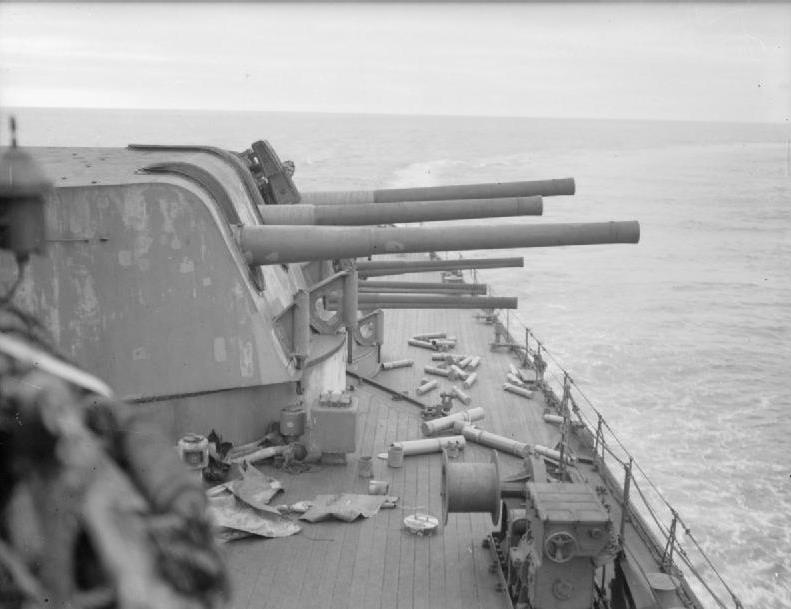
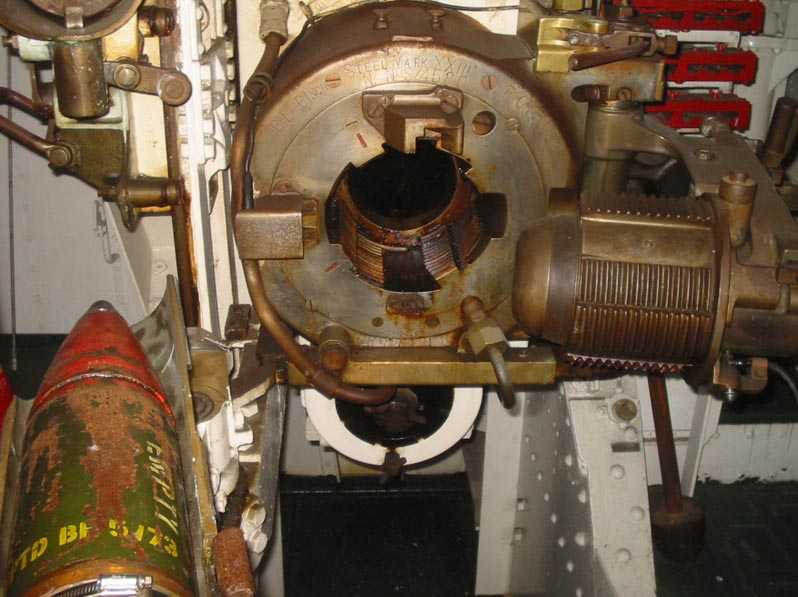
Engraving reads as follows:
B.L. 6 In Steel Mark XXIII
R.G.F.
N. NoS/4580
Where:
B.L. 6 In Steel Mark XXIII = Breech Loading 6 inch (15.2 cm) gun of All-Steel construction Mark XXIII
R.G.F. = Built at the Royal Gun Factory
Note: A manufacturing year should follow "R.G.F." but I cannot make it out
N. NoS/4580 = Navy Gun Serial Number 4580
Note that the projectile is stenciled with "EMPTY"
Photograph copyrighted by Vladimir Yakubov.

Images at The Vickers Photographic Archive
See Mark
XXI, 4675,
and 5031
Images at Australian War Memorial
6" (15.2 cm) guns on HMAS Sydney
"Nelson to Vanguard: Warship Design and Development 1923-1945" by D.K. Brown
"Naval Weapons of World War Two" and "British Naval Guns 1880-1945 No 13" article in "Warship Volume VIII" both by John Campbell
"The Twin 6in Mark XXI Turret" article by Peter Cannon published in Warships 2025
"The Postwar Naval Revolution" by Norman Friedman
"Cruisers of the Royal and Commonwealth Navies" by Douglas Morris
"British Cruisers of World War Two" by Alan Raven and John Roberts
"British Town Class Cruisers: Design, Development & Performance - Southhampton & Belfast Classes" by Conrad Waters
"Anatomy of the Ship: The Cruiser HMS Belfast" by Ross Watton
"Cruisers of World War Two" by M.J. Whitley
"HMS Belfast: In Trust for the Nation 1939-72" by John Wingate
26 November 2008 - Benchmark
30 January 2009 - Added information about both Mark XXIV guns
19 December 2009 - Added information about dispersion problems and Belfast ammunition outfit in 1948
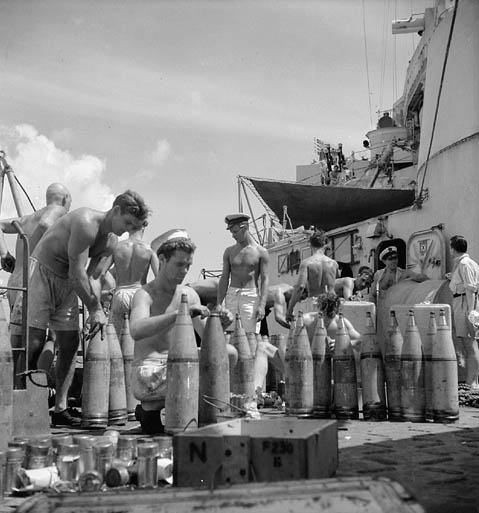
29 August 2011 - Added photograph of projectiles on HMCS Uganda
24 September 2011 - Added information about practice rounds, training motors, the Mark XXIII mounting and Loading Procedure
20 April 2012 - Added information about ammunition supply and rate of fire for Mark XXIII mountings
05 January 2014 - Added photographs of HMS Sheffield and interior of turrets on HMS Orion and HMS Jamaica
22 March 2014 - Minor changes to the Mounting / Turret section and updated link to Australian War Memorial website
06 May 2014 - Changed formatting
28 November 2015 - Changed Vickers Photographic Archive links to point at Wayback Archive
03 March 2017 - Converted to HTML 5 format
17 July 2020 - Reorganized notes, minor formatting changes
10 September 2023 - Fixed broken link to Australian War Memorial website and modified range table
16 November 2023 - Added notes regarding 'K' shell, rangefinders and RPC
06 August 2024 - Added burster type (TNT)
27 September 2024 - Added comments and photograph of turret from INS Delhi
01 December 2024 - Minor formatting change
07 May 2025 - Added notes on ROF, HMS Leander and crewmen for the twin turrets
05 May 2026 - Added trajectory chart